

180
CHAPTER 5. COASTAL STRUCTURE MODELS
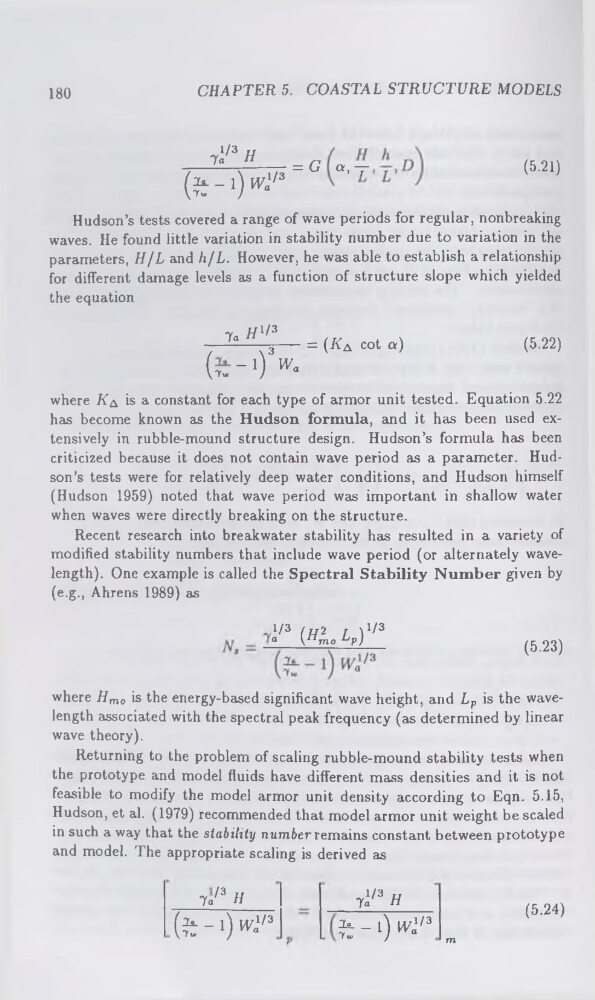
7i/3H
(^ " ') W' »1/3
= G “.T
(5.21)
Hudson’s tests covered a range of wave periods for regular, nonbreaking
waves. He found little variation in stability number due to variation in the
parameters, H/L and h/L. However, he was able to establish a relationship
for different damage levels as a function of structure slope which yielded
the equation
7. W1/3
/
\3
(
- 1 ) wa
\7w
/
= (/<△ cot Of)
(5.22)
where /<△ is a constant for each type of armor unit tested. Equation 5.22
has become known as the Hudson formula, and it has been used extensively in rubble-mound structure design. Hudson’s formula has been
criticized because it does not contain wave period as a parameter. Hudson’s tests were for relatively deep water conditions, and Hudson himself
(Hudson 1959) noted that wave period was important in shallow water
when waves were directly breaking on the structure.
Recent research into breakwater stability has resulted in a variety of
modified stability numbers that include wave period (or alternately wavelength). One example is called the Spectral Stability Number given by
(e.g., Ahrens 1989) as
i'3 K.^)1'3
(5.23)
where Hmo is the energy-based significant wave height, and Lp is the wavelength associated with the spectral peak frequency (as determined by linear
wave theory).
Returning to the problem of scaling rubble-mound stability tests when
the prototype and model fluids have different mass densities and it is not
feasible to modify the model armor unit density according to Eqn. 5.15,
Hudson, et al. (1979) recommended that model armor unit weight be scaled
in such a way that the stability number remains constant between prototype
and model. The appropriate scaling is derived as
7«/3 H
(^ - 1) Wi'3
*.l/3 Lf
7a n
£ - 0 ^/3
(5.24)
m
CHAPTER 5. COASTAL STRUCTURE MODELS
7i/3H
(^ " ') W' »1/3
= G “.T
(5.21)
Hudson’s tests covered a range of wave periods for regular, nonbreaking
waves. He found little variation in stability number due to variation in the
parameters, H/L and h/L. However, he was able to establish a relationship
for different damage levels as a function of structure slope which yielded
the equation
7. W1/3
/
\3
(
- 1 ) wa
\7w
/
= (/<△ cot Of)
(5.22)
where /<△ is a constant for each type of armor unit tested. Equation 5.22
has become known as the Hudson formula, and it has been used extensively in rubble-mound structure design. Hudson’s formula has been
criticized because it does not contain wave period as a parameter. Hudson’s tests were for relatively deep water conditions, and Hudson himself
(Hudson 1959) noted that wave period was important in shallow water
when waves were directly breaking on the structure.
Recent research into breakwater stability has resulted in a variety of
modified stability numbers that include wave period (or alternately wavelength). One example is called the Spectral Stability Number given by
(e.g., Ahrens 1989) as
i'3 K.^)1'3
(5.23)
where Hmo is the energy-based significant wave height, and Lp is the wavelength associated with the spectral peak frequency (as determined by linear
wave theory).
Returning to the problem of scaling rubble-mound stability tests when
the prototype and model fluids have different mass densities and it is not
feasible to modify the model armor unit density according to Eqn. 5.15,
Hudson, et al. (1979) recommended that model armor unit weight be scaled
in such a way that the stability number remains constant between prototype
and model. The appropriate scaling is derived as
7«/3 H
(^ - 1) Wi'3
*.l/3 Lf
7a n
£ - 0 ^/3
(5.24)
m