

5.2. RUBBLE-MOUND STRUCTURES
181
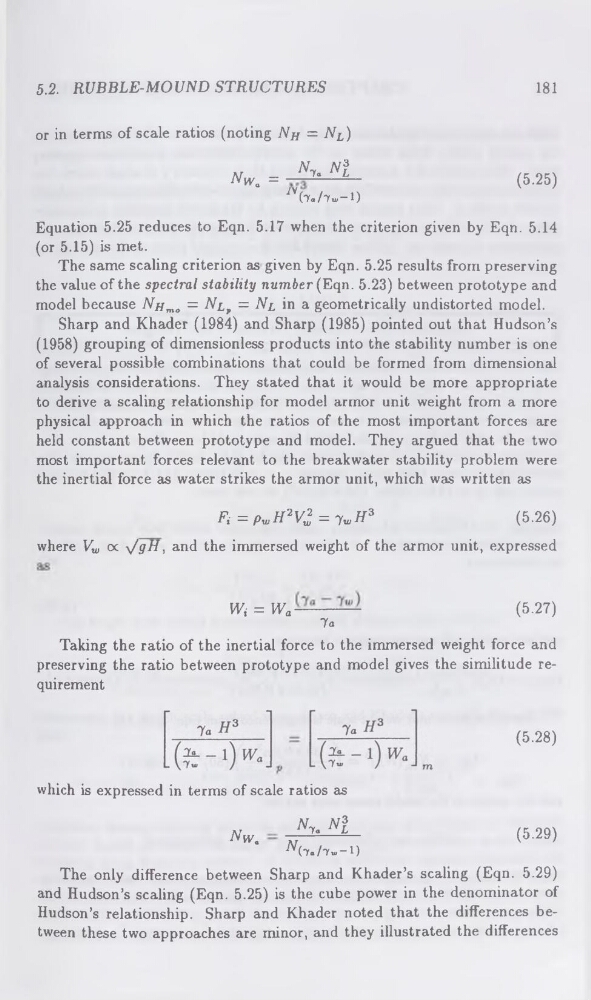
or in terms of scale ratios (noting Njj = Nl )
„
_ Ny. Nt
Nw. -
---------JV(7a/7w-l)
(5.25)
Equation 5.25 reduces to Eqn. 5.17 when the criterion given by Eqn. 5.14
(or 5.15) is met.
The same scaling criterion as given by Eqn. 5.25 results from preserving
the value of the spectral stability number (Eqn. 5.23) between prototype and
model because Nnmo = Nlp = Nl in a geometrically undistorted model.
Sharp and Khader (1984) and Sharp (1985) pointed out that Hudson’s
(1958) grouping of dimensionless products into the stability number is one
of several possible combinations that could be formed from dimensional
analysis considerations. They stated that it would be more appropriate
to derive a scaling relationship for model armor unit weight from a more
physical approach in which the ratios of the most important forces are
held constant between prototype and model. They argued that the two
most important forces relevant to the breakwater stability problem were
the inertial force as water strikes the armor unit, which was written as
Fi=pwH2V^ = ywH3
(5.26)
where Vw oc y/gH, and the immersed weight of the armor unit, expressed
Wi = Wa ——(5.27)
7a
Taking the ratio of the inertial force to the immersed weight force and
preserving the ratio between prototype and model gives the similitude requirement
(5.28)
which is expressed in terms of scale ratios as
Nwa
Nya Nj
-^(7a/7w-l)
(5.29)
The only difference between Sharp and Khader’s scaling (Eqn. 5.29)
and Hudson’s scaling (Eqn. 5.25) is the cube power in the denominator of
Hudson’s relationship. Sharp and Khader noted that the differences between these two approaches are minor, and they illustrated the differences
181
or in terms of scale ratios (noting Njj = Nl )
„
_ Ny. Nt
Nw. -
---------JV(7a/7w-l)
(5.25)
Equation 5.25 reduces to Eqn. 5.17 when the criterion given by Eqn. 5.14
(or 5.15) is met.
The same scaling criterion as given by Eqn. 5.25 results from preserving
the value of the spectral stability number (Eqn. 5.23) between prototype and
model because Nnmo = Nlp = Nl in a geometrically undistorted model.
Sharp and Khader (1984) and Sharp (1985) pointed out that Hudson’s
(1958) grouping of dimensionless products into the stability number is one
of several possible combinations that could be formed from dimensional
analysis considerations. They stated that it would be more appropriate
to derive a scaling relationship for model armor unit weight from a more
physical approach in which the ratios of the most important forces are
held constant between prototype and model. They argued that the two
most important forces relevant to the breakwater stability problem were
the inertial force as water strikes the armor unit, which was written as
Fi=pwH2V^ = ywH3
(5.26)
where Vw oc y/gH, and the immersed weight of the armor unit, expressed
Wi = Wa ——(5.27)
7a
Taking the ratio of the inertial force to the immersed weight force and
preserving the ratio between prototype and model gives the similitude requirement
(5.28)
which is expressed in terms of scale ratios as
Nwa
Nya Nj
-^(7a/7w-l)
(5.29)
The only difference between Sharp and Khader’s scaling (Eqn. 5.29)
and Hudson’s scaling (Eqn. 5.25) is the cube power in the denominator of
Hudson’s relationship. Sharp and Khader noted that the differences between these two approaches are minor, and they illustrated the differences