

5.2. RUBBLE-MOUND STRUCTURES
179
study, they might not have the same relative density relationship for the
next study. Another example is modeling of quarrystone breakwaters where
it is difficult to find model stones having the necessary density as calculated
by.Eqn. 5.15.
An alternate method for compensating for the increased buoyancy of
salt water relative to the fresh water used in most scale models is to adjust the weight of the model armor units. This method is not as rigorous
as satisfying Eqn. 5.15, and it should be viewed as an empirical scaling
modification. The scaling requirement is based on preserving the value
of a “stability parameter” between prototype and model. This method is
developed below.
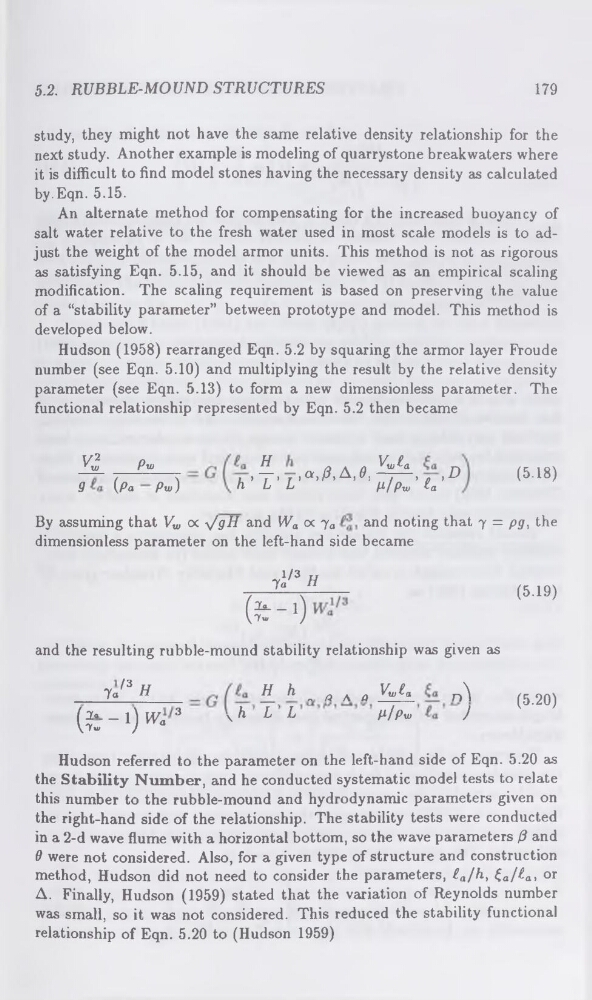
Hudson (1958) rearranged Eqn. 5.2 by squaring the armor layer Froude
number (see Eqn. 5.10) and multiplying the result by the relative density
parameter (see Eqn. 5.13) to form a new dimensionless parameter. The
functional relationship represented by Eqn. 5.2 then became
22
pw
9 (Pa Pw )
!L
P a n V^g
„
h' l'l'a'/3's’e- p/Pw‘ea'D
(5.18)
By assuming that Vw oc y/g H and Wa oc ya
and noting that 7 = pg, the
dimensionless parameter on the left-hand side became
1/3 H
7a n
(5.19)
and the resulting rubble-mound stability relationship was given as
7«/3 H
H h _ a s a Vwta
n\
(l-__ i) Wa 3
\ h L L
p/pw
J
\7w
)
(5.20)
Hudson referred to the parameter on the left-hand side of Eqn. 5.20 as
the Stability Number, and he conducted systematic model tests to relate
this number to the rubble-mound and hydrodynamic parameters given on
the right-hand side of the relationship. The stability tests were conducted
in a 2-d wave flume with a horizontal bottom, so the wave parameters (3 and
0 were not considered. Also, for a given type of structure and construction
method, Hudson did not need to consider the parameters, £a/h, £a/t.a, or
A. Finally, Hudson (1959) stated that the variation of Reynolds number
was small, so it was not considered. This reduced the stability functional
relationship of Eqn. 5.20 to (Hudson 1959)
179
study, they might not have the same relative density relationship for the
next study. Another example is modeling of quarrystone breakwaters where
it is difficult to find model stones having the necessary density as calculated
by.Eqn. 5.15.
An alternate method for compensating for the increased buoyancy of
salt water relative to the fresh water used in most scale models is to adjust the weight of the model armor units. This method is not as rigorous
as satisfying Eqn. 5.15, and it should be viewed as an empirical scaling
modification. The scaling requirement is based on preserving the value
of a “stability parameter” between prototype and model. This method is
developed below.
Hudson (1958) rearranged Eqn. 5.2 by squaring the armor layer Froude
number (see Eqn. 5.10) and multiplying the result by the relative density
parameter (see Eqn. 5.13) to form a new dimensionless parameter. The
functional relationship represented by Eqn. 5.2 then became
22
pw
9 (Pa Pw )
!L
P a n V^g
„
h' l'l'a'/3's’e- p/Pw‘ea'D
(5.18)
By assuming that Vw oc y/g H and Wa oc ya
and noting that 7 = pg, the
dimensionless parameter on the left-hand side became
1/3 H
7a n
(5.19)
and the resulting rubble-mound stability relationship was given as
7«/3 H
H h _ a s a Vwta
n\
(l-__ i) Wa 3
\ h L L
p/pw
J
\7w
)
(5.20)
Hudson referred to the parameter on the left-hand side of Eqn. 5.20 as
the Stability Number, and he conducted systematic model tests to relate
this number to the rubble-mound and hydrodynamic parameters given on
the right-hand side of the relationship. The stability tests were conducted
in a 2-d wave flume with a horizontal bottom, so the wave parameters (3 and
0 were not considered. Also, for a given type of structure and construction
method, Hudson did not need to consider the parameters, £a/h, £a/t.a, or
A. Finally, Hudson (1959) stated that the variation of Reynolds number
was small, so it was not considered. This reduced the stability functional
relationship of Eqn. 5.20 to (Hudson 1959)