

178
CHAPTER 5. COASTAL STRUCTURE MODELS
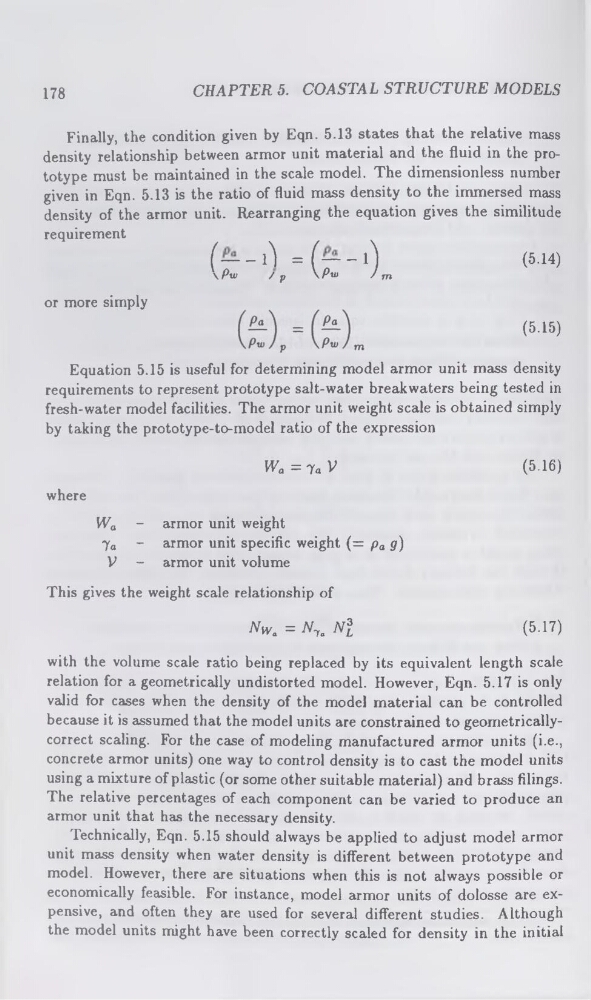
Finally, the condition given by Eqn. 5.13 states that the relative mass
density relationship between armor unit material and the fluid in the prototype must be maintained in the scale model. The dimensionless number
given in Eqn. 5.13 is the ratio of fluid mass density to the immersed mass
density of the armor unit. Rearranging the equation gives the similitude
requirement
f—- Û = (— - 1)
(5-14)
\Pw
/ p
\Pw
/ m
or more simply
(5.15)
Equation 5.15 is useful for determining model armor unit mass density
requirements to represent prototype salt-water breakwaters being tested in
fresh-water model facilities. The armor unit weight scale is obtained simply
by taking the prototype-to-model ratio of the expression
Wa = 7a V
where
Wa - armor unit weight
7a - armor unit specific weight (= pa g)
V - armor unit volume
This gives the weight scale relationship of
Nw. = N-,. Nt
(5.16)
(5.17)
with the volume scale ratio being replaced by its equivalent length scale
relation for a geometrically undistorted model. However, Eqn. 5.17 is only
valid for cases when the density of the model material can be controlled
because it is assumed that the model units are constrained to geometricallycorrect scaling. For the case of modeling manufactured armor units (i.e.,
concrete armor units) one way to control density is to cast the model units
using a mixture of plastic (or some other suitable material) and brass filings.
The relative percentages of each component can be varied to produce an
armor unit that has the necessary density.
Technically, Eqn. 5.15 should always be applied to adjust model armor
unit mass density when water density is different between prototype and
model. However, there are situations when this is not always possible or
economically feasible. For instance, model armor units of dolosse are expensive, and often they are used for several different studies. Although
the model units might have been correctly scaled for density in the initial
CHAPTER 5. COASTAL STRUCTURE MODELS
Finally, the condition given by Eqn. 5.13 states that the relative mass
density relationship between armor unit material and the fluid in the prototype must be maintained in the scale model. The dimensionless number
given in Eqn. 5.13 is the ratio of fluid mass density to the immersed mass
density of the armor unit. Rearranging the equation gives the similitude
requirement
f—- Û = (— - 1)
(5-14)
\Pw
/ p
\Pw
/ m
or more simply
(5.15)
Equation 5.15 is useful for determining model armor unit mass density
requirements to represent prototype salt-water breakwaters being tested in
fresh-water model facilities. The armor unit weight scale is obtained simply
by taking the prototype-to-model ratio of the expression
Wa = 7a V
where
Wa - armor unit weight
7a - armor unit specific weight (= pa g)
V - armor unit volume
This gives the weight scale relationship of
Nw. = N-,. Nt
(5.16)
(5.17)
with the volume scale ratio being replaced by its equivalent length scale
relation for a geometrically undistorted model. However, Eqn. 5.17 is only
valid for cases when the density of the model material can be controlled
because it is assumed that the model units are constrained to geometricallycorrect scaling. For the case of modeling manufactured armor units (i.e.,
concrete armor units) one way to control density is to cast the model units
using a mixture of plastic (or some other suitable material) and brass filings.
The relative percentages of each component can be varied to produce an
armor unit that has the necessary density.
Technically, Eqn. 5.15 should always be applied to adjust model armor
unit mass density when water density is different between prototype and
model. However, there are situations when this is not always possible or
economically feasible. For instance, model armor units of dolosse are expensive, and often they are used for several different studies. Although
the model units might have been correctly scaled for density in the initial