

4.3. LONG-WAVE HYDRODYNAMIC MODELS
159
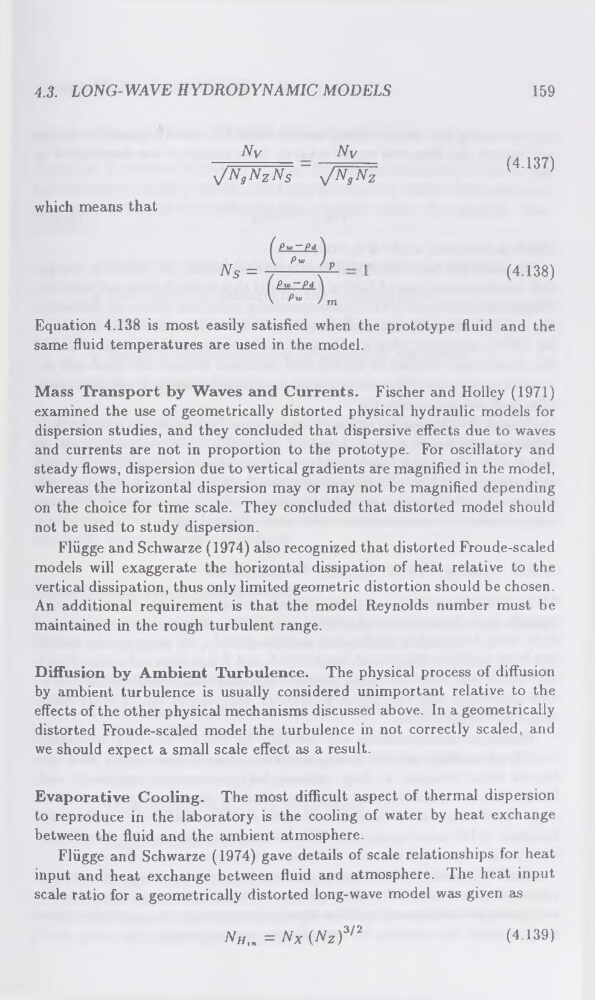
which means that
Ny
Ny
^NgNzNs ~ JÏÇNÏ
(4.137)
(4.138)
Equation 4.138 is most easily satisfied when the prototype fluid and the
same fluid temperatures are used in the model.
Mass Transport by Waves and Currents. Fischer and Holley (1971)
examined the use of geometrically distorted physical hydraulic models for
dispersion studies, and they concluded that dispersive effects due to waves
and currents are not in proportion to the prototype. For oscillatory and
steady flows, dispersion due to vertical gradients are magnified in the model,
whereas the horizontal dispersion may or may not be magnified depending
on the choice for time scale. They concluded that distorted model should
not be used to study dispersion.
Fliigge and Schwarze (1974) also recognized that distorted Froude-scaled
models will exaggerate the horizontal dissipation of heat relative to the
vertical dissipation, thus only limited geometric distortion should be chosen.
An additional requirement is that the model Reynolds number must be
maintained in the rough turbulent range.
Diffusion by Ambient Turbulence. The physical process of diffusion
by ambient turbulence is usually considered unimportant relative to the
effects of the other physical mechanisms discussed above. In a geometrically
distorted Froude-scaled model the turbulence in not correctly scaled, and
we should expect a small scale effect as a result.
Evaporative Cooling. The most difficult aspect of thermal dispersion
to reproduce in the laboratory is the cooling of water by heat exchange
between the fluid and the ambient atmosphere.
Fliigge and Schwarze (1974) gave details of scale relationships for heat
input and heat exchange between fluid and atmosphere. The heat input
scale ratio for a geometrically distorted long-wave model was given as
7VHin = Ax(Az)3/2
(4.139)
159
which means that
Ny
Ny
^NgNzNs ~ JÏÇNÏ
(4.137)
(4.138)
Equation 4.138 is most easily satisfied when the prototype fluid and the
same fluid temperatures are used in the model.
Mass Transport by Waves and Currents. Fischer and Holley (1971)
examined the use of geometrically distorted physical hydraulic models for
dispersion studies, and they concluded that dispersive effects due to waves
and currents are not in proportion to the prototype. For oscillatory and
steady flows, dispersion due to vertical gradients are magnified in the model,
whereas the horizontal dispersion may or may not be magnified depending
on the choice for time scale. They concluded that distorted model should
not be used to study dispersion.
Fliigge and Schwarze (1974) also recognized that distorted Froude-scaled
models will exaggerate the horizontal dissipation of heat relative to the
vertical dissipation, thus only limited geometric distortion should be chosen.
An additional requirement is that the model Reynolds number must be
maintained in the rough turbulent range.
Diffusion by Ambient Turbulence. The physical process of diffusion
by ambient turbulence is usually considered unimportant relative to the
effects of the other physical mechanisms discussed above. In a geometrically
distorted Froude-scaled model the turbulence in not correctly scaled, and
we should expect a small scale effect as a result.
Evaporative Cooling. The most difficult aspect of thermal dispersion
to reproduce in the laboratory is the cooling of water by heat exchange
between the fluid and the ambient atmosphere.
Fliigge and Schwarze (1974) gave details of scale relationships for heat
input and heat exchange between fluid and atmosphere. The heat input
scale ratio for a geometrically distorted long-wave model was given as
7VHin = Ax(Az)3/2
(4.139)