

160
CHAPTER 4. HYDRODYNAMIC MODELS
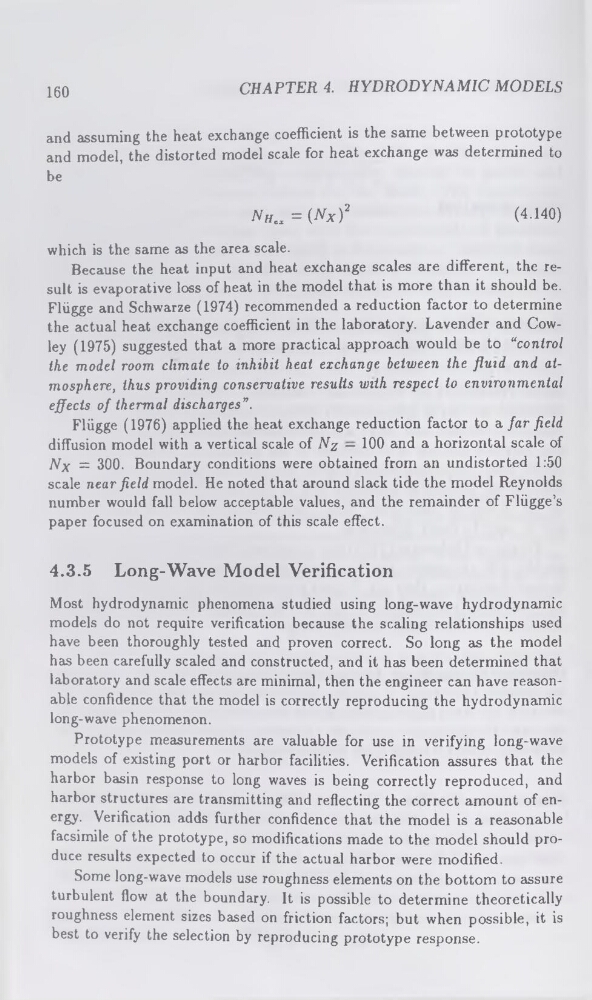
and assuming the heat exchange coefficient is the same between prototype
and model, the distorted model scale for heat exchange was determined to
be
NH„ = (W
(4.140)
which is the same as the area scale.
Because the heat input and heat exchange scales are different, the result is evaporative loss of heat in the model that is more than it should be.
Fliigge and Schwarze (1974) recommended a reduction factor to determine
the actual heat exchange coefficient in the laboratory. Lavender and Cowley (1975) suggested that a more practical approach would be to “control
the model room climate to inhibit heat exchange between the fluid and atmosphere, thus providing conservative results with respect to environmental
effects of thermal discharges”.
Fliigge (1976) applied the heat exchange reduction factor to a far field
diffusion model with a vertical scale of Nz — 100 and a horizontal scale of
Nx = 300. Boundary conditions were obtained from an undistorted 1:50
scale near field model. He noted that around slack tide the model Reynolds
number would fall below acceptable values, and the remainder of Fliigge’s
paper focused on examination of this scale effect.
4.3.5 Long-Wave Model Verification
Most hydrodynamic phenomena studied using long-wave hydrodynamic
models do not require verification because the scaling relationships used
have been thoroughly tested and proven correct. So long as the model
has been carefully scaled and constructed, and it has been determined that
laboratory and scale effects are minimal, then the engineer can have reasonable confidence that the model is correctly reproducing the hydrodynamic
long-wave phenomenon.
Prototype measurements are valuable for use in verifying long-wave
models of existing port or harbor facilities. Verification assures that the
harbor basin response to long waves is being correctly reproduced, and
harbor structures are transmitting and reflecting the correct amount of energy. Verification adds further confidence that the model is a reasonable
facsimile of the prototype, so modifications made to the model should produce results expected to occur if the actual harbor were modified.
Some long-wave models use roughness elements on the bottom to assure
turbulent flow at the boundary. It is possible to determine theoretically
roughness element sizes based on friction factors; but when possible, it is
best to verify the selection by reproducing prototype response.
CHAPTER 4. HYDRODYNAMIC MODELS
and assuming the heat exchange coefficient is the same between prototype
and model, the distorted model scale for heat exchange was determined to
be
NH„ = (W
(4.140)
which is the same as the area scale.
Because the heat input and heat exchange scales are different, the result is evaporative loss of heat in the model that is more than it should be.
Fliigge and Schwarze (1974) recommended a reduction factor to determine
the actual heat exchange coefficient in the laboratory. Lavender and Cowley (1975) suggested that a more practical approach would be to “control
the model room climate to inhibit heat exchange between the fluid and atmosphere, thus providing conservative results with respect to environmental
effects of thermal discharges”.
Fliigge (1976) applied the heat exchange reduction factor to a far field
diffusion model with a vertical scale of Nz — 100 and a horizontal scale of
Nx = 300. Boundary conditions were obtained from an undistorted 1:50
scale near field model. He noted that around slack tide the model Reynolds
number would fall below acceptable values, and the remainder of Fliigge’s
paper focused on examination of this scale effect.
4.3.5 Long-Wave Model Verification
Most hydrodynamic phenomena studied using long-wave hydrodynamic
models do not require verification because the scaling relationships used
have been thoroughly tested and proven correct. So long as the model
has been carefully scaled and constructed, and it has been determined that
laboratory and scale effects are minimal, then the engineer can have reasonable confidence that the model is correctly reproducing the hydrodynamic
long-wave phenomenon.
Prototype measurements are valuable for use in verifying long-wave
models of existing port or harbor facilities. Verification assures that the
harbor basin response to long waves is being correctly reproduced, and
harbor structures are transmitting and reflecting the correct amount of energy. Verification adds further confidence that the model is a reasonable
facsimile of the prototype, so modifications made to the model should produce results expected to occur if the actual harbor were modified.
Some long-wave models use roughness elements on the bottom to assure
turbulent flow at the boundary. It is possible to determine theoretically
roughness element sizes based on friction factors; but when possible, it is
best to verify the selection by reproducing prototype response.