

158
CHAPTER 4. HYDRODYNAMIC MODELS
Buoyant Rise of the Discharge. As previously noted for short-wave
models, proper similitude of the buoyant rise of the discharge jet, when
injected below the surface of the ambient water, depends on gravity and
the relative density difference between the two fluids. This requirement
is met by maintaining the same value of densimetric Froude number
between model and prototype along with the requirements of geometric
similarity and undistorted Froude-scaled hydrodynamics. Distorted longwave models do not meet these criteria, so we must expect that model
results scaled to prototype will differ from actual prototype response of the
buoyant jet.
Kato and Wada (1980) agreed with the above scaling criteria, but noted
that sometimes it is necessary to conduct a geometrically distorted model in
order to obtain large far field coverage. They proposed alternative scaling
for use in distorted models. Their prototype-to-model comparisons were
reported as good for models with distortions of 5 and 10, but a distortion
factor of 20 produced poor comparisons.
Convective Spreading. Lavender and Cowley (1975) stated that convective spreading of the discharge plume would be in similitude provided
the densimetric Froude similitude criterion is met and the model densimetric Reynolds number is high enough to assure the convective spread remains
nonviscous from the point of discharge over the extent of the region of interest. The requirement for turbulent mixing of the plume may lead to a
geometrically distorted model if the plume covers a large distance. However, large distortion is undesirable because it results in unrealistic lateral
spread of the plume.
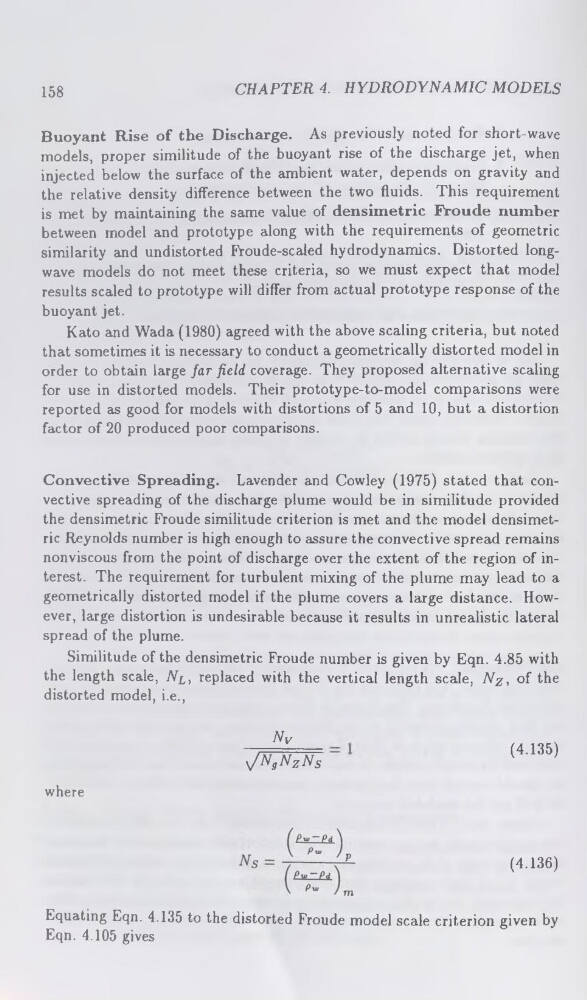
Similitude of the densimetric Froude number is given by Eqn. 4.85 with
the length scale, N^, replaced with the vertical length scale, Nz, of the
distorted model, i.e.,
Ny
x/NgNzNs
(4.135)
where
(4.136)
Equating Eqn. 4.135 to the distorted Froude model scale criterion given by
Eqn. 4.105 gives
CHAPTER 4. HYDRODYNAMIC MODELS
Buoyant Rise of the Discharge. As previously noted for short-wave
models, proper similitude of the buoyant rise of the discharge jet, when
injected below the surface of the ambient water, depends on gravity and
the relative density difference between the two fluids. This requirement
is met by maintaining the same value of densimetric Froude number
between model and prototype along with the requirements of geometric
similarity and undistorted Froude-scaled hydrodynamics. Distorted longwave models do not meet these criteria, so we must expect that model
results scaled to prototype will differ from actual prototype response of the
buoyant jet.
Kato and Wada (1980) agreed with the above scaling criteria, but noted
that sometimes it is necessary to conduct a geometrically distorted model in
order to obtain large far field coverage. They proposed alternative scaling
for use in distorted models. Their prototype-to-model comparisons were
reported as good for models with distortions of 5 and 10, but a distortion
factor of 20 produced poor comparisons.
Convective Spreading. Lavender and Cowley (1975) stated that convective spreading of the discharge plume would be in similitude provided
the densimetric Froude similitude criterion is met and the model densimetric Reynolds number is high enough to assure the convective spread remains
nonviscous from the point of discharge over the extent of the region of interest. The requirement for turbulent mixing of the plume may lead to a
geometrically distorted model if the plume covers a large distance. However, large distortion is undesirable because it results in unrealistic lateral
spread of the plume.
Similitude of the densimetric Froude number is given by Eqn. 4.85 with
the length scale, N^, replaced with the vertical length scale, Nz, of the
distorted model, i.e.,
Ny
x/NgNzNs
(4.135)
where
(4.136)
Equating Eqn. 4.135 to the distorted Froude model scale criterion given by
Eqn. 4.105 gives