

4.3. LONG-WAVE HYDRODYNAMIC MODELS
155
and
d
9 CT~i\
1 dr
(4.127)
J-(w'2) « 0
dz
(4.128)
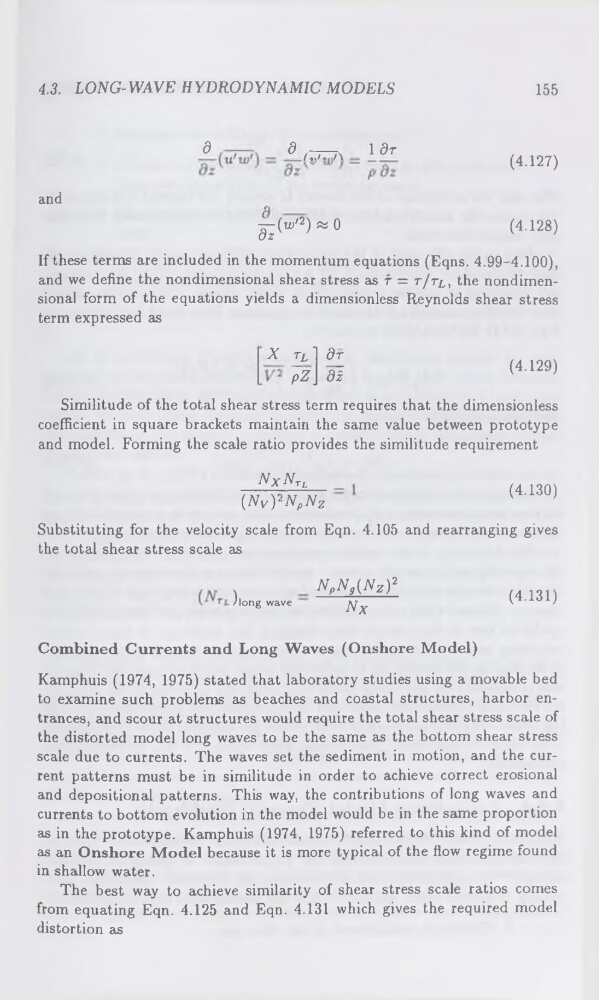
If these terms are included in the momentum equations (Eqns. 4.99-4.100),
and we define the nondimensional shear stress as f = t/tl, the nondimensional form of the equations yields a dimensionless Reynolds shear stress
term expressed as
X rL' dr
7z\dï
(4.129)
Similitude of the total shear stress term requires that the dimensionless
coefficient in square brackets maintain the same value between prototype
and model. Forming the scale ratio provides the similitude requirement
NXNTL
(NvyNpNz
(4.130)
Substituting for the velocity scale from Eqn. 4.105 and rearranging gives
the total shear stress scale as
)long wave
fWNz)2
Nx
(4.131)
Combined Currents and Long Waves (Onshore Model)
Kamphuis (1974, 1975) stated that laboratory studies using a movable bed
to examine such problems as beaches and coastal structures, harbor entrances, and scour at structures would require the total shear stress scale of
the distorted model long waves to be the same as the bottom shear stress
scale due to currents. The waves set the sediment in motion, and the current patterns must be in similitude in order to achieve correct erosional
and depositional patterns. This way, the contributions of long waves and
currents to bottom evolution in the model would be in the same proportion
as in the prototype. Kamphuis (1974, 1975) referred to this kind of model
as an Onshore Model because it is more typical of the flow regime found
in shallow water.
The best way to achieve similarity of shear stress scale ratios comes
from equating Eqn. 4.125 and Eqn. 4.131 which gives the required model
distortion as
155
and
d
9 CT~i\
1 dr
(4.127)
J-(w'2) « 0
dz
(4.128)
If these terms are included in the momentum equations (Eqns. 4.99-4.100),
and we define the nondimensional shear stress as f = t/tl, the nondimensional form of the equations yields a dimensionless Reynolds shear stress
term expressed as
X rL' dr
7z\dï
(4.129)
Similitude of the total shear stress term requires that the dimensionless
coefficient in square brackets maintain the same value between prototype
and model. Forming the scale ratio provides the similitude requirement
NXNTL
(NvyNpNz
(4.130)
Substituting for the velocity scale from Eqn. 4.105 and rearranging gives
the total shear stress scale as
)long wave
fWNz)2
Nx
(4.131)
Combined Currents and Long Waves (Onshore Model)
Kamphuis (1974, 1975) stated that laboratory studies using a movable bed
to examine such problems as beaches and coastal structures, harbor entrances, and scour at structures would require the total shear stress scale of
the distorted model long waves to be the same as the bottom shear stress
scale due to currents. The waves set the sediment in motion, and the current patterns must be in similitude in order to achieve correct erosional
and depositional patterns. This way, the contributions of long waves and
currents to bottom evolution in the model would be in the same proportion
as in the prototype. Kamphuis (1974, 1975) referred to this kind of model
as an Onshore Model because it is more typical of the flow regime found
in shallow water.
The best way to achieve similarity of shear stress scale ratios comes
from equating Eqn. 4.125 and Eqn. 4.131 which gives the required model
distortion as