

156
CHAPTER 4. HYDRODYNAMIC MODELS
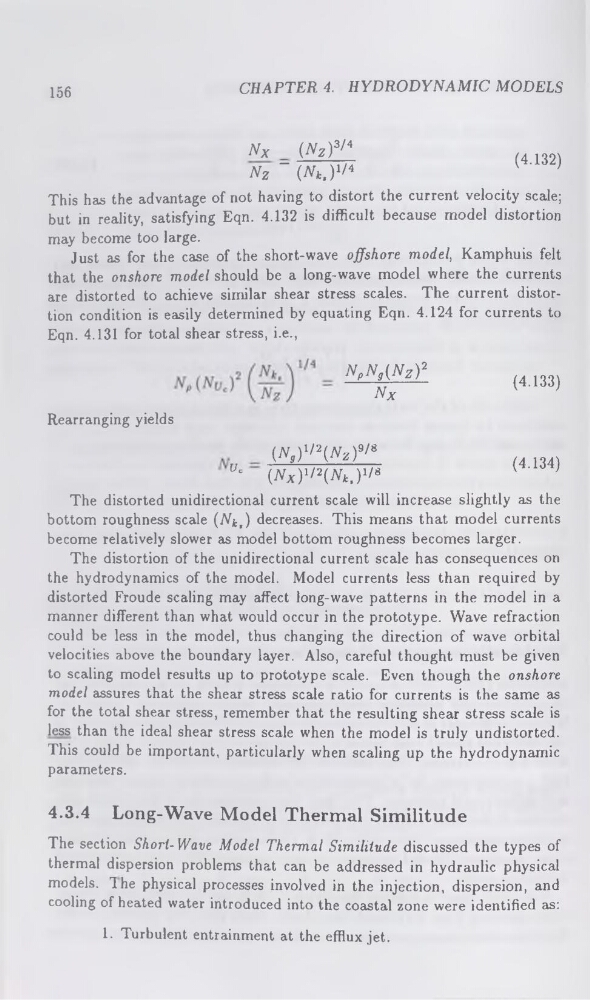
Nx _ (M?)3/4
Nz
(Nkly/4
(4.132)
This has the advantage of not having to distort the current velocity scale;
but in reality, satisfying Eqn. 4.132 is difficult because model distortion
may become too large.
Just as for the case of the short-wave offshore model, Kamphuis felt
that the onshore model should be a long-wave model where the currents
are distorted to achieve similar shear stress scales. The current distortion condition is easily determined by equating Eqn. 4.124 for currents to
Eqn. 4.131 for total shear stress, i.e.,
NPNffNzff
Nx
(4.133)
Rearranging yields
(N,)V;(7VZ)9/8
u‘
(Nxyi^Nt,yi«
(4.134)
The distorted unidirectional current scale will increase slightly as the
bottom roughness scale (Nk,) decreases. This means that model currents
become relatively slower as model bottom roughness becomes larger.
The distortion of the unidirectional current scale has consequences on
the hydrodynamics of the model. Model currents less than required by
distorted Froude scaling may affect long-wave patterns in the model in a
manner different than what would occur in the prototype. Wave refraction
could be less in the model, thus changing the direction of wave orbital
velocities above the boundary layer. Also, careful thought must be given
to scaling model results up to prototype scale. Even though the onshore
model assures that the shear stress scale ratio for currents is the same as
for the total shear stress, remember that the resulting shear stress scale is
less than the ideal shear stress scale when the model is truly undistorted.
This could be important, particularly when scaling up the hydrodynamic
parameters.
4.3.4 Long-Wave Model Thermal Similitude
The section Short-Wave Model Thermal Similitude discussed the types of
thermal dispersion problems that can be addressed in hydraulic physical
models. The physical processes involved in the injection, dispersion, and
cooling of heated water introduced into the coastal zone were identified as:
1. Turbulent entrainment at the efflux jet.
CHAPTER 4. HYDRODYNAMIC MODELS
Nx _ (M?)3/4
Nz
(Nkly/4
(4.132)
This has the advantage of not having to distort the current velocity scale;
but in reality, satisfying Eqn. 4.132 is difficult because model distortion
may become too large.
Just as for the case of the short-wave offshore model, Kamphuis felt
that the onshore model should be a long-wave model where the currents
are distorted to achieve similar shear stress scales. The current distortion condition is easily determined by equating Eqn. 4.124 for currents to
Eqn. 4.131 for total shear stress, i.e.,
NPNffNzff
Nx
(4.133)
Rearranging yields
(N,)V;(7VZ)9/8
u‘
(Nxyi^Nt,yi«
(4.134)
The distorted unidirectional current scale will increase slightly as the
bottom roughness scale (Nk,) decreases. This means that model currents
become relatively slower as model bottom roughness becomes larger.
The distortion of the unidirectional current scale has consequences on
the hydrodynamics of the model. Model currents less than required by
distorted Froude scaling may affect long-wave patterns in the model in a
manner different than what would occur in the prototype. Wave refraction
could be less in the model, thus changing the direction of wave orbital
velocities above the boundary layer. Also, careful thought must be given
to scaling model results up to prototype scale. Even though the onshore
model assures that the shear stress scale ratio for currents is the same as
for the total shear stress, remember that the resulting shear stress scale is
less than the ideal shear stress scale when the model is truly undistorted.
This could be important, particularly when scaling up the hydrodynamic
parameters.
4.3.4 Long-Wave Model Thermal Similitude
The section Short-Wave Model Thermal Similitude discussed the types of
thermal dispersion problems that can be addressed in hydraulic physical
models. The physical processes involved in the injection, dispersion, and
cooling of heated water introduced into the coastal zone were identified as:
1. Turbulent entrainment at the efflux jet.