

154
CHAPTER 4. HYDRODYNAMIC MODELS
• Long-wave models are often used to study ship mooring
loads induced by long period motions. Elastic forces in
ship mooring lines must conform to the Cauchy similitude,
and ship mooring fenders must be very smooth or oiled to
reduce frictional scale effects. (Mooring line similitude is
discussed in Chapter 5.)
4.3.3 Long-Wave Model Boundary Layer Similitude
The primary interest we have in shear stress similitude in geometrically
distorted long-wave models is to reproduce the boundary layer effects when
long waves and currents (e.g., tidal currents) are combined in a single physical model. This is most often applied in studies of sediment transport.
Bottom Shear Stress in Long-Wave Models
In the section Short-Wave Model Shear Stress Similitude, the shear stress
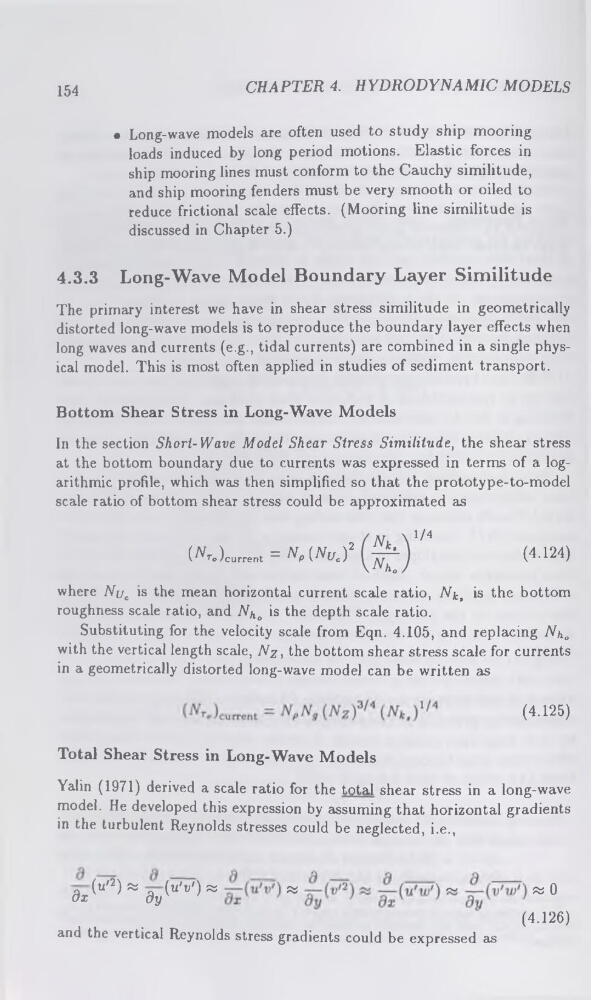
at the bottom boundary due to currents was expressed in terms of a logarithmic profile, which was then simplified so that the prototype-to-model
scale ratio of bottom shear stress could be approximated as
(Wr.)cu„ent = Nf(NV,)2
(4.124)
where Nuc is the mean horizontal current scale ratio, Nkt is the bottom
roughness scale ratio, and Nho is the depth scale ratio.
Substituting for the velocity scale from Eqn. 4.105, and replacing Nho
with the vertical length scale, Nz, the bottom shear stress scale for currents
in a geometrically distorted long-wave model can be written as
(4.125)
Total Shear Stress in Long-Wave Models
Yalin (1971) derived a scale ratio for the total shear stress in a long-wave
model. He developed this expression by assuming that horizontal gradients
in the turbulent Reynolds stresses could be neglected, i.e.,
3x(u'2) “ dy^'^ “
K
~
“ 0
(4.126)
and the vertical Reynolds stress gradients could be expressed as
CHAPTER 4. HYDRODYNAMIC MODELS
• Long-wave models are often used to study ship mooring
loads induced by long period motions. Elastic forces in
ship mooring lines must conform to the Cauchy similitude,
and ship mooring fenders must be very smooth or oiled to
reduce frictional scale effects. (Mooring line similitude is
discussed in Chapter 5.)
4.3.3 Long-Wave Model Boundary Layer Similitude
The primary interest we have in shear stress similitude in geometrically
distorted long-wave models is to reproduce the boundary layer effects when
long waves and currents (e.g., tidal currents) are combined in a single physical model. This is most often applied in studies of sediment transport.
Bottom Shear Stress in Long-Wave Models
In the section Short-Wave Model Shear Stress Similitude, the shear stress
at the bottom boundary due to currents was expressed in terms of a logarithmic profile, which was then simplified so that the prototype-to-model
scale ratio of bottom shear stress could be approximated as
(Wr.)cu„ent = Nf(NV,)2
(4.124)
where Nuc is the mean horizontal current scale ratio, Nkt is the bottom
roughness scale ratio, and Nho is the depth scale ratio.
Substituting for the velocity scale from Eqn. 4.105, and replacing Nho
with the vertical length scale, Nz, the bottom shear stress scale for currents
in a geometrically distorted long-wave model can be written as
(4.125)
Total Shear Stress in Long-Wave Models
Yalin (1971) derived a scale ratio for the total shear stress in a long-wave
model. He developed this expression by assuming that horizontal gradients
in the turbulent Reynolds stresses could be neglected, i.e.,
3x(u'2) “ dy^'^ “
K
~
“ 0
(4.126)
and the vertical Reynolds stress gradients could be expressed as