

4.3. LONG-WAVE HYDRODYNAMIC MODELS
151
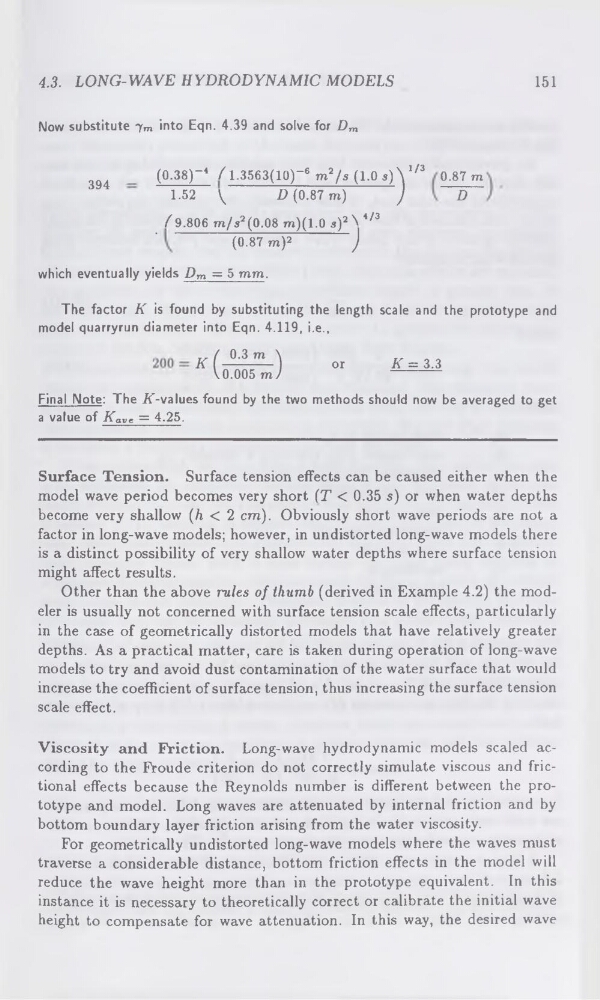
Now substitute ym into Eqn. 4.39 and solve for Dm
394
(0.38)-4 /1.3563(10)-6 m2/s (1.0 s)V/3
1.52 \
D (0.87 m)
)
/9.806 m/s2(0.08 m)(1.0 5)2\ 4>*3
'
(0.87 m)2
)
0.87 m
D
which eventually yields Dm = 5 mm.
The factor K is found by substituting the length scale and the prototype and
model quarryrun diameter into Eqn. 4.119, i.e.,
or
K = 3.3
Final Note: The K-values found by the two methods should now be averaged to get
a value of Kave = 4.25.
Surface Tension. Surface tension effects can be caused either when the
model wave period becomes very short (T < 0.35 s) or when water depths
become very shallow (h < 2 cm). Obviously short wave periods are not a
factor in long-wave models; however, in undistorted long-wave models there
is a distinct possibility of very shallow water depths where surface tension
might affect results.
Other than the above rules of thumb (derived in Example 4.2) the modeler is usually not concerned with surface tension scale effects, particularly
in the case of geometrically distorted models that have relatively greater
depths. As a practical matter, care is taken during operation of long-wave
models to try and avoid dust contamination of the water surface that would
increase the coefficient of surface tension, thus increasing the surface tension
scale effect.
Viscosity and Friction. Long-wave hydrodynamic models scaled according to the Froude criterion do not correctly simulate viscous and frictional effects because the Reynolds number is different between the prototype and model. Long waves are attenuated by internal friction and by
bottom boundary layer friction arising from the water viscosity.
For geometrically undistorted long-wave models where the waves must
traverse a considerable distance, bottom friction effects in the model will
reduce the wave height more than in the prototype equivalent. In this
instance it is necessary to theoretically correct or calibrate the initial wave
height to compensate for wave attenuation. In this way, the desired wave
151
Now substitute ym into Eqn. 4.39 and solve for Dm
394
(0.38)-4 /1.3563(10)-6 m2/s (1.0 s)V/3
1.52 \
D (0.87 m)
)
/9.806 m/s2(0.08 m)(1.0 5)2\ 4>*3
'
(0.87 m)2
)
0.87 m
D
which eventually yields Dm = 5 mm.
The factor K is found by substituting the length scale and the prototype and
model quarryrun diameter into Eqn. 4.119, i.e.,
or
K = 3.3
Final Note: The K-values found by the two methods should now be averaged to get
a value of Kave = 4.25.
Surface Tension. Surface tension effects can be caused either when the
model wave period becomes very short (T < 0.35 s) or when water depths
become very shallow (h < 2 cm). Obviously short wave periods are not a
factor in long-wave models; however, in undistorted long-wave models there
is a distinct possibility of very shallow water depths where surface tension
might affect results.
Other than the above rules of thumb (derived in Example 4.2) the modeler is usually not concerned with surface tension scale effects, particularly
in the case of geometrically distorted models that have relatively greater
depths. As a practical matter, care is taken during operation of long-wave
models to try and avoid dust contamination of the water surface that would
increase the coefficient of surface tension, thus increasing the surface tension
scale effect.
Viscosity and Friction. Long-wave hydrodynamic models scaled according to the Froude criterion do not correctly simulate viscous and frictional effects because the Reynolds number is different between the prototype and model. Long waves are attenuated by internal friction and by
bottom boundary layer friction arising from the water viscosity.
For geometrically undistorted long-wave models where the waves must
traverse a considerable distance, bottom friction effects in the model will
reduce the wave height more than in the prototype equivalent. In this
instance it is necessary to theoretically correct or calibrate the initial wave
height to compensate for wave attenuation. In this way, the desired wave