

150
CHAPTER 4. HYDRODYNAMIC MODELS
Keulegan's Method
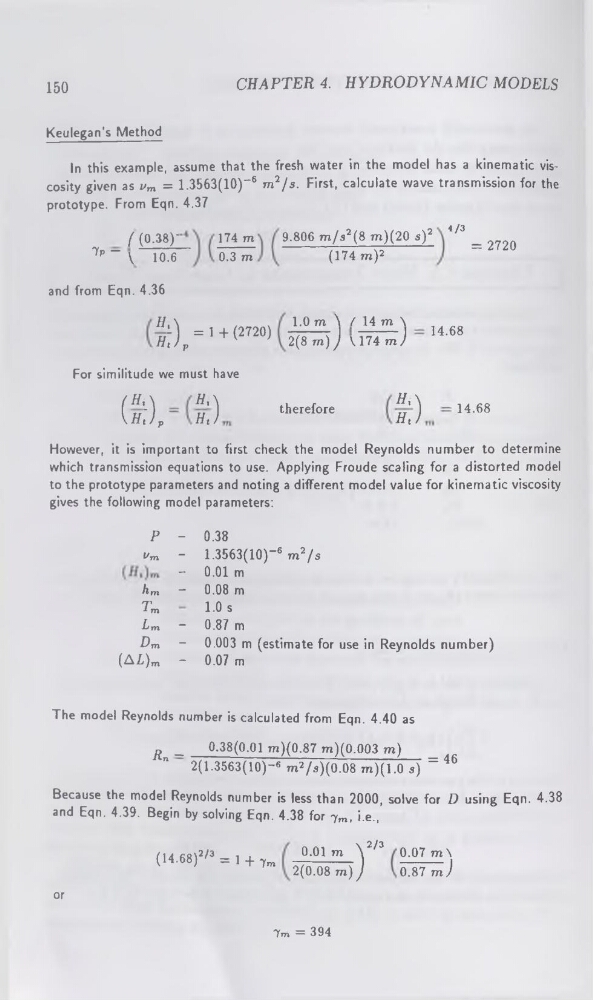
In this example, assume that the fresh water in the model has a kinematic viscosity given as vm = 1.3563(10)-6 m2/s. First, calculate wave transmission for the
prototype. From Eqn. 4.37
( (0.38)'
7p “ \ 10.6
174 m
0.3 m
9.806 m/s2(8 m)(20 s)2
(174 m)2
4/3
= 2720
and from Eqn. 4.36
77, \
77 J = 1 + (2720)
p
1.0m \ / 14 m \
2(8 m) ) \ 174 mJ
14.68
For similitude we must have
(Hi_ \
\77tJp
77, X
Ht)
therefore
77, \
Ht)
14.68
However, it is important to first check the model Reynolds number to determine
which transmission equations to use. Applying Froude scaling for a distorted model
to the prototype parameters and noting a different model value for kinematic viscosity
gives the following model parameters:
P -
I'm
~
-
hm
~~
T 1 m
I'm
~
Dm
~
(△L)m
-
0.38
1.3563(10)"6 m2/s
0.01 m
0.08 m
1.0 s
0.87 m
0.003 m (estimate for use in Reynolds number)
0.07 m
The model Reynolds number is calculated from Eqn. 4.40 as
R _
0.38(0.01 m)(0,87 m)(0.003 m)
_
n
2(1,3563(10)-6 m2/s)(0.08 m)(1.0 s) ~ 46
Because the model Reynolds number is less than 2000, solve for D using Eqn. 4.38
and Eqn. 4.39. Begin by solving Eqn. 4.38 for 7m, i.e.,
or
(14.68)2'3 = 1 + 7m
0.01 m V/3
2(0.08 m) J
0.07 m\
0.87 m)
~im = 394
CHAPTER 4. HYDRODYNAMIC MODELS
Keulegan's Method
In this example, assume that the fresh water in the model has a kinematic viscosity given as vm = 1.3563(10)-6 m2/s. First, calculate wave transmission for the
prototype. From Eqn. 4.37
( (0.38)'
7p “ \ 10.6
174 m
0.3 m
9.806 m/s2(8 m)(20 s)2
(174 m)2
4/3
= 2720
and from Eqn. 4.36
77, \
77 J = 1 + (2720)
p
1.0m \ / 14 m \
2(8 m) ) \ 174 mJ
14.68
For similitude we must have
(Hi_ \
\77tJp
77, X
Ht)
therefore
77, \
Ht)
14.68
However, it is important to first check the model Reynolds number to determine
which transmission equations to use. Applying Froude scaling for a distorted model
to the prototype parameters and noting a different model value for kinematic viscosity
gives the following model parameters:
P -
I'm
~
-
hm
~~
T 1 m
I'm
~
Dm
~
(△L)m
-
0.38
1.3563(10)"6 m2/s
0.01 m
0.08 m
1.0 s
0.87 m
0.003 m (estimate for use in Reynolds number)
0.07 m
The model Reynolds number is calculated from Eqn. 4.40 as
R _
0.38(0.01 m)(0,87 m)(0.003 m)
_
n
2(1,3563(10)-6 m2/s)(0.08 m)(1.0 s) ~ 46
Because the model Reynolds number is less than 2000, solve for D using Eqn. 4.38
and Eqn. 4.39. Begin by solving Eqn. 4.38 for 7m, i.e.,
or
(14.68)2'3 = 1 + 7m
0.01 m V/3
2(0.08 m) J
0.07 m\
0.87 m)
~im = 394