

4.3. LONG-WAVE HYDRODYNAMIC MODELS
149
As previously mentioned, current guidance is to average the K-values
found using the Le Méhauté and the Keulegan methods. This guidance
also applies to both distorted and undistorted long-wave physical models.
Additional information on scale models of rubble structures is given in
Sharp and Khader (1984) and in Chapter 5 (Stability Models).
Example 4.5. Wave Transmission in Long-Wave Models
Wave transmission through a prototype structure is to be modeled in a geometrically distorted hydraulic model having a vertical length scale of 1:100 and a horizontal
length scale of 1:200. Structure and design wave parameters in the prototype are given
as follows:
P
-
"p ~
WP
-
hp
TP
~
Lp
-
Dp
-
(AZ)P
-
0.38
1.0565(10)“6 m2 / s
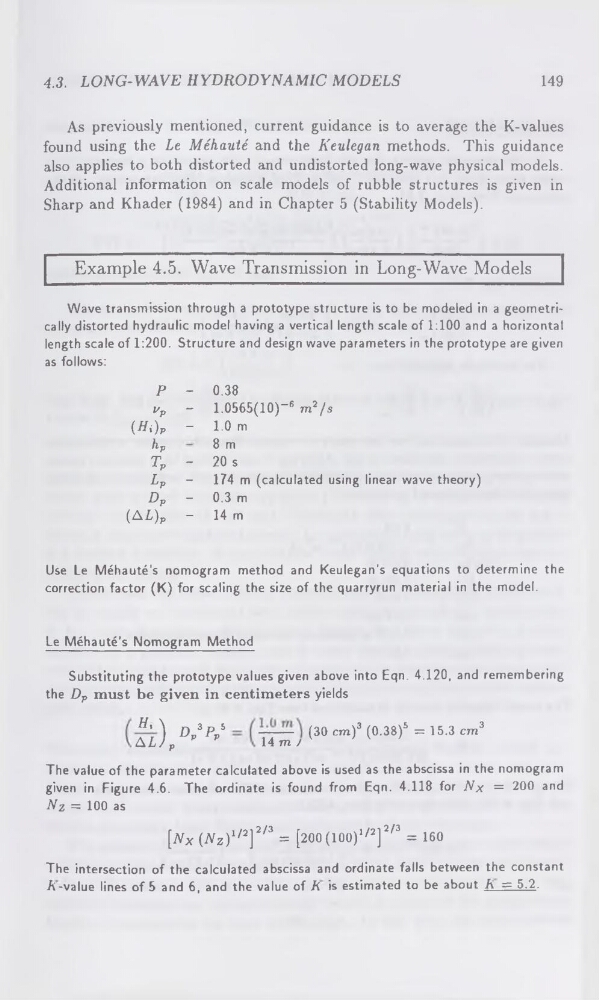
Substituting the prototype values given above into Eqn. 4.120, and remembering
the Dp must be given in centimeters yields
(30 cm)3 (0.38)5 = 15.3 cm3
14m/
The value of the parameter calculated above is used as the abscissa in the nomogram
given in Figure 4.6. The ordinate is found from Eqn. 4.118 for Nx = 200 and
Nz = 100 as
[Ax (Az)1/2]2/3 = [200 (100)1/2]2/3 = 160
The intersection of the calculated abscissa and ordinate falls between the constant
A-value lines of 5 and 6, and the value of K is estimated to be about K = 5.2.
1.0 m
8 m
20 s
174 m (calculated using linear wave theory)
0.3 m
14 m
Use Le Méhauté’s nomogram method and Keulegan's equations to determine the
correction factor (K) for scaling the size of the quarryrun material in the model.
Le Méhauté’s Nomogram Method
H, \
al)
D 3 P 5
iZp r p
P
149
As previously mentioned, current guidance is to average the K-values
found using the Le Méhauté and the Keulegan methods. This guidance
also applies to both distorted and undistorted long-wave physical models.
Additional information on scale models of rubble structures is given in
Sharp and Khader (1984) and in Chapter 5 (Stability Models).
Example 4.5. Wave Transmission in Long-Wave Models
Wave transmission through a prototype structure is to be modeled in a geometrically distorted hydraulic model having a vertical length scale of 1:100 and a horizontal
length scale of 1:200. Structure and design wave parameters in the prototype are given
as follows:
P
-
"p ~
WP
-
hp
TP
~
Lp
-
Dp
-
(AZ)P
-
0.38
1.0565(10)“6 m2 / s
Substituting the prototype values given above into Eqn. 4.120, and remembering
the Dp must be given in centimeters yields
(30 cm)3 (0.38)5 = 15.3 cm3
14m/
The value of the parameter calculated above is used as the abscissa in the nomogram
given in Figure 4.6. The ordinate is found from Eqn. 4.118 for Nx = 200 and
Nz = 100 as
[Ax (Az)1/2]2/3 = [200 (100)1/2]2/3 = 160
The intersection of the calculated abscissa and ordinate falls between the constant
A-value lines of 5 and 6, and the value of K is estimated to be about K = 5.2.
1.0 m
8 m
20 s
174 m (calculated using linear wave theory)
0.3 m
14 m
Use Le Méhauté’s nomogram method and Keulegan's equations to determine the
correction factor (K) for scaling the size of the quarryrun material in the model.
Le Méhauté’s Nomogram Method
H, \
al)
D 3 P 5
iZp r p
P