

152
CHAPTER 4. HYDRODYNAMIC MODELS
ondition is propagated to the opposite end of the long extent in the model
(Le Méhauté 1976).
In geometrically distorted long-wave models, travel distances are usually shorter, depths are greater, and bottom friction effects are considered
negligible for the most part. Where necessary, the modeler can reduce wave
height with distance of wave travel using the method developed by Keulegan
(1950b) (derived in the Short-Wave Viscosity and Friction section) using
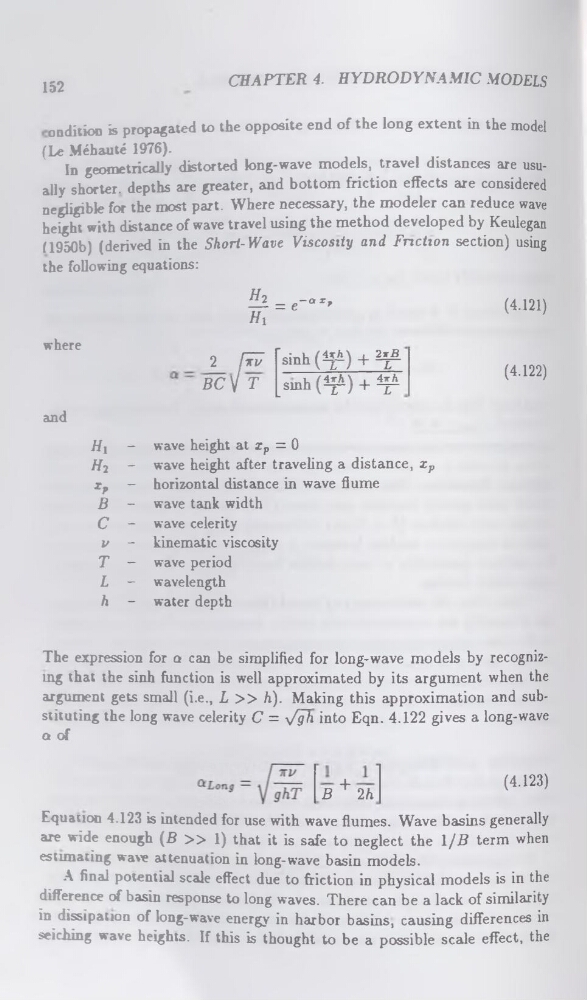
the following equations:
where
Hl = e-^r
Hi
2 /ÏÏT [sinh^ + y
BC\ T [Smh(^) + ^
(4-121)
(4.122)
and
Hi - wave height at xp = 0
7/2 ~ wave height after traveling a distance, xp
xp - horizontal distance in wave flume
B - wave tank width
C - wave celerity
v - kinematic viscosity
T - wave period
L — wavelength
h - water depth
The expression for a can be simplified for long-wave models by recognizing that the sinh function is well approximated by its argument when the
argument gets small (i.e., L >> h). Making this approximation and substituting the long wave celerity C = y/gh into Eqn. 4.122 gives a long-wave
a of
B + 2h
(4.123)
Equation 4.1'23 is intended for use with wave flumes. Wave basins generally
are wide enough (B » 1) that it is safe to neglect the 1/B term when
estimating wave attenuation in long-wave basin models.
A final potential scale effect due to friction in physical models is in the
difference of basin response to long waves. There can be a lack of similarity
in dissipation of long-wave energy in harbor basins, causing differences in
seiching wave heights. If this is thought to be a possible scale effect, the
CHAPTER 4. HYDRODYNAMIC MODELS
ondition is propagated to the opposite end of the long extent in the model
(Le Méhauté 1976).
In geometrically distorted long-wave models, travel distances are usually shorter, depths are greater, and bottom friction effects are considered
negligible for the most part. Where necessary, the modeler can reduce wave
height with distance of wave travel using the method developed by Keulegan
(1950b) (derived in the Short-Wave Viscosity and Friction section) using
the following equations:
where
Hl = e-^r
Hi
2 /ÏÏT [sinh^ + y
BC\ T [Smh(^) + ^
(4-121)
(4.122)
and
Hi - wave height at xp = 0
7/2 ~ wave height after traveling a distance, xp
xp - horizontal distance in wave flume
B - wave tank width
C - wave celerity
v - kinematic viscosity
T - wave period
L — wavelength
h - water depth
The expression for a can be simplified for long-wave models by recognizing that the sinh function is well approximated by its argument when the
argument gets small (i.e., L >> h). Making this approximation and substituting the long wave celerity C = y/gh into Eqn. 4.122 gives a long-wave
a of
B + 2h
(4.123)
Equation 4.1'23 is intended for use with wave flumes. Wave basins generally
are wide enough (B » 1) that it is safe to neglect the 1/B term when
estimating wave attenuation in long-wave basin models.
A final potential scale effect due to friction in physical models is in the
difference of basin response to long waves. There can be a lack of similarity
in dissipation of long-wave energy in harbor basins, causing differences in
seiching wave heights. If this is thought to be a possible scale effect, the