

4.3. LONG-WAVE HYDRODYNAMIC MODELS
135
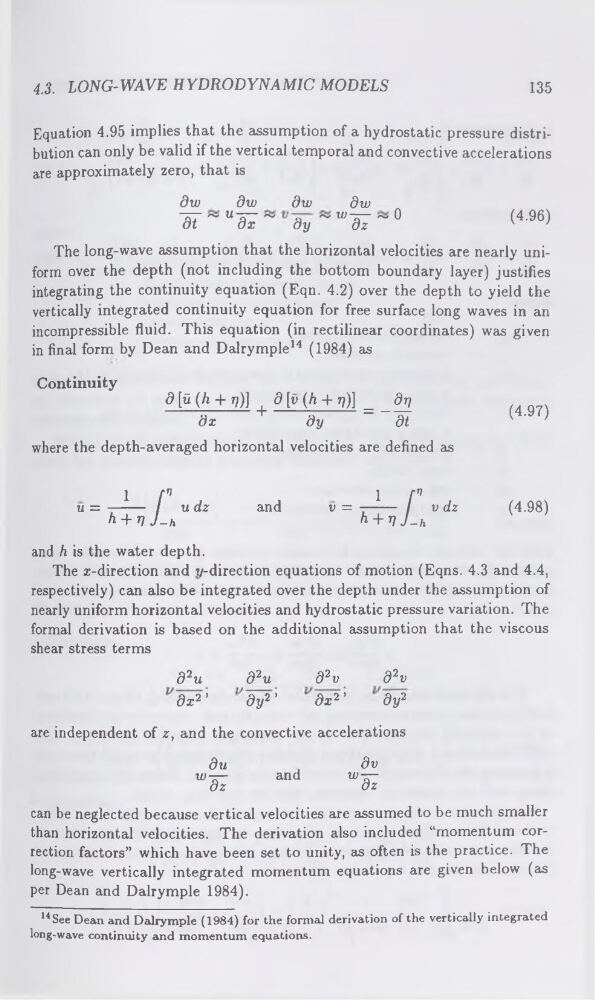
Equation 4.95 implies that the assumption of a hydrostatic pressure distribution can only be valid if the vertical temporal and convective accelerations
are approximately zero, that is
dw
dw
dw
dw
“âT ~ u~â~ ~
~ WT~ ~ 0
dt
ox
dy
dz
(4.96)
The long-wave assumption that the horizontal velocities are nearly uniform over the depth (not including the bottom boundary layer) justifies
integrating the continuity equation (Eqn. 4.2) over the depth to yield the
vertically integrated continuity equation for free surface long waves in an
incompressible fluid. This equation (in rectilinear coordinates) was given
in final form by Dean and Dalrymple14 (1984) as
14See Dean and Dalrymple (1984) for the formal derivation of the vertically integrated
long-wave continuity and momentum equations.
Continuity
d [ü (A + z/)]
d [v (A + 7?)]
drj
------ di------ +------- d~y---- = “ â
(O7)
where the depth-averaged horizontal velocities are defined as
1 r j
u = ----- / u dz
hAr) J_h
and
1
h + rj
v dz
(4.98)
v =
and h is the water depth.
The x-direction and ^/-direction equations of motion (Eqns. 4.3 and 4.4,
respectively) can also be integrated over the depth under the assumption of
nearly uniform horizontal velocities and hydrostatic pressure variation. The
formal derivation is based on the additional assumption that the viscous
shear stress terms
d2u
d2u
d2v
d2v
dx2 ’
dy2 ’
dx2 ’
dy2
are independent of z, and the convective accelerations
du
dv
w—~
and
w—
dz
dz
can be neglected because vertical velocities are assumed to be much smaller
than horizontal velocities. The derivation also included “momentum correction factors” which have been set to unity, as often is the practice. The
long-wave vertically integrated momentum equations are given below (as
per Dean and Dalrymple 1984).
135
Equation 4.95 implies that the assumption of a hydrostatic pressure distribution can only be valid if the vertical temporal and convective accelerations
are approximately zero, that is
dw
dw
dw
dw
“âT ~ u~â~ ~
~ WT~ ~ 0
dt
ox
dy
dz
(4.96)
The long-wave assumption that the horizontal velocities are nearly uniform over the depth (not including the bottom boundary layer) justifies
integrating the continuity equation (Eqn. 4.2) over the depth to yield the
vertically integrated continuity equation for free surface long waves in an
incompressible fluid. This equation (in rectilinear coordinates) was given
in final form by Dean and Dalrymple14 (1984) as
14See Dean and Dalrymple (1984) for the formal derivation of the vertically integrated
long-wave continuity and momentum equations.
Continuity
d [ü (A + z/)]
d [v (A + 7?)]
drj
------ di------ +------- d~y---- = “ â
(O7)
where the depth-averaged horizontal velocities are defined as
1 r j
u = ----- / u dz
hAr) J_h
and
1
h + rj
v dz
(4.98)
v =
and h is the water depth.
The x-direction and ^/-direction equations of motion (Eqns. 4.3 and 4.4,
respectively) can also be integrated over the depth under the assumption of
nearly uniform horizontal velocities and hydrostatic pressure variation. The
formal derivation is based on the additional assumption that the viscous
shear stress terms
d2u
d2u
d2v
d2v
dx2 ’
dy2 ’
dx2 ’
dy2
are independent of z, and the convective accelerations
du
dv
w—~
and
w—
dz
dz
can be neglected because vertical velocities are assumed to be much smaller
than horizontal velocities. The derivation also included “momentum correction factors” which have been set to unity, as often is the practice. The
long-wave vertically integrated momentum equations are given below (as
per Dean and Dalrymple 1984).