

136
CHAPTER 4. HYDRODYNAMIC MODELS
x-Direction
dû
dû
dû
dr)
( d2u
d2u\
dt+UdC'"dj~
Sy2)
v
du T>
+ 77—-v
4.99
(Æ 4- 77) dz _h
y-Direction
dû
dv
dv
du
( d2v
d2v\
dt+'‘dC'’di~ 9dy + ,,\dz2
dy2 )
v
dv n
+ (h + 77) dz _
(4.100)
where
t - time
x,y - horizontal coordinates
z - vertical coordinate
u,v - instantaneous horizontal components of velocity in the
x and y directions, respectively
û,v - vertically integrated components of velocity in the
x and y directions, respectively
g - gravitational acceleration
h - water depth
7]
- sea surface elevation
u - fluid kinematic viscosity
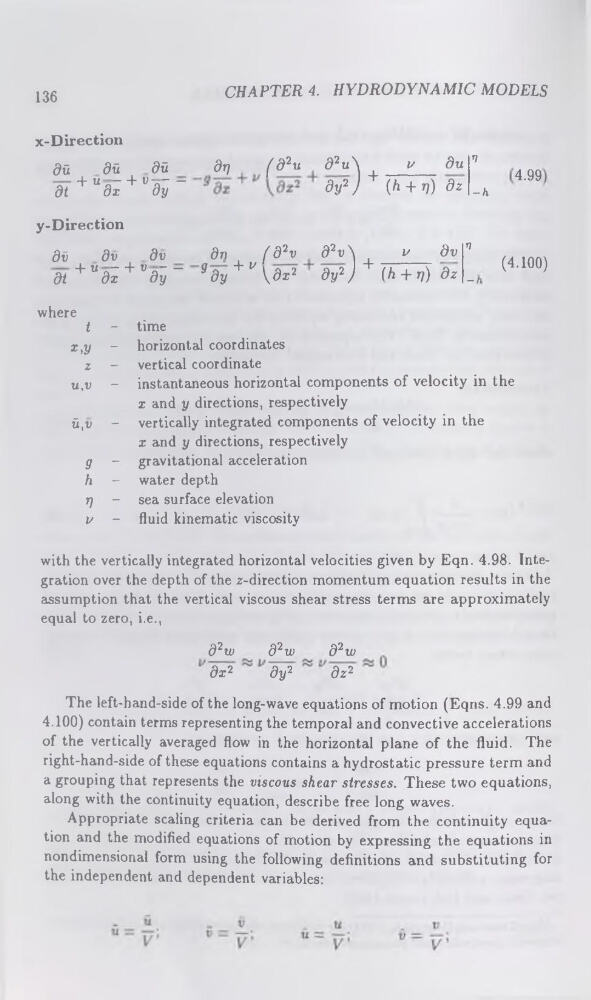
with the vertically integrated horizontal velocities given by Eqn. 4.98. Integration over the depth of the z-direction momentum equation results in the
assumption that the vertical viscous shear stress terms are approximately
equal to zero, i.e.,
d2w
d2w
d2w
dx2
dy2
dz2
The left-hand-side of the long-wave equations of motion (Eqns. 4.99 and
4.100) contain terms representing the temporal and convective accelerations
of the vertically averaged flow in the horizontal plane of the fluid. The
right-hand-side of these equations contains a hydrostatic pressure term and
a grouping that represents the viscous shear stresses. These two equations,
along with the continuity equation, describe free long waves.
Appropriate scaling criteria can be derived from the continuity equation and the modified equations of motion by expressing the equations in
nondimensional form using the following definitions and substituting for
the independent and dependent variables:
CHAPTER 4. HYDRODYNAMIC MODELS
x-Direction
dû
dû
dû
dr)
( d2u
d2u\
dt+UdC'"dj~
Sy2)
v
du T>
+ 77—-v
4.99
(Æ 4- 77) dz _h
y-Direction
dû
dv
dv
du
( d2v
d2v\
dt+'‘dC'’di~ 9dy + ,,\dz2
dy2 )
v
dv n
+ (h + 77) dz _
(4.100)
where
t - time
x,y - horizontal coordinates
z - vertical coordinate
u,v - instantaneous horizontal components of velocity in the
x and y directions, respectively
û,v - vertically integrated components of velocity in the
x and y directions, respectively
g - gravitational acceleration
h - water depth
7]
- sea surface elevation
u - fluid kinematic viscosity
with the vertically integrated horizontal velocities given by Eqn. 4.98. Integration over the depth of the z-direction momentum equation results in the
assumption that the vertical viscous shear stress terms are approximately
equal to zero, i.e.,
d2w
d2w
d2w
dx2
dy2
dz2
The left-hand-side of the long-wave equations of motion (Eqns. 4.99 and
4.100) contain terms representing the temporal and convective accelerations
of the vertically averaged flow in the horizontal plane of the fluid. The
right-hand-side of these equations contains a hydrostatic pressure term and
a grouping that represents the viscous shear stresses. These two equations,
along with the continuity equation, describe free long waves.
Appropriate scaling criteria can be derived from the continuity equation and the modified equations of motion by expressing the equations in
nondimensional form using the following definitions and substituting for
the independent and dependent variables: