

134
CHAPTER 4. HYDRODYNAMIC MODELS
4.3.1 Scaling Requirements for Long-Wave Models
Governing Equations of Motion
Long-wave model scaling requirements can be derived by applying some
simplifying assumptions to the equations of motion used in deriving the
similitude requirements for short-wave models (Eqns. 4.2-4.5). In longwave motion we assume that the horizontal velocities are nearly uniform
over the depth (outside of the bottom boundary layer) and that vertical flow
velocities are much smaller than horizontal velocities. It is also reasonable
to assume there will be less turbulent dissipation due to processes that occur
over short distances, such as wave breaking or hydraulic jumps; therefore,
we will drop the turbulent Reynolds shear stress terms that are present in
the short-wave equations of motion to accommodate geometrically distorted
models.
Development of equations describing long-wave motion often begins by
assuming that the pressure beneath the long wave in the inviscid region is
hydrostatic (Yalin 1971, Dean and Dalrymple 1984, Hudson, et al. 1979),
i.e.,
p( * )
= Pg(jl~ z)
(4.92)
where y is the long-wave free surface elevation and z is the vertical coordinate (positive upward) with z = 0 at the still water level.
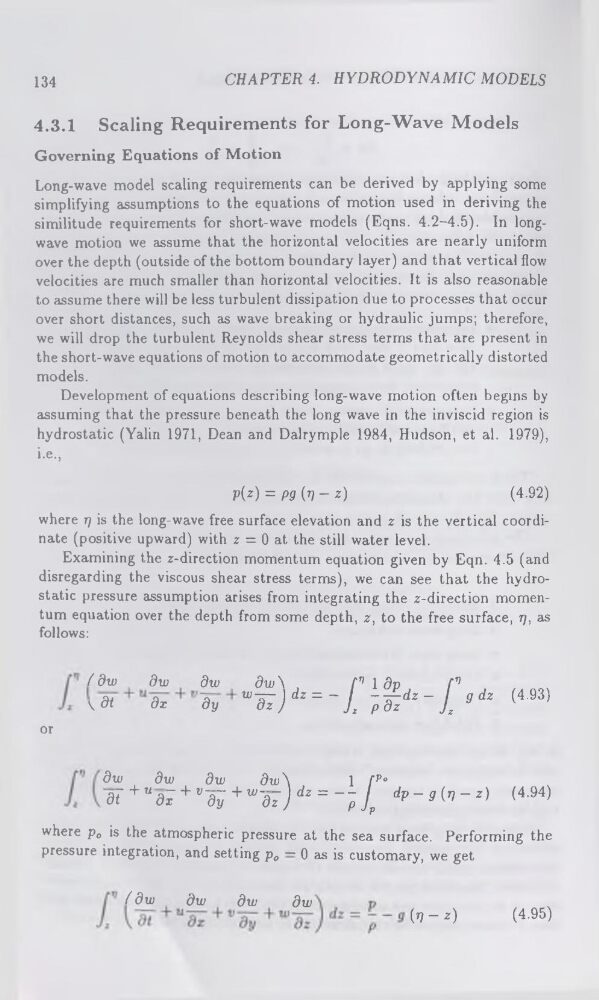
Examining the z-direction momentum equation given by Eqn. 4.5 (and
disregarding the viscous shear stress terms), we can see that the hydrostatic pressure assumption arises from integrating the z-direction momentum equation over the depth from some depth, z, to the free surface, rj, as
follows:
/dw
dw
dw
\ dt
dx
dy
dw\
T 1 dn
/ * ”
w—— I dz = — / -yf-dz— / g dz (4.93)
dz )
Jz p dz
Jz
or
dw
dw
dw
dw\
1 [Po
'di + ud^ + v'd^ + w'dl)dz = -~pJp dp-g^-z) (4.94)
where p0 is the atmospheric pressure at the sea surface. Performing the
pressure integration, and setting po ~ 0 as is customary, we get
/ dw
dw
dw
dw
(ry- z)
(4.95)
CHAPTER 4. HYDRODYNAMIC MODELS
4.3.1 Scaling Requirements for Long-Wave Models
Governing Equations of Motion
Long-wave model scaling requirements can be derived by applying some
simplifying assumptions to the equations of motion used in deriving the
similitude requirements for short-wave models (Eqns. 4.2-4.5). In longwave motion we assume that the horizontal velocities are nearly uniform
over the depth (outside of the bottom boundary layer) and that vertical flow
velocities are much smaller than horizontal velocities. It is also reasonable
to assume there will be less turbulent dissipation due to processes that occur
over short distances, such as wave breaking or hydraulic jumps; therefore,
we will drop the turbulent Reynolds shear stress terms that are present in
the short-wave equations of motion to accommodate geometrically distorted
models.
Development of equations describing long-wave motion often begins by
assuming that the pressure beneath the long wave in the inviscid region is
hydrostatic (Yalin 1971, Dean and Dalrymple 1984, Hudson, et al. 1979),
i.e.,
p( * )
= Pg(jl~ z)
(4.92)
where y is the long-wave free surface elevation and z is the vertical coordinate (positive upward) with z = 0 at the still water level.
Examining the z-direction momentum equation given by Eqn. 4.5 (and
disregarding the viscous shear stress terms), we can see that the hydrostatic pressure assumption arises from integrating the z-direction momentum equation over the depth from some depth, z, to the free surface, rj, as
follows:
/dw
dw
dw
\ dt
dx
dy
dw\
T 1 dn
/ * ”
w—— I dz = — / -yf-dz— / g dz (4.93)
dz )
Jz p dz
Jz
or
dw
dw
dw
dw\
1 [Po
'di + ud^ + v'd^ + w'dl)dz = -~pJp dp-g^-z) (4.94)
where p0 is the atmospheric pressure at the sea surface. Performing the
pressure integration, and setting po ~ 0 as is customary, we get
/ dw
dw
dw
dw
(ry- z)
(4.95)