

4.3. LONG-WAVE HYDRODYNAMIC MODELS
133
, .
%
hl
kh < — or
— < —
(4 on
10
L
20
1
’
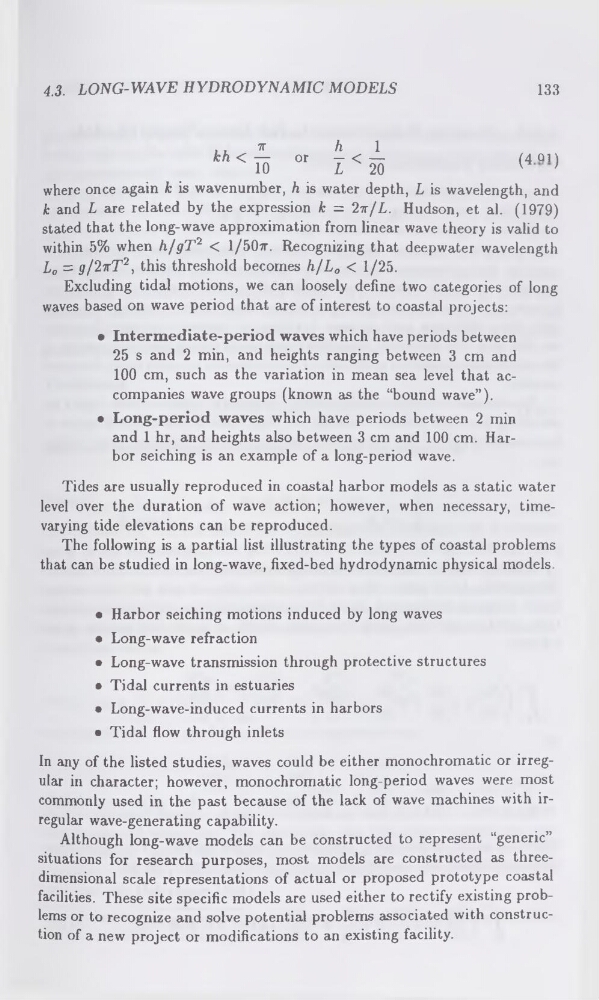
where once again k is wavenumber, h is water depth, L is wavelength, and
k and L are related by the expression k = 2tt/L. Hudson, et al. (1979)
stated that the long-wave approximation from linear wave theory is valid to
within 5% when h/gT2 < 1/50tt. Recognizing that deepwater wavelength
Lo = g/ïirT2, this threshold becomes h/L0 < 1/25.
Excluding tidal motions, we can loosely define two categories of long
waves based on wave period that are of interest to coastal projects:
• Intermediate-period waves which have periods between
25 s and 2 min, and heights ranging between 3 cm and
100 cm, such as the variation in mean sea level that accompanies wave groups (known as the “bound wave”).
• Long-period waves which have periods between 2 min
and 1 hr, and heights also between 3 cm and 100 cm. Harbor seiching is an example of a long-period wave.
Tides are usually reproduced in coastal harbor models as a static water
level over the duration of wave action; however, when necessary, timevarying tide elevations can be reproduced.
The following is a partial list illustrating the types of coastal problems
that can be studied in long-wave, fixed-bed hydrodynamic physical models.
• Harbor seiching motions induced by long waves
• Long-wave refraction
• Long-wave transmission through protective structures
• Tidal currents in estuaries
• Long-wave-induced currents in harbors
• Tidal flow through inlets
In any of the listed studies, waves could be either monochromatic or irregular in character; however, monochromatic long-period waves were most
commonly used in the past because of the lack of wave machines with irregular wave-generating capability.
Although long-wave models can be constructed to represent “generic”
situations for research purposes, most models are constructed as threedimensional scale representations of actual or proposed prototype coastal
facilities. These site specific models are used either to rectify existing problems or to recognize and solve potential problems associated with construction of a new project or modifications to an existing facility.
133
, .
%
hl
kh < — or
— < —
(4 on
10
L
20
1
’
where once again k is wavenumber, h is water depth, L is wavelength, and
k and L are related by the expression k = 2tt/L. Hudson, et al. (1979)
stated that the long-wave approximation from linear wave theory is valid to
within 5% when h/gT2 < 1/50tt. Recognizing that deepwater wavelength
Lo = g/ïirT2, this threshold becomes h/L0 < 1/25.
Excluding tidal motions, we can loosely define two categories of long
waves based on wave period that are of interest to coastal projects:
• Intermediate-period waves which have periods between
25 s and 2 min, and heights ranging between 3 cm and
100 cm, such as the variation in mean sea level that accompanies wave groups (known as the “bound wave”).
• Long-period waves which have periods between 2 min
and 1 hr, and heights also between 3 cm and 100 cm. Harbor seiching is an example of a long-period wave.
Tides are usually reproduced in coastal harbor models as a static water
level over the duration of wave action; however, when necessary, timevarying tide elevations can be reproduced.
The following is a partial list illustrating the types of coastal problems
that can be studied in long-wave, fixed-bed hydrodynamic physical models.
• Harbor seiching motions induced by long waves
• Long-wave refraction
• Long-wave transmission through protective structures
• Tidal currents in estuaries
• Long-wave-induced currents in harbors
• Tidal flow through inlets
In any of the listed studies, waves could be either monochromatic or irregular in character; however, monochromatic long-period waves were most
commonly used in the past because of the lack of wave machines with irregular wave-generating capability.
Although long-wave models can be constructed to represent “generic”
situations for research purposes, most models are constructed as threedimensional scale representations of actual or proposed prototype coastal
facilities. These site specific models are used either to rectify existing problems or to recognize and solve potential problems associated with construction of a new project or modifications to an existing facility.