

114
CHAPTER 4. HYDRODYNAMIC MODELS
H1 - wave height at xp = 0
H2 - wave height after traveling a distance, xp
x
— horizontal distance in wave flume
p
B - wave tank width
C - wave celerity
v - kinematic viscosity
T - wave period
L - wavelength
h - water depth
If the wave flume width is many times greater than the water depth,
then the friction factor given by Eqn. 4.68 reduces to
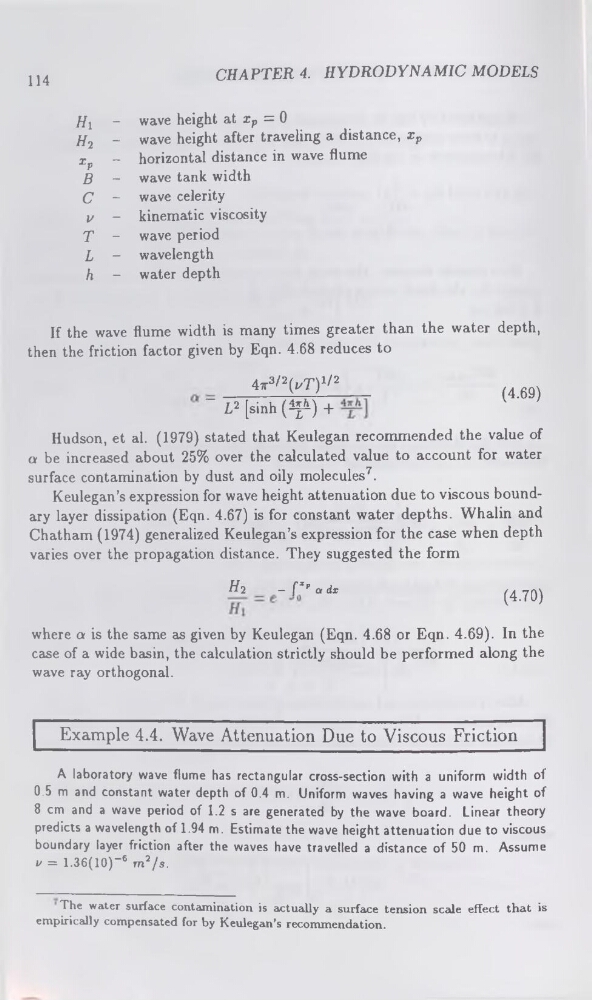
47r3/2(I/T)1/2
“ P [sinh m +
(4.69)
Hudson, et al. (1979) stated that Keulegan recommended the value of
a be increased about 25% over the calculated value to account for water
surface contamination by dust and oily molecules7.
Keulegan’s expression for wave height attenuation due to viscous boundary layer dissipation (Eqn. 4.67) is for constant water depths. Whalin and
Chatham (1974) generalized Keulegan’s expression for the case when depth
varies over the propagation distance. They suggested the form
H2
— fIp a dx
(4.70)
where a is the same as given by Keulegan (Eqn. 4.68 or Eqn. 4.69). In the
case of a wide basin, the calculation strictly should be performed along the
wave ray orthogonal.
Example 4.4. Wave Attenuation Due to Viscous Friction
A laboratory wave flume has rectangular cross-section with a uniform width of
0.5 m and constant water depth of 0.4 m. Uniform waves having a wave height of
8 cm and a wave period of 1.2 s are generated by the wave board. Linear theory
predicts a wavelength of 1.94 m. Estimate the wave height attenuation due to viscous
boundary layer friction after the waves have travelled a distance of 50 m. Assume
p = 1.36(10)-6 m2/s.
The water surface contamination is actually a surface tension scale effect that is
empirically compensated for by Keulegan’s recommendation.
CHAPTER 4. HYDRODYNAMIC MODELS
H1 - wave height at xp = 0
H2 - wave height after traveling a distance, xp
x
— horizontal distance in wave flume
p
B - wave tank width
C - wave celerity
v - kinematic viscosity
T - wave period
L - wavelength
h - water depth
If the wave flume width is many times greater than the water depth,
then the friction factor given by Eqn. 4.68 reduces to
47r3/2(I/T)1/2
“ P [sinh m +
(4.69)
Hudson, et al. (1979) stated that Keulegan recommended the value of
a be increased about 25% over the calculated value to account for water
surface contamination by dust and oily molecules7.
Keulegan’s expression for wave height attenuation due to viscous boundary layer dissipation (Eqn. 4.67) is for constant water depths. Whalin and
Chatham (1974) generalized Keulegan’s expression for the case when depth
varies over the propagation distance. They suggested the form
H2
— fIp a dx
(4.70)
where a is the same as given by Keulegan (Eqn. 4.68 or Eqn. 4.69). In the
case of a wide basin, the calculation strictly should be performed along the
wave ray orthogonal.
Example 4.4. Wave Attenuation Due to Viscous Friction
A laboratory wave flume has rectangular cross-section with a uniform width of
0.5 m and constant water depth of 0.4 m. Uniform waves having a wave height of
8 cm and a wave period of 1.2 s are generated by the wave board. Linear theory
predicts a wavelength of 1.94 m. Estimate the wave height attenuation due to viscous
boundary layer friction after the waves have travelled a distance of 50 m. Assume
p = 1.36(10)-6 m2/s.
The water surface contamination is actually a surface tension scale effect that is
empirically compensated for by Keulegan’s recommendation.