

4.2. SHORT-WAVE HYDRODYNAMIC MODELS
113
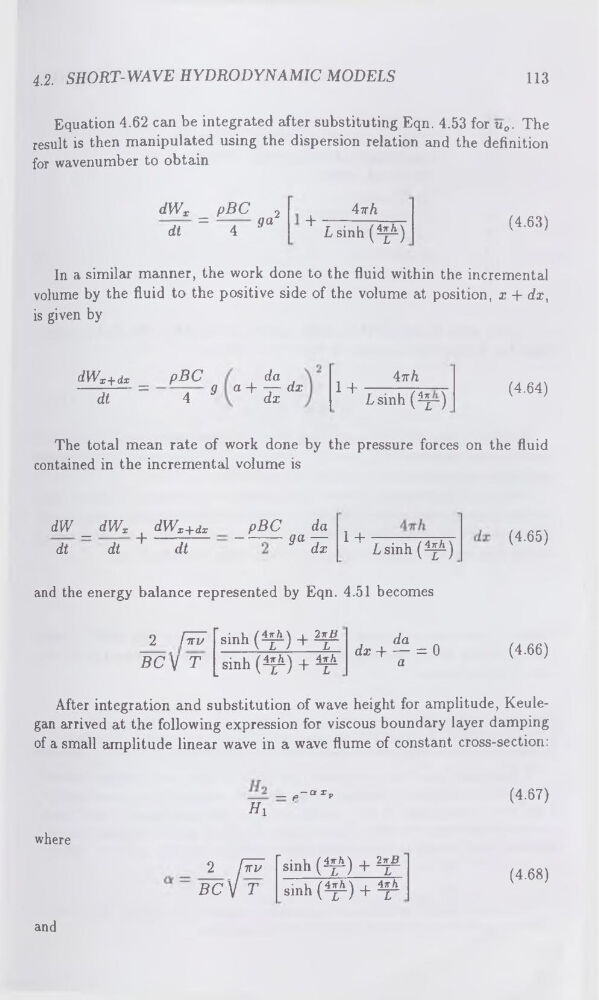
Equation 4.62 can be integrated after substituting Eqn. 4.53 for uo. The
result is then manipulated using the dispersion relation and the definition
for wavenumber to obtain
dWx _ pBC 2
4irh
dt ~ 4 S<1
+L sinh (1^)
(4.63)
In a similar manner, the work done to the fluid within the incremental
volume by the fluid to the positive side of the volume at position, x + dx,
is given by
dWx+dx _ pBC
dt
~ 4 9
da
a + — dx
dx
4-ivh
Lsinh (^r)
(4.64)
1 +
The total mean rate of work done by the pressure forces on the fluid
contained in the incremental volume is
dW _ dWx
dWx+dx
dt
dt +
dt
pBC
da
~—9aTx 1+Lsinh (1^)
(4.65)
and the energy balance represented by Eqn. 4.51 becomes
2
&[sinh(^) + ^
BCV T [sinh (^) + ^
,
da
dx 4-----= 0
a
(4.66)
After integration and substitution of wave height for amplitude, Keulegan arrived at the following expression for viscous boundary layer damping
of a small amplitude linear wave in a wave flume of constant cross-section:
where
— p~O‘xp
Hi
2 /77 [sinh(^) + y
BC\ T
sinh(lj4)+^
(4.67)
(4.68)
and
113
Equation 4.62 can be integrated after substituting Eqn. 4.53 for uo. The
result is then manipulated using the dispersion relation and the definition
for wavenumber to obtain
dWx _ pBC 2
4irh
dt ~ 4 S<1
+L sinh (1^)
(4.63)
In a similar manner, the work done to the fluid within the incremental
volume by the fluid to the positive side of the volume at position, x + dx,
is given by
dWx+dx _ pBC
dt
~ 4 9
da
a + — dx
dx
4-ivh
Lsinh (^r)
(4.64)
1 +
The total mean rate of work done by the pressure forces on the fluid
contained in the incremental volume is
dW _ dWx
dWx+dx
dt
dt +
dt
pBC
da
~—9aTx 1+Lsinh (1^)
(4.65)
and the energy balance represented by Eqn. 4.51 becomes
2
&[sinh(^) + ^
BCV T [sinh (^) + ^
,
da
dx 4-----= 0
a
(4.66)
After integration and substitution of wave height for amplitude, Keulegan arrived at the following expression for viscous boundary layer damping
of a small amplitude linear wave in a wave flume of constant cross-section:
where
— p~O‘xp
Hi
2 /77 [sinh(^) + y
BC\ T
sinh(lj4)+^
(4.67)
(4.68)
and