

4.2. SHORT-WAVE HYDRODYNAMIC MODELS
115
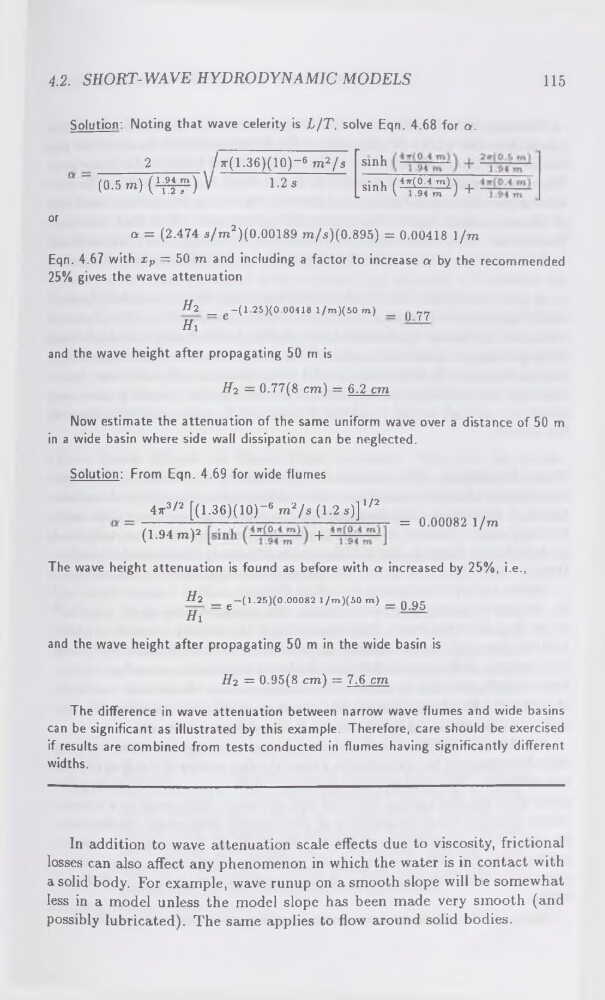
Solution: Noting that wave celerity is L/T, solve Eqn. 4.68 for a.
2
/k(1.36)(10)-« m * /s
[anh
(0.5 m)(l^)V
1.2»
[sinh (M^l) +
or
a = (2.474 s/m2)(0.00189 m/s)(0.895) = 0.00418 1/m
Eqn. 4.67 with xp = 50 m and including a factor to increase a by the recommended
25% gives the wave attenuation
#2 _ e-(1.25)(0.00418 l/m)(50 m) _ q 77
Hi
and the wave height after propagating 50 m is
H2 — 0.77(8 cm) = 6.2 cm
Now estimate the attenuation of the same uniform wave over a distance of 50 m
in a wide basin where side wall dissipation can be neglected.
Solution: From Eqn. 4.69 for wide flumes
4tt3/2 [(1,36)( 10)“6 m2/s (1.2 s)]1/2
(1.94 m)2
+
= 0.00082 1/m
The wave height attenuation is found as before with a increased by 25%, i.e.,
H2 _ e-( 1,25)(0.00082 l/m)(50 "») _ Q 95
Hi
and the wave height after propagating 50 m in the wide basin is
H2 = 0.95(8 cm) = 7.6 cm
The difference in wave attenuation between narrow wave flumes and wide basins
can be significant as illustrated by this example. Therefore, care should be exercised
if results are combined from tests conducted in flumes having significantly different
widths.
In addition to wave attenuation scale effects due to viscosity, frictional
losses can also affect any phenomenon in which the water is in contact with
a solid body. For example, wave runup on a smooth slope will be somewhat
less in a model unless the model slope has been made very smooth (and
possibly lubricated). The same applies to flow around solid bodies.
115
Solution: Noting that wave celerity is L/T, solve Eqn. 4.68 for a.
2
/k(1.36)(10)-« m * /s
[anh
(0.5 m)(l^)V
1.2»
[sinh (M^l) +
or
a = (2.474 s/m2)(0.00189 m/s)(0.895) = 0.00418 1/m
Eqn. 4.67 with xp = 50 m and including a factor to increase a by the recommended
25% gives the wave attenuation
#2 _ e-(1.25)(0.00418 l/m)(50 m) _ q 77
Hi
and the wave height after propagating 50 m is
H2 — 0.77(8 cm) = 6.2 cm
Now estimate the attenuation of the same uniform wave over a distance of 50 m
in a wide basin where side wall dissipation can be neglected.
Solution: From Eqn. 4.69 for wide flumes
4tt3/2 [(1,36)( 10)“6 m2/s (1.2 s)]1/2
(1.94 m)2
+
= 0.00082 1/m
The wave height attenuation is found as before with a increased by 25%, i.e.,
H2 _ e-( 1,25)(0.00082 l/m)(50 "») _ Q 95
Hi
and the wave height after propagating 50 m in the wide basin is
H2 = 0.95(8 cm) = 7.6 cm
The difference in wave attenuation between narrow wave flumes and wide basins
can be significant as illustrated by this example. Therefore, care should be exercised
if results are combined from tests conducted in flumes having significantly different
widths.
In addition to wave attenuation scale effects due to viscosity, frictional
losses can also affect any phenomenon in which the water is in contact with
a solid body. For example, wave runup on a smooth slope will be somewhat
less in a model unless the model slope has been made very smooth (and
possibly lubricated). The same applies to flow around solid bodies.