

7. Scour Around Marine Structures
227
3 Equal current and wave velocity: the combined velocity varies between
the combined value of current plus wave velocities and zéro velocity. This
situation is difficult to evaluate.
7.8 Maximum Scour Depth
An analytical method for estimating the maximum scour depth under the
offshore pipelines due to currents was developed by Chao and Hennessy
1972]. This method provides an order of magnitude estimation of the possible scour hole depth.
The subsurface current is assumed to flow perpendicular to the longitudinal axis of the pipeline. Based on two-dimensional potential flow theory
and the assumptions outlined by Chao and Hennessy, the discharge through
the scour hole is,
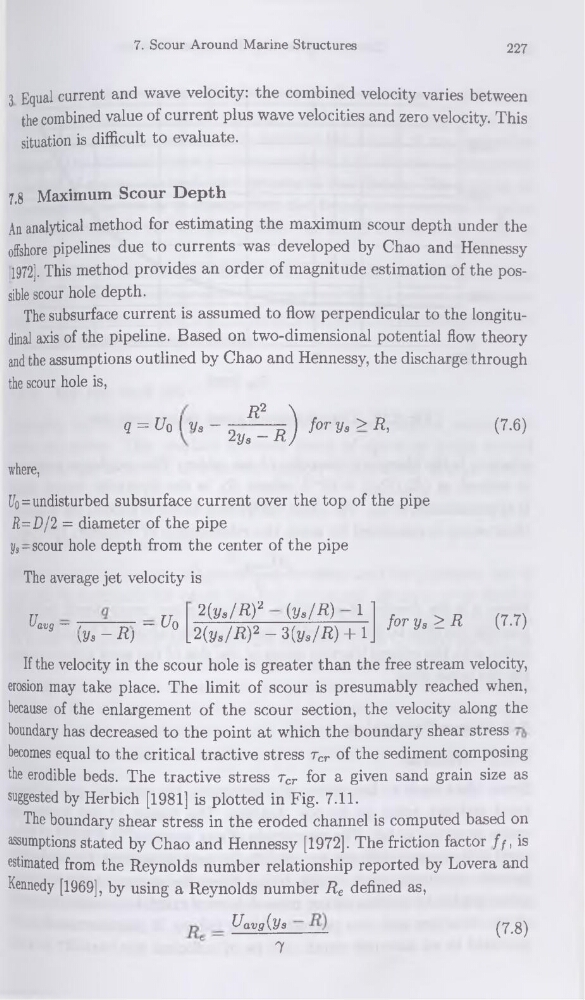
q = Uo h/5 -
R2 \
2ys - r) for ys > R,
(7-6)
where,
Uo = undisturbed subsurface current over the top of the pipe
R=£)/2 = diameter of the pipe
ys- scour hole depth from the center of the pipe
The average jet velocity is
Uavg — , _
—■ Uq
\Vs R)
2(Ub/R')2 (.Vi/R') 1 1 . > R n «
kw-sM+d Smy‘-R (7J)
If the velocity in the scour hole is greater than the free stream velocity,
érosion may take place. The limit of scour is presumably reached when,
because of the enlargement of the scour section, the velocity along the
boundary has decreased to the point at which the boundary shear stress
becomes equal to the critical tractive stress rcr of the sédiment composing
the erodible beds. The tractive stress rcr for a given sand grain size as
suggested by Herbich [1981] is plotted in Fig. 7.11.
The boundary shear stress in the eroded channel is computed based on
assumptions stated by Chao and Hennessy [1972]. The friction factor f f, is
estimated from the Reynolds number relationship reported by Lovera and
Kennedy [1969], by using a Reynolds number Re defined as,
UgygÇys
y
(7-8)
227
3 Equal current and wave velocity: the combined velocity varies between
the combined value of current plus wave velocities and zéro velocity. This
situation is difficult to evaluate.
7.8 Maximum Scour Depth
An analytical method for estimating the maximum scour depth under the
offshore pipelines due to currents was developed by Chao and Hennessy
1972]. This method provides an order of magnitude estimation of the possible scour hole depth.
The subsurface current is assumed to flow perpendicular to the longitudinal axis of the pipeline. Based on two-dimensional potential flow theory
and the assumptions outlined by Chao and Hennessy, the discharge through
the scour hole is,
q = Uo h/5 -
R2 \
2ys - r) for ys > R,
(7-6)
where,
Uo = undisturbed subsurface current over the top of the pipe
R=£)/2 = diameter of the pipe
ys- scour hole depth from the center of the pipe
The average jet velocity is
Uavg — , _
—■ Uq
\Vs R)
2(Ub/R')2 (.Vi/R') 1 1 . > R n «
kw-sM+d Smy‘-R (7J)
If the velocity in the scour hole is greater than the free stream velocity,
érosion may take place. The limit of scour is presumably reached when,
because of the enlargement of the scour section, the velocity along the
boundary has decreased to the point at which the boundary shear stress
becomes equal to the critical tractive stress rcr of the sédiment composing
the erodible beds. The tractive stress rcr for a given sand grain size as
suggested by Herbich [1981] is plotted in Fig. 7.11.
The boundary shear stress in the eroded channel is computed based on
assumptions stated by Chao and Hennessy [1972]. The friction factor f f, is
estimated from the Reynolds number relationship reported by Lovera and
Kennedy [1969], by using a Reynolds number Re defined as,
UgygÇys
y
(7-8)