

228
Coastal Engineering: Theory and Practice
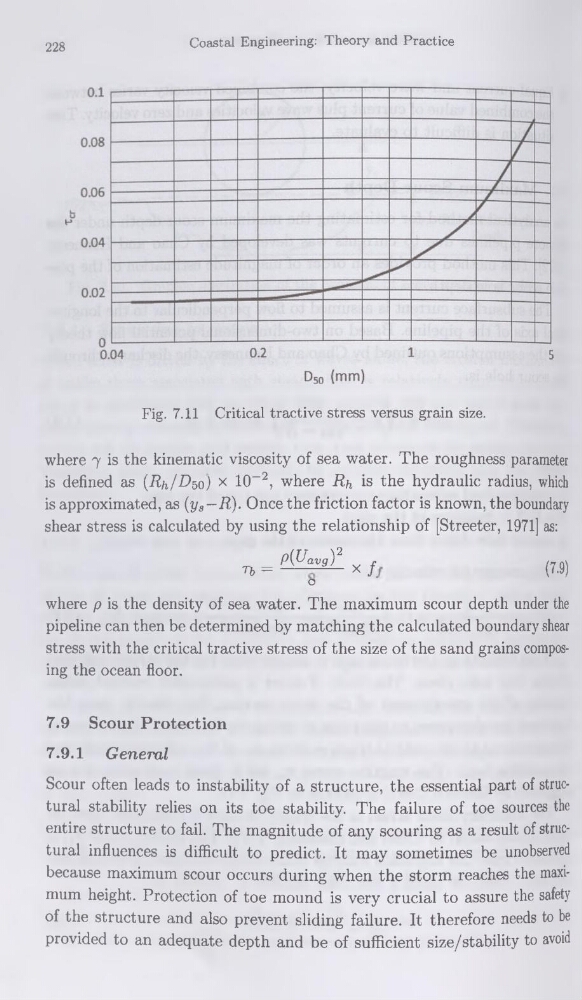
Fig. 7.11 Critical tractive stress versus grain size.
where 7 is the kinematic viscosity of sea water. The roughness parameter
is defined as (Rh/Dm) x 10“2, where Rh is the hydraulic radius, which
is approximated, as (ys-R). Once the friction factor is known, the boundary
shear stress is calculated by using the relationship of [Streeter, 1971] as:
Tb = dtMl x f
(M)
O
where p is the density of sea water. The maximum scour depth under the
pipeline can then be determined by matching the calculated boundary shear
stress with the critical tractive stress of the size of the sand grains composing the océan floor.
7.9 Scour Protection
7.9.1 General
Scour often leads to instability of a structure, the essential part of structural stability relies on its toe stability. The failure of toe sources the
entire structure to fail. The magnitude of any scouring as a resuit of structural influences is difficult to predict. It may sometimes be unobserved
because maximum scour occurs during when the storm reaches the maximum height. Protection of toe mound is very crucial to assure the safety
of the structure and also prevent sliding failure. It therefore needs to be
provided to an adéquate depth and be of sufficient size/stability to avoid
Coastal Engineering: Theory and Practice
Fig. 7.11 Critical tractive stress versus grain size.
where 7 is the kinematic viscosity of sea water. The roughness parameter
is defined as (Rh/Dm) x 10“2, where Rh is the hydraulic radius, which
is approximated, as (ys-R). Once the friction factor is known, the boundary
shear stress is calculated by using the relationship of [Streeter, 1971] as:
Tb = dtMl x f
(M)
O
where p is the density of sea water. The maximum scour depth under the
pipeline can then be determined by matching the calculated boundary shear
stress with the critical tractive stress of the size of the sand grains composing the océan floor.
7.9 Scour Protection
7.9.1 General
Scour often leads to instability of a structure, the essential part of structural stability relies on its toe stability. The failure of toe sources the
entire structure to fail. The magnitude of any scouring as a resuit of structural influences is difficult to predict. It may sometimes be unobserved
because maximum scour occurs during when the storm reaches the maximum height. Protection of toe mound is very crucial to assure the safety
of the structure and also prevent sliding failure. It therefore needs to be
provided to an adéquate depth and be of sufficient size/stability to avoid