

226
Coastal Engineering: Theory and Practice
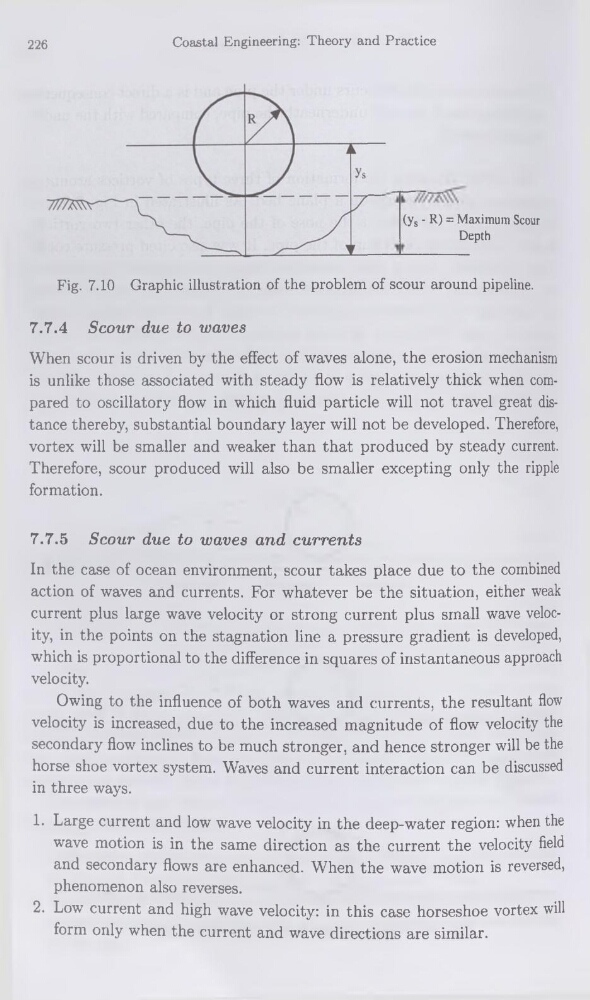
(ys - R) = Maximum Scour
Depth
Fig. 7.10 Graphie illustration of the problem of scour around pipeline.
7.7.4 Scour due to waves
When scour is driven by the effect of waves alone, the érosion mechanism
is unlike those associated with steady flow is relatively thick when compared to oscillatory flow in which fluid particle will not travel great distance thereby, substantial boundary layer will not be developed. Therefore,
vortex will be smaller and weaker than that produced by steady current.
Therefore, scour produced will also be smaller excepting only the ripple
formation.
7.7.5 Scour due to waves and currents
In the case of océan environment, scour takes place due to the combined
action of waves and currents. For whatever be the situation, either weak
current plus large wave velocity or strong current plus small wave velocity, in the points on the stagnation line a pressure gradient is developed,
which is proportional to the différence in squares of instantaneous approach
velocity.
Owing to the influence of both waves and currents, the résultant flow
velocity is increased, due to the increased magnitude of flow velocity the
second ary flow inclines to be much stronger, and hence stronger will be the
horse shoe vortex System. Waves and current interaction can be discussed
in three ways.
1. Large current and low wave velocity in the deep-water région: when the
wave motion is in the same direction as the current the velocity field
and secondary flows are enhanced. When the wave motion is reversed,
phenomenon also reverses.
2. Low current and high wave velocity: in this case horseshoe vortex will
form only when the current and wave directions are similar.
Coastal Engineering: Theory and Practice
(ys - R) = Maximum Scour
Depth
Fig. 7.10 Graphie illustration of the problem of scour around pipeline.
7.7.4 Scour due to waves
When scour is driven by the effect of waves alone, the érosion mechanism
is unlike those associated with steady flow is relatively thick when compared to oscillatory flow in which fluid particle will not travel great distance thereby, substantial boundary layer will not be developed. Therefore,
vortex will be smaller and weaker than that produced by steady current.
Therefore, scour produced will also be smaller excepting only the ripple
formation.
7.7.5 Scour due to waves and currents
In the case of océan environment, scour takes place due to the combined
action of waves and currents. For whatever be the situation, either weak
current plus large wave velocity or strong current plus small wave velocity, in the points on the stagnation line a pressure gradient is developed,
which is proportional to the différence in squares of instantaneous approach
velocity.
Owing to the influence of both waves and currents, the résultant flow
velocity is increased, due to the increased magnitude of flow velocity the
second ary flow inclines to be much stronger, and hence stronger will be the
horse shoe vortex System. Waves and current interaction can be discussed
in three ways.
1. Large current and low wave velocity in the deep-water région: when the
wave motion is in the same direction as the current the velocity field
and secondary flows are enhanced. When the wave motion is reversed,
phenomenon also reverses.
2. Low current and high wave velocity: in this case horseshoe vortex will
form only when the current and wave directions are similar.