

222
Coastal Engineering: Theory and Practice
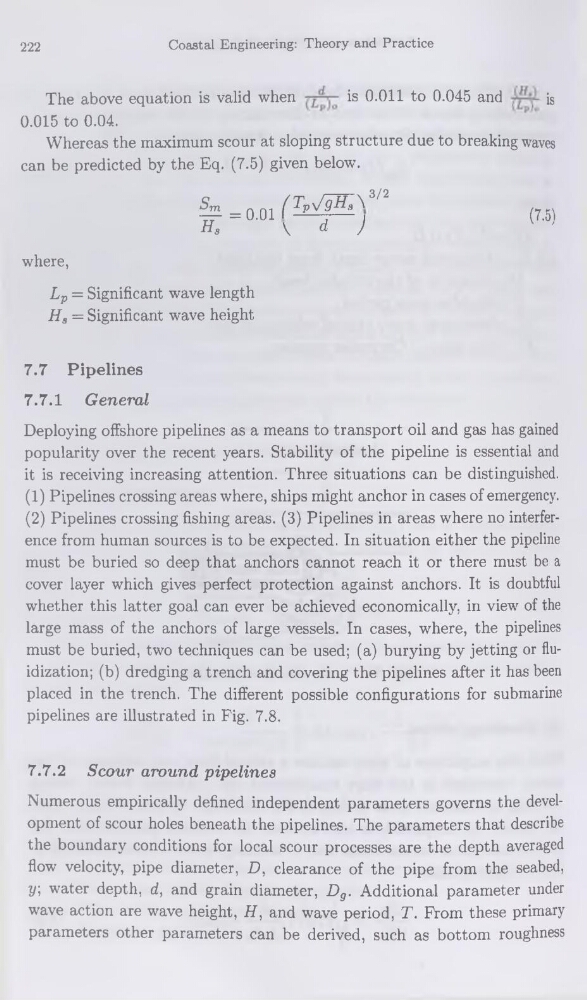
The above équation is valid when
is 0.011 to 0.045 and
is
0.015 to 0.04.
Whereas the maximum scour at sloping structure due to breaking waves
can be predicted by the Eq. (7.5) given below.
^2- = 0.01
Hs
(TEV]fâ\3/2
\
d
J
(7.5)
where,
Lp = Significant wave length
Hs = Significant wave height
7.7 Pipelines
7.7.1 General
Deploying offshore pipelines as a means to transport oil and gas has gained
popularity over the recent years. Stability of the pipeline is essential and
it is receiving increasing attention. Three situations can be distinguished.
(1) Pipelines Crossing areas where, ships might anchor in cases of emergency.
(2) Pipelines Crossing fishing areas. (3) Pipelines in areas where no interférence from human sources is to be expected. In situation either the pipeline
must be buried so deep that anchors cannot reach it or there must be a
cover layer which gives perfect protection against anchors. It is doubtful
whether this latter goal can ever be achieved economically, in view of the
large mass of the anchors of large vessels. In cases, where, the pipelines
must be buried, two techniques can be used; (a) burying by jetting or fluidization; (b) dredging a trench and covering the pipelines after it has been
placed in the trench. The different possible configurations for submarine
pipelines are illustrated in Fig. 7.8.
7.7.2 Scour around pipelines
Numerous empirically defined independent parameters governs the development of scour holes beneath the pipelines. The parameters that describe
the boundary conditions for local scour processes are the depth averaged
flow velocity, pipe diameter, D, clearance of the pipe from the seabed,
y; water depth, d, and grain diameter, Dg. Additional parameter under
wave action are wave height, H, and wave period, T. From these primary
parameters other parameters can be derived, such as bottom roughness
Coastal Engineering: Theory and Practice
The above équation is valid when
is 0.011 to 0.045 and
is
0.015 to 0.04.
Whereas the maximum scour at sloping structure due to breaking waves
can be predicted by the Eq. (7.5) given below.
^2- = 0.01
Hs
(TEV]fâ\3/2
\
d
J
(7.5)
where,
Lp = Significant wave length
Hs = Significant wave height
7.7 Pipelines
7.7.1 General
Deploying offshore pipelines as a means to transport oil and gas has gained
popularity over the recent years. Stability of the pipeline is essential and
it is receiving increasing attention. Three situations can be distinguished.
(1) Pipelines Crossing areas where, ships might anchor in cases of emergency.
(2) Pipelines Crossing fishing areas. (3) Pipelines in areas where no interférence from human sources is to be expected. In situation either the pipeline
must be buried so deep that anchors cannot reach it or there must be a
cover layer which gives perfect protection against anchors. It is doubtful
whether this latter goal can ever be achieved economically, in view of the
large mass of the anchors of large vessels. In cases, where, the pipelines
must be buried, two techniques can be used; (a) burying by jetting or fluidization; (b) dredging a trench and covering the pipelines after it has been
placed in the trench. The different possible configurations for submarine
pipelines are illustrated in Fig. 7.8.
7.7.2 Scour around pipelines
Numerous empirically defined independent parameters governs the development of scour holes beneath the pipelines. The parameters that describe
the boundary conditions for local scour processes are the depth averaged
flow velocity, pipe diameter, D, clearance of the pipe from the seabed,
y; water depth, d, and grain diameter, Dg. Additional parameter under
wave action are wave height, H, and wave period, T. From these primary
parameters other parameters can be derived, such as bottom roughness