

7. Scour Around Marine Structures
221
Similarlly, the maximum scour depth from the bed level (Sm) due to
non-breaking waves at the bed in the vicinity of the breakwater can be
predicted by establishing the maximum orbital velocity.
Sm/D = 0.5[l-e-0175<7fc-1)]
(7.3)
where,
KC=(UM/D
and Sm = Maximum scour depth from bed level
D = Diameter of the circular head
T = Regular wave period
Um = Maximum wave orbital velocity at bed
KC = Keulegan - Carpenter number
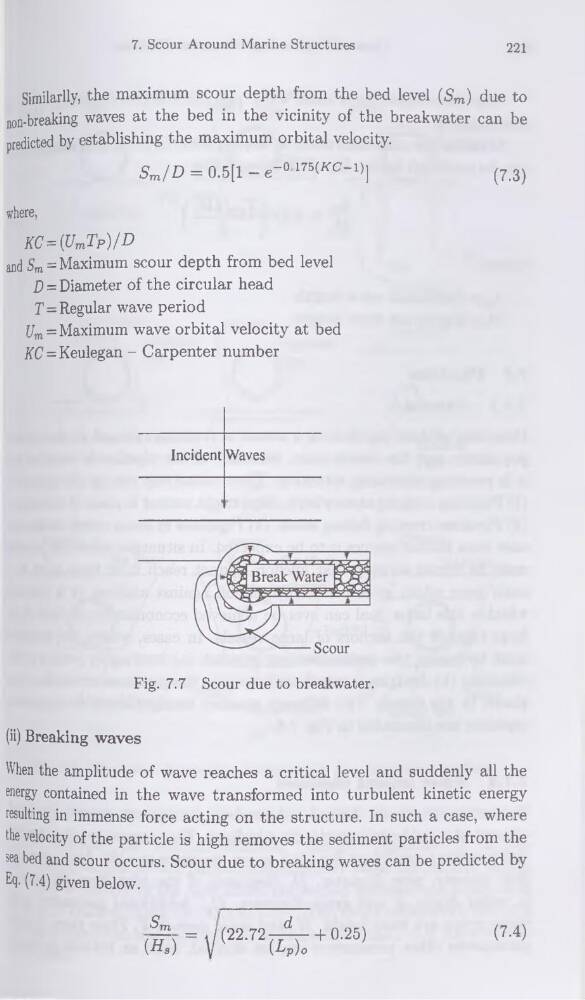
Incident Waves
Fig. 7.7 Scour due to breakwater.
(ii) Breaking waves
When the amplitude of wave reaches a critical level and suddenly ail the
energy contained in the wave transformed into turbulent kinetic energy
resulting in immense force acting on the structure. In such a case, where
the velocity of the particle is high removes the sédiment particles from the
sea bed and scour occurs. Scour due to breaking waves can be predicted by
Eq. (7.4) given below.
(t) = V(22-72(à+0'25)
(7.4)
221
Similarlly, the maximum scour depth from the bed level (Sm) due to
non-breaking waves at the bed in the vicinity of the breakwater can be
predicted by establishing the maximum orbital velocity.
Sm/D = 0.5[l-e-0175<7fc-1)]
(7.3)
where,
KC=(UM/D
and Sm = Maximum scour depth from bed level
D = Diameter of the circular head
T = Regular wave period
Um = Maximum wave orbital velocity at bed
KC = Keulegan - Carpenter number
Incident Waves
Fig. 7.7 Scour due to breakwater.
(ii) Breaking waves
When the amplitude of wave reaches a critical level and suddenly ail the
energy contained in the wave transformed into turbulent kinetic energy
resulting in immense force acting on the structure. In such a case, where
the velocity of the particle is high removes the sédiment particles from the
sea bed and scour occurs. Scour due to breaking waves can be predicted by
Eq. (7.4) given below.
(t) = V(22-72(à+0'25)
(7.4)