

220
Coastal Engineering: Theory and Practice
scour hole depth further aggravâtes in the development phase. The upper
part of the upstream slope is in approximate equilibrium and development
occurs beyond it, enlarging the hole while its shape remains approximately
constant. The development of the hole results in a progressive decay in
the velocity near the bed and rate of érosion. A near equilibrium State is
said to be achieved during the stabilisation phase, when the érosion rate is
small at the base of hole, although érosion continues at the more exposed
and vulnérable position near the top of downstream slope, which results in
lengthening of scour hole. In the equilibrium phase, the dimensions of the
scour hole are virtually fixed. In the case of structures such as piers and
piles, the scour hole usually originates along either sides of the structure and
at the points of maximum width maximum depth of scour hole is observed,
attributing to the high flow velocities. When the hole deepens further, they
increase in extent and (unless the structure is extremely wide) join to form
a single scour hole around the upstream end of the structure.
7.6 Scour Due to Vertical Walls
(i) Non-breaking waves
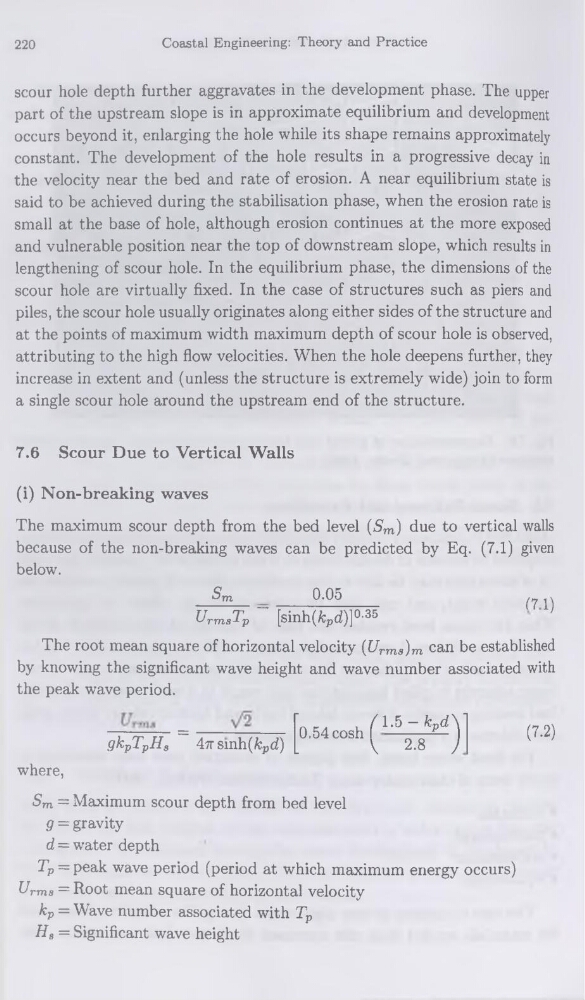
The maximum scour depth from the bed level (Sm) due to vertical walls
because of the non-breaking waves can be predicted by Eq. (7.1) given
below.
Sm
____ 0-05____
(71)
UrmsTp ~ [sinh(M)]0-35
'
The root mean square of horizontal velocity ((7rms)m can be established
by knowing the significant wave height and wave number associated with
the peak wave period.
-TVTF = T
,» [o.54cosh ( 1'5~M)1
(7-2)
gkpTpHa
4tt sinh(fcpd) | _
\
2.8
J
where,
Sm = Maximum scour depth from bed level
g = gravity
d = water depth
Tp = peak wave period (period at which maximum energy occurs)
Urms = Root mean square of horizontal velocity
kp = Wave number associated with Tp
Hs = Significant wave height
Coastal Engineering: Theory and Practice
scour hole depth further aggravâtes in the development phase. The upper
part of the upstream slope is in approximate equilibrium and development
occurs beyond it, enlarging the hole while its shape remains approximately
constant. The development of the hole results in a progressive decay in
the velocity near the bed and rate of érosion. A near equilibrium State is
said to be achieved during the stabilisation phase, when the érosion rate is
small at the base of hole, although érosion continues at the more exposed
and vulnérable position near the top of downstream slope, which results in
lengthening of scour hole. In the equilibrium phase, the dimensions of the
scour hole are virtually fixed. In the case of structures such as piers and
piles, the scour hole usually originates along either sides of the structure and
at the points of maximum width maximum depth of scour hole is observed,
attributing to the high flow velocities. When the hole deepens further, they
increase in extent and (unless the structure is extremely wide) join to form
a single scour hole around the upstream end of the structure.
7.6 Scour Due to Vertical Walls
(i) Non-breaking waves
The maximum scour depth from the bed level (Sm) due to vertical walls
because of the non-breaking waves can be predicted by Eq. (7.1) given
below.
Sm
____ 0-05____
(71)
UrmsTp ~ [sinh(M)]0-35
'
The root mean square of horizontal velocity ((7rms)m can be established
by knowing the significant wave height and wave number associated with
the peak wave period.
-TVTF = T
,» [o.54cosh ( 1'5~M)1
(7-2)
gkpTpHa
4tt sinh(fcpd) | _
\
2.8
J
where,
Sm = Maximum scour depth from bed level
g = gravity
d = water depth
Tp = peak wave period (period at which maximum energy occurs)
Urms = Root mean square of horizontal velocity
kp = Wave number associated with Tp
Hs = Significant wave height