

7. Scour Around Marine Structures
219
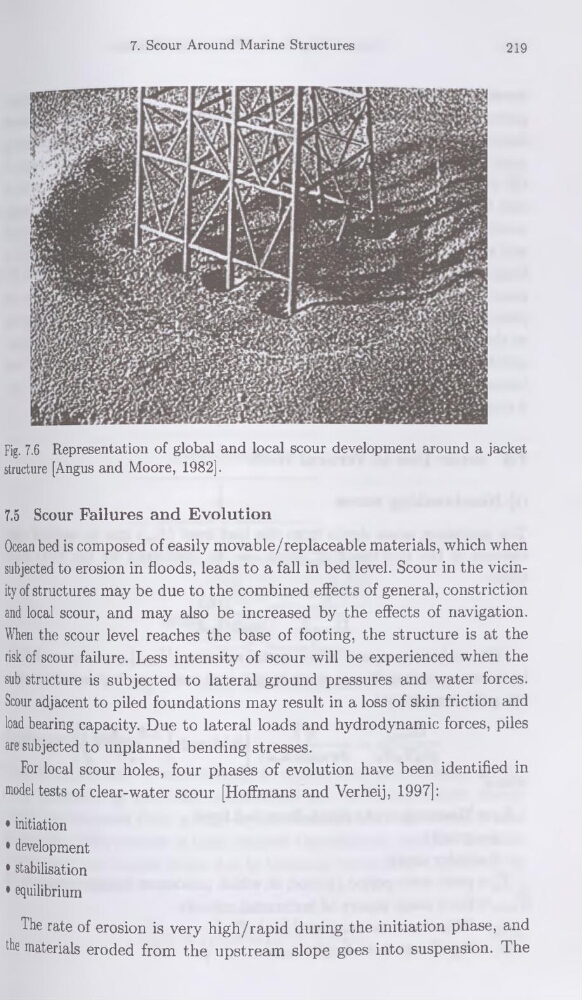
Fig. 7.6 Représentation of global and local scour development around a jacket
structure [Angus and Moore, 1982].
7.5 Scour Failures and Evolution
Océan bed is composed of easily movable/replaceable materials, which when
subjected to érosion in floods, leads to a fall in bed level. Scour in the vicinity of structures may be due to the combined effects of general, constriction
and local scour, and may also be increased by the effects of navigation.
When the scour level reaches the base of footing, the structure is at the
risk of scour failure. Less intensity of scour will be experienced when the
sub structure is subjected to latéral ground pressures and water forces.
Scour adjacent to piled foundations may resuit in a loss of skin friction and
load bearing capacity. Due to latéral loads and hydrodynamic forces, piles
are subjected to unplanned bending stresses.
For local scour holes, four phases of évolution hâve been identified in
model tests of clear-water scour [Hoffmans and Verheij, 1997]:
• initiation
• development
• stabilisation
• equilibrium
The rate of érosion is very high/rapid during the initiation phase, and
the materials eroded from the upstream slope goes into suspension. The
219
Fig. 7.6 Représentation of global and local scour development around a jacket
structure [Angus and Moore, 1982].
7.5 Scour Failures and Evolution
Océan bed is composed of easily movable/replaceable materials, which when
subjected to érosion in floods, leads to a fall in bed level. Scour in the vicinity of structures may be due to the combined effects of general, constriction
and local scour, and may also be increased by the effects of navigation.
When the scour level reaches the base of footing, the structure is at the
risk of scour failure. Less intensity of scour will be experienced when the
sub structure is subjected to latéral ground pressures and water forces.
Scour adjacent to piled foundations may resuit in a loss of skin friction and
load bearing capacity. Due to latéral loads and hydrodynamic forces, piles
are subjected to unplanned bending stresses.
For local scour holes, four phases of évolution hâve been identified in
model tests of clear-water scour [Hoffmans and Verheij, 1997]:
• initiation
• development
• stabilisation
• equilibrium
The rate of érosion is very high/rapid during the initiation phase, and
the materials eroded from the upstream slope goes into suspension. The