

Particle Fluxes at the Edge of the Ross Ice Shelf: the Rôle of Physical Forcing
183
Température, div=0.05 °C
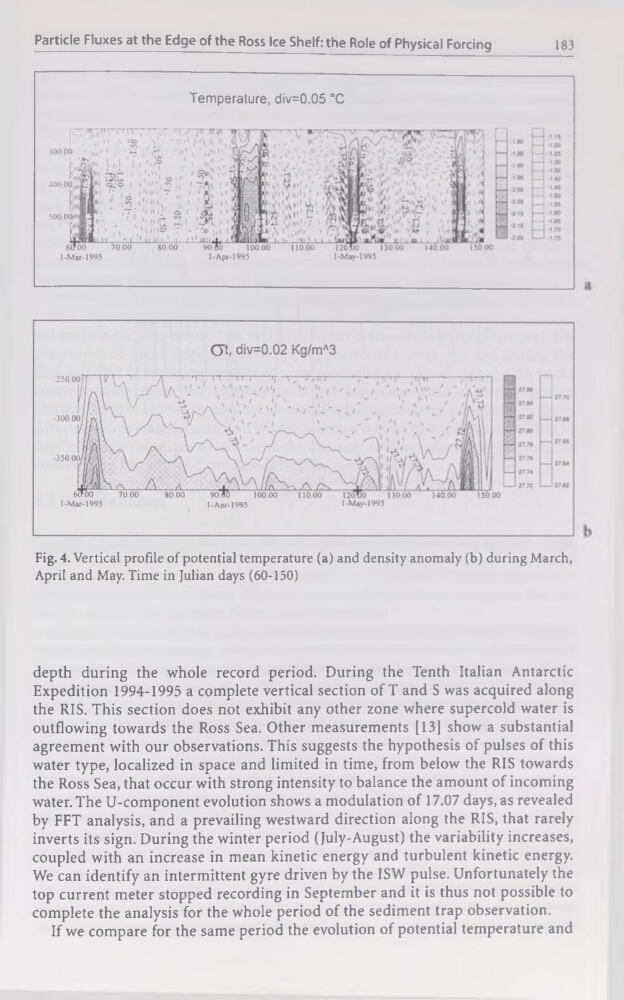
Fig. 4. Vertical profile of potential température (a) and density anomaly (b) during March,
April and May. Time in Julian days (60-150)
depth during the whole record period. During the Tenth Italian Antarctic
Expédition 1994-1995 a complété vertical section of T and S was acquired along
the RIS. This section does not exhibit any other zone where supercold water is
outflowing towards the Ross Sea. Other measurements [13] show a substantial
agreement with our observations. This suggests the hypothesis of puises of this
water type, localized in space and limited in time, from below the RIS towards
the Ross Sea, that occur with strong intensity to balance the amount of incoming
water. The U-component évolution shows a modulation of 17.07 days, as revealed
by FFT analysis, and a prevailing westward direction along the RIS, that rarely
inverts its sign. During the winter period (July-August) the variability increases,
coupled with an increase in mean kinetic energy and turbulent kinetic energy.
We can identify an intermittent gyre driven by the ISW puise. Unfortunately the
top current meter stopped recording in September and it is thus not possible to
complété the analysis for the whole period of the sédiment trap observation.
If we compare for the same period the évolution of potential température and
183
Température, div=0.05 °C
Fig. 4. Vertical profile of potential température (a) and density anomaly (b) during March,
April and May. Time in Julian days (60-150)
depth during the whole record period. During the Tenth Italian Antarctic
Expédition 1994-1995 a complété vertical section of T and S was acquired along
the RIS. This section does not exhibit any other zone where supercold water is
outflowing towards the Ross Sea. Other measurements [13] show a substantial
agreement with our observations. This suggests the hypothesis of puises of this
water type, localized in space and limited in time, from below the RIS towards
the Ross Sea, that occur with strong intensity to balance the amount of incoming
water. The U-component évolution shows a modulation of 17.07 days, as revealed
by FFT analysis, and a prevailing westward direction along the RIS, that rarely
inverts its sign. During the winter period (July-August) the variability increases,
coupled with an increase in mean kinetic energy and turbulent kinetic energy.
We can identify an intermittent gyre driven by the ISW puise. Unfortunately the
top current meter stopped recording in September and it is thus not possible to
complété the analysis for the whole period of the sédiment trap observation.
If we compare for the same period the évolution of potential température and