

Temporal Variability of Currents in the Ross Sea (Antarctica)
111
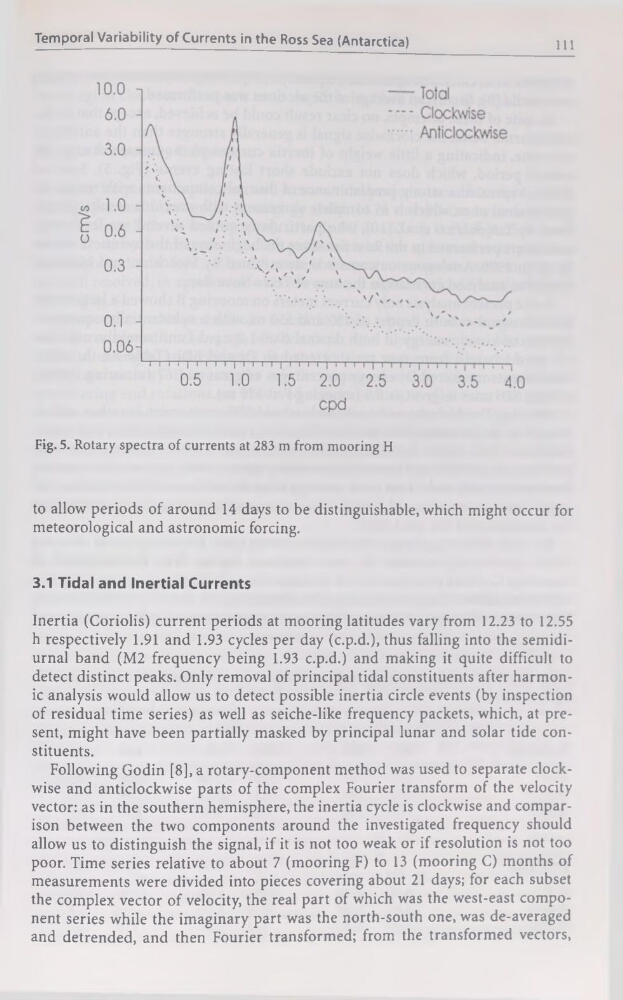
Fig. 5. Rotary spectra of currents at 283 m from mooring H
to allow periods of around 14 days to be distinguishable, which might occur for
meteorological and astronomie forcing.
3.1 Tidal and Inertial Currents
Inertia (Coriolis) current periods at mooring latitudes vary from 12.23 to 12.55
h respectively 1.91 and 1.93 cycles per day (c.p.d.), thus falling into the semidiurnal band (M2 frequency being 1.93 c.p.d.) and making it quite difficult to
detect distinct peaks. Only removal of principal tidal constituents after harmonie analysis would allow us to detect possible inertia circle events (by inspection
of residual time sériés) as well as seiche-like frequency packets, which, at présent, might hâve been partially masked by principal lunar and solar tide constituents.
Following Godin [8], a rotary-component method was used to separate clockwise and anticlockwise parts of the complex Fourier transform of the velocity
vector: as in the Southern hemisphere, the inertia cycle is clockwise and comparison between the two components around the investigated frequency should
allow us to distinguish the signal, if it is not too weak or if resolution is not too
poor. Time sériés relative to about 7 (mooring F) to 13 (mooring C) months of
measurements were divided into pièces covering about 21 days; for each subset
the complex vector of velocity, the real part of which was the west-east component sériés while the imaginary part was the north-south one, was de-averaged
and detrended, and then Fourier transformed; from the transformed vectors,
111
Fig. 5. Rotary spectra of currents at 283 m from mooring H
to allow periods of around 14 days to be distinguishable, which might occur for
meteorological and astronomie forcing.
3.1 Tidal and Inertial Currents
Inertia (Coriolis) current periods at mooring latitudes vary from 12.23 to 12.55
h respectively 1.91 and 1.93 cycles per day (c.p.d.), thus falling into the semidiurnal band (M2 frequency being 1.93 c.p.d.) and making it quite difficult to
detect distinct peaks. Only removal of principal tidal constituents after harmonie analysis would allow us to detect possible inertia circle events (by inspection
of residual time sériés) as well as seiche-like frequency packets, which, at présent, might hâve been partially masked by principal lunar and solar tide constituents.
Following Godin [8], a rotary-component method was used to separate clockwise and anticlockwise parts of the complex Fourier transform of the velocity
vector: as in the Southern hemisphere, the inertia cycle is clockwise and comparison between the two components around the investigated frequency should
allow us to distinguish the signal, if it is not too weak or if resolution is not too
poor. Time sériés relative to about 7 (mooring F) to 13 (mooring C) months of
measurements were divided into pièces covering about 21 days; for each subset
the complex vector of velocity, the real part of which was the west-east component sériés while the imaginary part was the north-south one, was de-averaged
and detrended, and then Fourier transformed; from the transformed vectors,