

The Large-Scale Thermohaline Structure of the Ross Gyre
95
6.2 Eastern Boundary
Comparing the circulation patterns at different levels and surfaces with the bottom topography of the study area suggests a close link between the bottom topography and the eastward extension of the Ross Gyre. The situation particularly
comparable with the eastern Ross Gyre is found in the Atlantic sector of the
Southern Océan where the ACC crosses the Southwest Indian Ridge. Here, the
ACC core associated with the Antarctic Polar Front flows through a gap near 25 °E
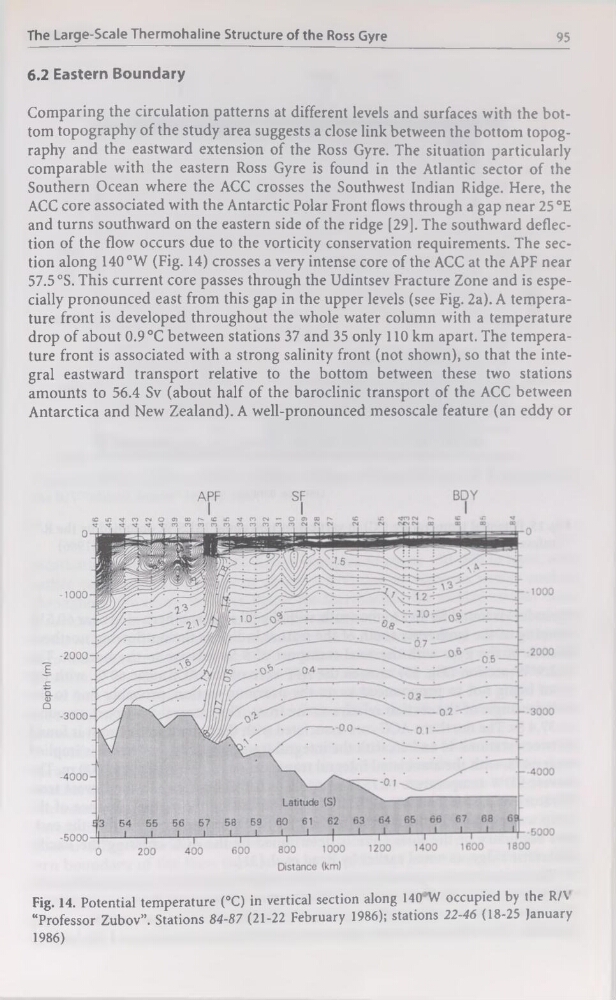
and turns southward on the eastern side of the ridge [29]. The southward deflection of the flow occurs due to the vorticity conservation requirements. The section along 140 °W (Fig. 14) crosses a very intense core of the ACC at the APF near
57.5 °S. This current core passes through the Udintsev Fracture Zone and is especially pronounced east from this gap in the upper levels (see Fig. 2a). A température front is developed throughout the whole water column with a température
drop of about 0.9 °C between stations 37 and 35 only 110 km apart. The température front is associated with a strong salinity front (not shown), so that the intégral eastward transport relative to the bottom between these two stations
amounts to 56.4 Sv (about half of the baroclinie transport of the ACC between
Antarctica and New Zealand). A well-pronounced mesoscale feature (an eddy or
Fig. 14. Potential température (°C) in vertical section along 140 W occupied by the R/\
“Professer Zubov”. Stations 84-87 (21-22 February 1986); stations 22-46 (18-25 January
1986)
95
6.2 Eastern Boundary
Comparing the circulation patterns at different levels and surfaces with the bottom topography of the study area suggests a close link between the bottom topography and the eastward extension of the Ross Gyre. The situation particularly
comparable with the eastern Ross Gyre is found in the Atlantic sector of the
Southern Océan where the ACC crosses the Southwest Indian Ridge. Here, the
ACC core associated with the Antarctic Polar Front flows through a gap near 25 °E
and turns southward on the eastern side of the ridge [29]. The southward deflection of the flow occurs due to the vorticity conservation requirements. The section along 140 °W (Fig. 14) crosses a very intense core of the ACC at the APF near
57.5 °S. This current core passes through the Udintsev Fracture Zone and is especially pronounced east from this gap in the upper levels (see Fig. 2a). A température front is developed throughout the whole water column with a température
drop of about 0.9 °C between stations 37 and 35 only 110 km apart. The température front is associated with a strong salinity front (not shown), so that the intégral eastward transport relative to the bottom between these two stations
amounts to 56.4 Sv (about half of the baroclinie transport of the ACC between
Antarctica and New Zealand). A well-pronounced mesoscale feature (an eddy or
Fig. 14. Potential température (°C) in vertical section along 140 W occupied by the R/\
“Professer Zubov”. Stations 84-87 (21-22 February 1986); stations 22-46 (18-25 January
1986)