

94
V. Gouretski
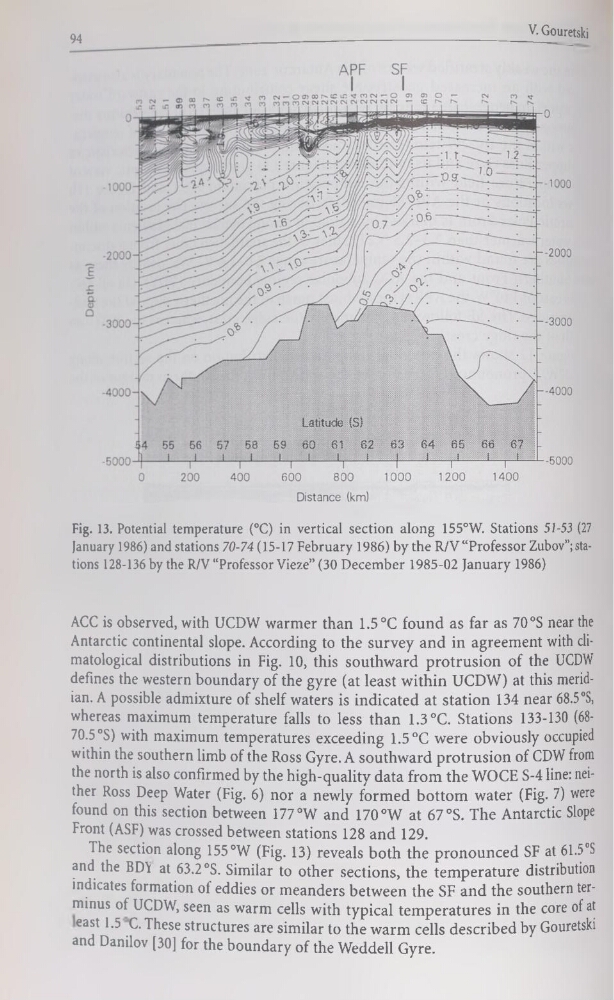
Fig. 13. Potential température (°C) in vertical section along 155°W. Stations 51-53 (27
January 1986) and stations 70-74 (15-17 February 1986) by the R/V“Professor Zubov”;stations 128-136 by the R/V “Professer Vieze” (30 December 1985-02 January 1986)
ACC is observed, with UCDW warmer than 1.5°C found as far as 70°S near the
Antarctic continental slope. According to the survey and in agreement with climatological distributions in Fig. 10, this southward protrusion of the UCDW
defines the western boundary of the gyre (at least within UCDW) at this meridian. A possible admixture of shelf waters is indicated at station 134 near 68.5 °S,
whereas maximum température falls to less than 1.3 °C. Stations 133-130 (6870.5 °S) with maximum températures exceeding 1.5 °C were obviously occupied
within the Southern limb of the Ross Gyre. A southward protrusion of CDW from
the north is also confirmed by the high-quality data from the WOCE S-4 line: neither Ross Deep Water (Fig. 6) nor a newly formed bottom water (Fig. 7) were
found on this section between 177 °W and 170°W at 67 °S. The Antarctic Slope
Front (ASF) was crossed between stations 128 and 129.
The section along 155°W (Fig. 13) reveals both the pronounced SF at 61.5°S
and the B DI at 63.2 °S. Similar to other sections, the température distribution
indicates formation of eddies or meanders between the SF and the Southern terminus of UCDW, seen as warm cells with typical températures in the core of at
east 1.5 G. These structures are similar to the warm cells described by Gouretski
and Danilov [30] for the boundary of the Weddell Gyre.
V. Gouretski
Fig. 13. Potential température (°C) in vertical section along 155°W. Stations 51-53 (27
January 1986) and stations 70-74 (15-17 February 1986) by the R/V“Professor Zubov”;stations 128-136 by the R/V “Professer Vieze” (30 December 1985-02 January 1986)
ACC is observed, with UCDW warmer than 1.5°C found as far as 70°S near the
Antarctic continental slope. According to the survey and in agreement with climatological distributions in Fig. 10, this southward protrusion of the UCDW
defines the western boundary of the gyre (at least within UCDW) at this meridian. A possible admixture of shelf waters is indicated at station 134 near 68.5 °S,
whereas maximum température falls to less than 1.3 °C. Stations 133-130 (6870.5 °S) with maximum températures exceeding 1.5 °C were obviously occupied
within the Southern limb of the Ross Gyre. A southward protrusion of CDW from
the north is also confirmed by the high-quality data from the WOCE S-4 line: neither Ross Deep Water (Fig. 6) nor a newly formed bottom water (Fig. 7) were
found on this section between 177 °W and 170°W at 67 °S. The Antarctic Slope
Front (ASF) was crossed between stations 128 and 129.
The section along 155°W (Fig. 13) reveals both the pronounced SF at 61.5°S
and the B DI at 63.2 °S. Similar to other sections, the température distribution
indicates formation of eddies or meanders between the SF and the Southern terminus of UCDW, seen as warm cells with typical températures in the core of at
east 1.5 G. These structures are similar to the warm cells described by Gouretski
and Danilov [30] for the boundary of the Weddell Gyre.