

The Large-Scale Thermohaline Structure of the Ross Gyre
89
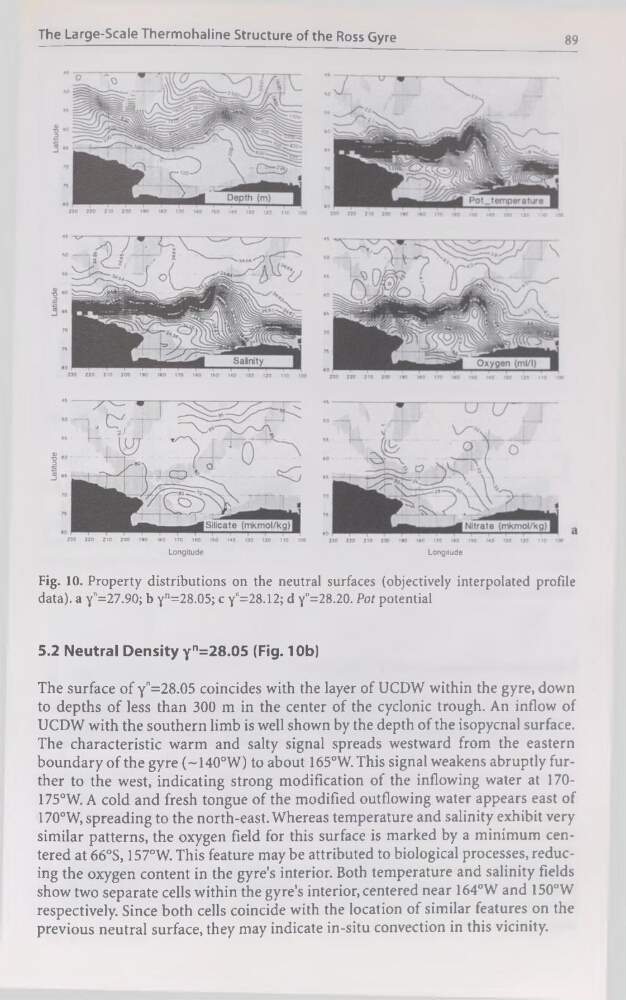
Fig. 10. Property distributions on the neutral surfaces (objectively interpolated profile
data), a y"=27.90; b yn=28.05; c yn=28.12; d y"=28.20. Pot potential
Longitude
5.2 Neutral Density yn=28.05 (Fig. 10b)
The surface of yn=28.05 coïncides with the layer of UCDW within the gyre, down
to depths of less than 300 m in the center of the cyclonic trough. An inflow of
UCDW with the Southern limb is well shown by the depth of the isopycnal surface.
The characteristic warm and salty signal spreads westward from the eastern
boundary of the gyre (~140°W) to about 165°W. This signal weakens abruptly further to the west, indicating strong modification of the inflowing water at 170175°W. A cold and fresh tongue of the modified outflowing water appears east of
170°W, spreading to the north-east. Whereas température and salinity exhibit very
similar patterns, the oxygen field for this surface is marked by a minimum centered at 66°S, 157°W. This feature may be attributed to biological processes, reducing the oxygen content in the gyre's interior. Both température and salinity fields
show two separate cells within the gyre's interior, centered near 164°W and 150°W
respectively. Since both cells coincide with the location of similar features on the
previous neutral surface, they may indicate in-situ convection in this vicinity.
89
Fig. 10. Property distributions on the neutral surfaces (objectively interpolated profile
data), a y"=27.90; b yn=28.05; c yn=28.12; d y"=28.20. Pot potential
Longitude
5.2 Neutral Density yn=28.05 (Fig. 10b)
The surface of yn=28.05 coïncides with the layer of UCDW within the gyre, down
to depths of less than 300 m in the center of the cyclonic trough. An inflow of
UCDW with the Southern limb is well shown by the depth of the isopycnal surface.
The characteristic warm and salty signal spreads westward from the eastern
boundary of the gyre (~140°W) to about 165°W. This signal weakens abruptly further to the west, indicating strong modification of the inflowing water at 170175°W. A cold and fresh tongue of the modified outflowing water appears east of
170°W, spreading to the north-east. Whereas température and salinity exhibit very
similar patterns, the oxygen field for this surface is marked by a minimum centered at 66°S, 157°W. This feature may be attributed to biological processes, reducing the oxygen content in the gyre's interior. Both température and salinity fields
show two separate cells within the gyre's interior, centered near 164°W and 150°W
respectively. Since both cells coincide with the location of similar features on the
previous neutral surface, they may indicate in-situ convection in this vicinity.