

Free surface flows 85
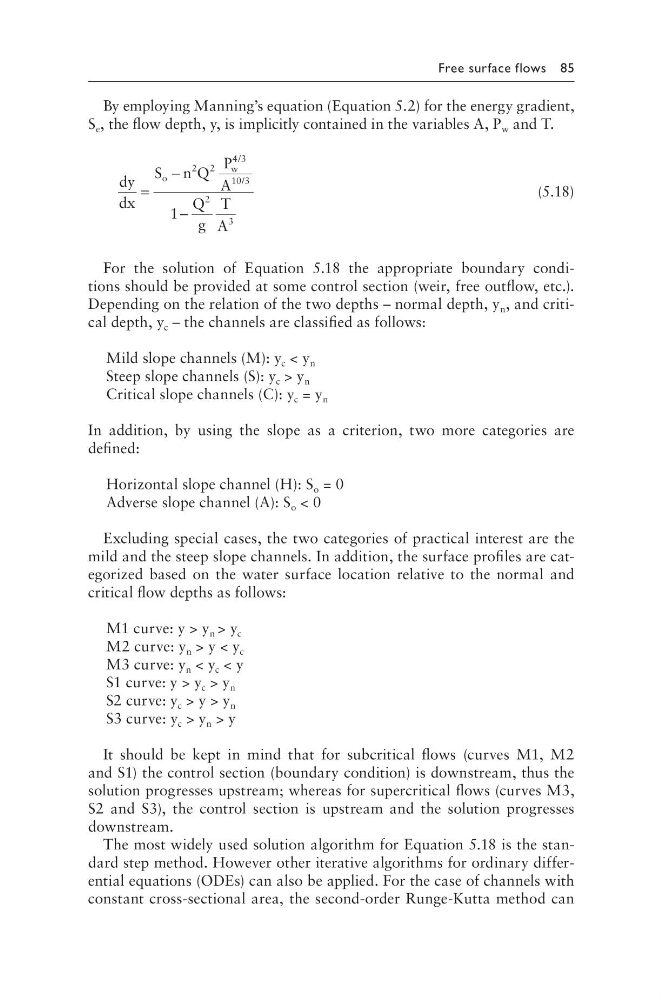
By employing Manning’s equation (Equation 5.2) for the energy gradient,
S e , the flow depth, y, is implicitly contained in the variables A, P w and T.
dy
dx
S n Q
P
A
Q
g
T
A
o
w
=
−
−
2 2
4 3
10 3
2
3
1
/
/
(5.18)
For the solution of Equation 5.18 the appropriate boundary conditions should be provided at some control section (weir, free outflow, etc.).
Depending on the relation of the two depths – normal depth, y n , and critical depth, y c – the channels are classified as follows:
Mild slope channels (M): y c < y n
Steep slope channels (S): y c > y n
Critical slope channels (C): y c = y n
In addition, by using the slope as a criterion, two more categories are
defined:
Horizontal slope channel (H): S o = 0
Adverse slope channel (A): S o < 0
Excluding special cases, the two categories of practical interest are the
mild and the steep slope channels. In addition, the surface profiles are categorized based on the water surface location relative to the normal and
critical flow depths as follows:
M1 curve: y > y n > y c
M2 curve: y n > y < y c
M3 curve: y n < y c < y
S1 curve: y > y c > y n
S2 curve: y c > y > y n
S3 curve: y c > y n > y
It should be kept in mind that for subcritical flows (curves M1, M2
and S1) the control section (boundary condition) is downstream, thus the
solution progresses upstream; whereas for supercritical flows (curves M3,
S2 and S3), the control section is upstream and the solution progresses
downstream.
The most widely used solution algorithm for Equation 5.18 is the standard step method. However other iterative algorithms for ordinary differential equations (ODEs) can also be applied. For the case of channels with
constant cross-sectional area, the second-order Runge-Kutta method can
By employing Manning’s equation (Equation 5.2) for the energy gradient,
S e , the flow depth, y, is implicitly contained in the variables A, P w and T.
dy
dx
S n Q
P
A
Q
g
T
A
o
w
=
−
−
2 2
4 3
10 3
2
3
1
/
/
(5.18)
For the solution of Equation 5.18 the appropriate boundary conditions should be provided at some control section (weir, free outflow, etc.).
Depending on the relation of the two depths – normal depth, y n , and critical depth, y c – the channels are classified as follows:
Mild slope channels (M): y c < y n
Steep slope channels (S): y c > y n
Critical slope channels (C): y c = y n
In addition, by using the slope as a criterion, two more categories are
defined:
Horizontal slope channel (H): S o = 0
Adverse slope channel (A): S o < 0
Excluding special cases, the two categories of practical interest are the
mild and the steep slope channels. In addition, the surface profiles are categorized based on the water surface location relative to the normal and
critical flow depths as follows:
M1 curve: y > y n > y c
M2 curve: y n > y < y c
M3 curve: y n < y c < y
S1 curve: y > y c > y n
S2 curve: y c > y > y n
S3 curve: y c > y n > y
It should be kept in mind that for subcritical flows (curves M1, M2
and S1) the control section (boundary condition) is downstream, thus the
solution progresses upstream; whereas for supercritical flows (curves M3,
S2 and S3), the control section is upstream and the solution progresses
downstream.
The most widely used solution algorithm for Equation 5.18 is the standard step method. However other iterative algorithms for ordinary differential equations (ODEs) can also be applied. For the case of channels with
constant cross-sectional area, the second-order Runge-Kutta method can