

Other numerical methods 279
9.4.1 Mathematical background
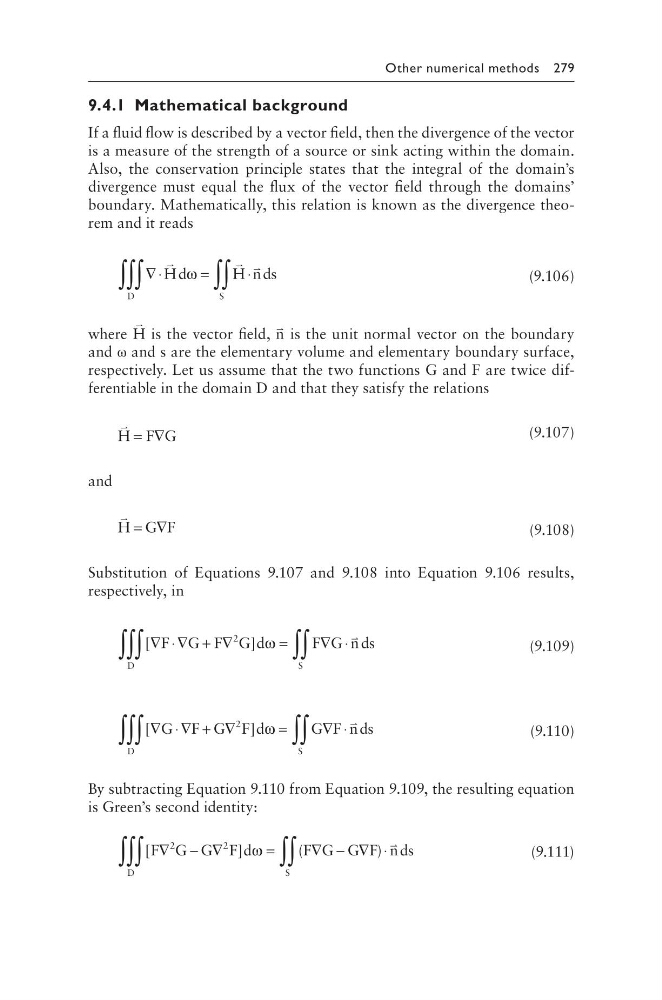
If a fluid flow is described by a vector field, then the divergence of the vector
is a measure of the strength of a source or sink acting within the domain.
Also, the conservation principle states that the integral of the domain’s
divergence must equal the flux of the vector field through the domains’
boundary. Mathematically, this relation is known as the divergence theorem and it reads
∇ ⋅
=
⋅
∫∫∫
∫∫
H d
H nds
D
S
ω
(9.106)
where
H is the vector field,
n is the unit normal vector on the boundary
and ω and s are the elementary volume and elementary boundary surface,
respectively. Let us assume that the two functions G and F are twice differentiable in the domain D and that they satisfy the relations
H F G
= ∇
(9.107)
and
H G F
= ∇
(9.108)
Substitution of Equations 9.107 and 9.108 into Equation 9.106 results,
respectively, in
[
]
∇ ⋅∇ + ∇
=
∇ ⋅
∫∫∫
∫∫
F G F G d
F G nds
D
S
2
ω
(9.109)
[
]
∇ ⋅∇ + ∇
=
∇ ⋅
∫∫∫
∫∫
G F G F d
G F nds
D
S
2
ω
(9.110)
By subtracting Equation 9.110 from Equation 9.109, the resulting equation
is Green’s second identity:
[
]
(
)
F G G F d
F G G F nds
D
S
∇ − ∇
=
∇ − ∇ ⋅
∫∫∫
∫∫
2
2
ω
(9.111)
9.4.1 Mathematical background
If a fluid flow is described by a vector field, then the divergence of the vector
is a measure of the strength of a source or sink acting within the domain.
Also, the conservation principle states that the integral of the domain’s
divergence must equal the flux of the vector field through the domains’
boundary. Mathematically, this relation is known as the divergence theorem and it reads
∇ ⋅
=
⋅
∫∫∫
∫∫
H d
H nds
D
S
ω
(9.106)
where
H is the vector field,
n is the unit normal vector on the boundary
and ω and s are the elementary volume and elementary boundary surface,
respectively. Let us assume that the two functions G and F are twice differentiable in the domain D and that they satisfy the relations
H F G
= ∇
(9.107)
and
H G F
= ∇
(9.108)
Substitution of Equations 9.107 and 9.108 into Equation 9.106 results,
respectively, in
[
]
∇ ⋅∇ + ∇
=
∇ ⋅
∫∫∫
∫∫
F G F G d
F G nds
D
S
2
ω
(9.109)
[
]
∇ ⋅∇ + ∇
=
∇ ⋅
∫∫∫
∫∫
G F G F d
G F nds
D
S
2
ω
(9.110)
By subtracting Equation 9.110 from Equation 9.109, the resulting equation
is Green’s second identity:
[
]
(
)
F G G F d
F G G F nds
D
S
∇ − ∇
=
∇ − ∇ ⋅
∫∫∫
∫∫
2
2
ω
(9.111)