

274 Computational Modelling in Hydraulic and Coastal Engineering
9.3.3.2 Saint-Venant system of equations
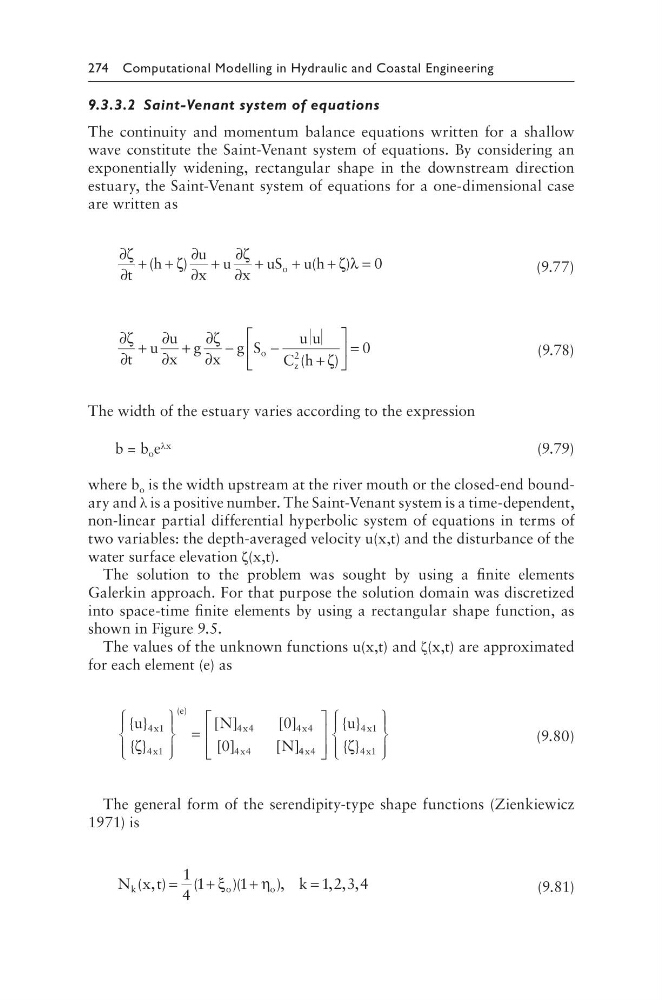
The continuity and momentum balance equations written for a shallow
wave constitute the Saint-Venant system of equations. By considering an
exponentially widening, rectangular shape in the downstream direction
estuary, the Saint-Venant system of equations for a one-dimensional case
are written as
∂
∂
+ +
∂
∂
+
∂
∂
+
+
+
=
ζ
ζ
ζ
ζ λ
t
h
u
x
u x
uS u h
o
(
)
(
)
0
(9.77)
∂
∂
+
∂
∂
+
∂
∂
−
−
+
=
ζ
ζ
ζ
t
u
u
x
g x
g S
u u
C h
o
z
2
0
(
)
(9.78)
The width of the estuary varies according to the expression
b = b o e λx
(9.79)
where b o is the width upstream at the river mouth or the closed-end boundary and λ is a positive number. The Saint-Venant system is a time- dependent,
non-linear partial differential hyperbolic system of equations in terms of
two variables: the depth-averaged velocity u(x,t) and the disturbance of the
water surface elevation ζ(x,t).
The solution to the problem was sought by using a finite elements
Galerkin approach. For that purpose the solution domain was discretized
into space-time finite elements by using a rectangular shape function, as
shown in Figure 9.5.
The values of the unknown functions u(x,t) and ζ(x,t) are approximated
for each element (e) as
{ }
{ }
[ ]
[ ]
[ ]
[ ]
( )
u
N
N
x
x
e
x
x
x
4 1
4 1
4 4
4 4
4 4
0
0
ζ
=
4 4 4
4 1
4 1
x
x
x
u
{ }
{ }
ζ
(9.80)
The general form of the serendipity-type shape functions (Zienkiewicz
1971) is
N x t
k
k
o
o
( , )
(
)(
),
, , ,
=
+
+
=
1
4
1
1
1 2 3 4
ξ
η
(9.81)
9.3.3.2 Saint-Venant system of equations
The continuity and momentum balance equations written for a shallow
wave constitute the Saint-Venant system of equations. By considering an
exponentially widening, rectangular shape in the downstream direction
estuary, the Saint-Venant system of equations for a one-dimensional case
are written as
∂
∂
+ +
∂
∂
+
∂
∂
+
+
+
=
ζ
ζ
ζ
ζ λ
t
h
u
x
u x
uS u h
o
(
)
(
)
0
(9.77)
∂
∂
+
∂
∂
+
∂
∂
−
−
+
=
ζ
ζ
ζ
t
u
u
x
g x
g S
u u
C h
o
z
2
0
(
)
(9.78)
The width of the estuary varies according to the expression
b = b o e λx
(9.79)
where b o is the width upstream at the river mouth or the closed-end boundary and λ is a positive number. The Saint-Venant system is a time- dependent,
non-linear partial differential hyperbolic system of equations in terms of
two variables: the depth-averaged velocity u(x,t) and the disturbance of the
water surface elevation ζ(x,t).
The solution to the problem was sought by using a finite elements
Galerkin approach. For that purpose the solution domain was discretized
into space-time finite elements by using a rectangular shape function, as
shown in Figure 9.5.
The values of the unknown functions u(x,t) and ζ(x,t) are approximated
for each element (e) as
{ }
{ }
[ ]
[ ]
[ ]
[ ]
( )
u
N
N
x
x
e
x
x
x
4 1
4 1
4 4
4 4
4 4
0
0
ζ
=
4 4 4
4 1
4 1
x
x
x
u
{ }
{ }
ζ
(9.80)
The general form of the serendipity-type shape functions (Zienkiewicz
1971) is
N x t
k
k
o
o
( , )
(
)(
),
, , ,
=
+
+
=
1
4
1
1
1 2 3 4
ξ
η
(9.81)