

Contaminant and sediment transport by advection and diffusion 247
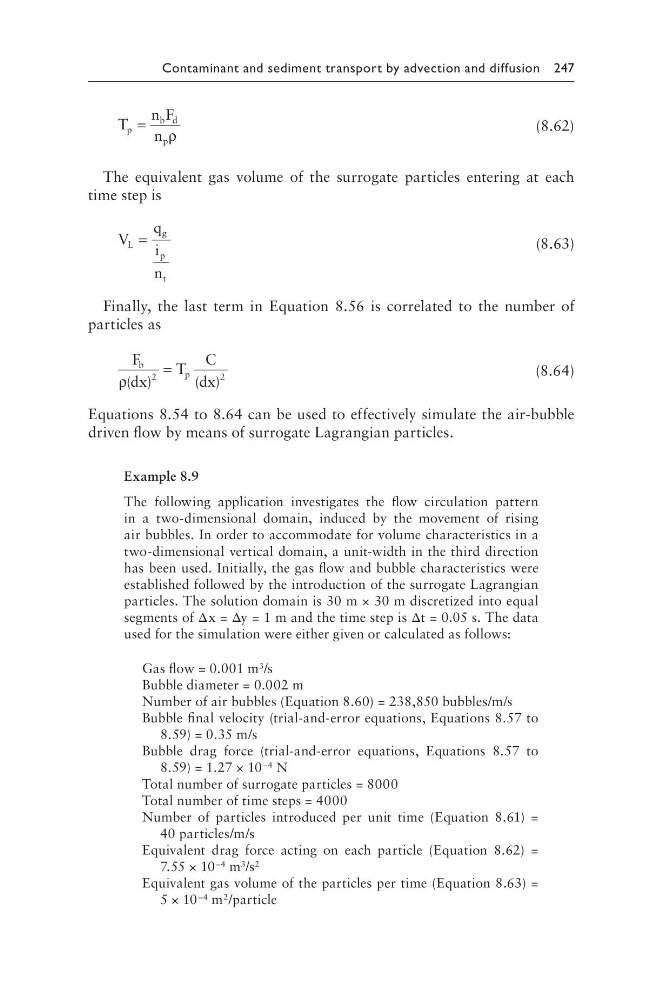
T
n F
n
p
b d
p
=
ρ
(8.62)
The equivalent gas volume of the surrogate particles entering at each
time step is
V
q
i
n
L
g
p
t
=
(8.63)
Finally, the last term in Equation 8.56 is correlated to the number of
particles as
F
dx
T
C
dx
b
p
ρ( )
( )
2
2
=
(8.64)
Equations 8.54 to 8.64 can be used to effectively simulate the air-bubble
driven flow by means of surrogate Lagrangian particles.
Example 8.9
The following application investigates the flow circulation pattern
in a two-dimensional domain, induced by the movement of rising
air bubbles. In order to accommodate for volume characteristics in a
two-dimensional vertical domain, a unit-width in the third direction
has been used. Initially, the gas flow and bubble characteristics were
established followed by the introduction of the surrogate Lagrangian
particles. The solution domain is 30 m × 30 m discretized into equal
segments of Δx = Δy = 1 m and the time step is Δt = 0.05 s. The data
used for the simulation were either given or calculated as follows:
Gas flow = 0.001 m 3 /s
Bubble diameter = 0.002 m
Number of air bubbles (Equation 8.60) = 238,850 bubbles/m/s
Bubble final velocity (trial-and-error equations, Equations 8.57 to
8.59) = 0.35 m/s
Bubble drag force (trial-and-error equations, Equations 8.57 to
8.59) = 1.27 × 10 –4 N
Total number of surrogate particles = 8000
Total number of time steps = 4000
Number of particles introduced per unit time (Equation 8.61) =
40 particles/m/s
Equivalent drag force acting on each particle (Equation 8.62) =
7.55 × 10 –4 m 3 /s 2
Equivalent gas volume of the particles per time (Equation 8.63) =
5 × 10 –4 m 2 /particle
T
n F
n
p
b d
p
=
ρ
(8.62)
The equivalent gas volume of the surrogate particles entering at each
time step is
V
q
i
n
L
g
p
t
=
(8.63)
Finally, the last term in Equation 8.56 is correlated to the number of
particles as
F
dx
T
C
dx
b
p
ρ( )
( )
2
2
=
(8.64)
Equations 8.54 to 8.64 can be used to effectively simulate the air-bubble
driven flow by means of surrogate Lagrangian particles.
Example 8.9
The following application investigates the flow circulation pattern
in a two-dimensional domain, induced by the movement of rising
air bubbles. In order to accommodate for volume characteristics in a
two-dimensional vertical domain, a unit-width in the third direction
has been used. Initially, the gas flow and bubble characteristics were
established followed by the introduction of the surrogate Lagrangian
particles. The solution domain is 30 m × 30 m discretized into equal
segments of Δx = Δy = 1 m and the time step is Δt = 0.05 s. The data
used for the simulation were either given or calculated as follows:
Gas flow = 0.001 m 3 /s
Bubble diameter = 0.002 m
Number of air bubbles (Equation 8.60) = 238,850 bubbles/m/s
Bubble final velocity (trial-and-error equations, Equations 8.57 to
8.59) = 0.35 m/s
Bubble drag force (trial-and-error equations, Equations 8.57 to
8.59) = 1.27 × 10 –4 N
Total number of surrogate particles = 8000
Total number of time steps = 4000
Number of particles introduced per unit time (Equation 8.61) =
40 particles/m/s
Equivalent drag force acting on each particle (Equation 8.62) =
7.55 × 10 –4 m 3 /s 2
Equivalent gas volume of the particles per time (Equation 8.63) =
5 × 10 –4 m 2 /particle