

246 Computational Modelling in Hydraulic and Coastal Engineering
Furthermore two of the remaining challenges are
1. To estimate the drag on each bubble and the vertical steady-state
buoyancy velocity
2. To correlate the drag force on each bubble to the force exercised by the
surrogate particle used in the simulation procedure to represent a number of air bubbles and to correlate such a particle with a gas volume
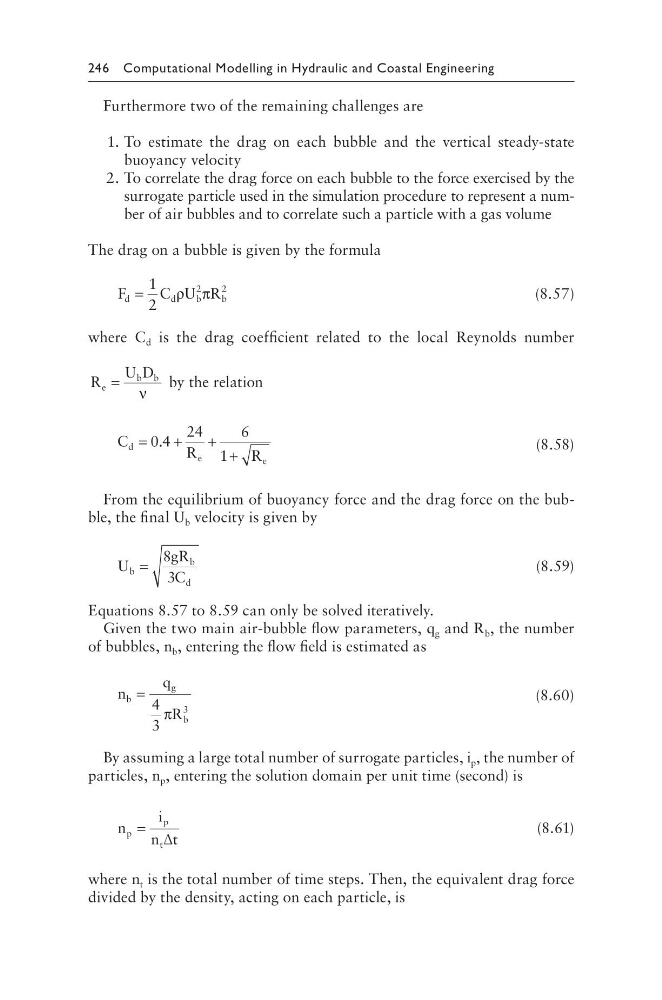
The drag on a bubble is given by the formula
F
C U R
d
d
b
b
=
1
2
2
2
ρ π
(8.57)
where C d is the drag coefficient related to the local Reynolds number
R
U D
e
b b
= ν
by the relation
C
R
R
d
e
e
=
+
+ +
0 4
24
6
1
.
(8.58)
From the equilibrium of buoyancy force and the drag force on the bubble, the final U b velocity is given by
U
gR
C
b
b
d
=
8
3
(8.59)
Equations 8.57 to 8.59 can only be solved iteratively.
Given the two main air-bubble flow parameters, q g and R b , the number
of bubbles, n b , entering the flow field is estimated as
n
q
R
b
g
b
= 4
3
3
π
(8.60)
By assuming a large total number of surrogate particles, i p , the number of
particles, n p , entering the solution domain per unit time (second) is
n
i
n t
p
p
t
= ∆
(8.61)
where n t is the total number of time steps. Then, the equivalent drag force
divided by the density, acting on each particle, is
Furthermore two of the remaining challenges are
1. To estimate the drag on each bubble and the vertical steady-state
buoyancy velocity
2. To correlate the drag force on each bubble to the force exercised by the
surrogate particle used in the simulation procedure to represent a number of air bubbles and to correlate such a particle with a gas volume
The drag on a bubble is given by the formula
F
C U R
d
d
b
b
=
1
2
2
2
ρ π
(8.57)
where C d is the drag coefficient related to the local Reynolds number
R
U D
e
b b
= ν
by the relation
C
R
R
d
e
e
=
+
+ +
0 4
24
6
1
.
(8.58)
From the equilibrium of buoyancy force and the drag force on the bubble, the final U b velocity is given by
U
gR
C
b
b
d
=
8
3
(8.59)
Equations 8.57 to 8.59 can only be solved iteratively.
Given the two main air-bubble flow parameters, q g and R b , the number
of bubbles, n b , entering the flow field is estimated as
n
q
R
b
g
b
= 4
3
3
π
(8.60)
By assuming a large total number of surrogate particles, i p , the number of
particles, n p , entering the solution domain per unit time (second) is
n
i
n t
p
p
t
= ∆
(8.61)
where n t is the total number of time steps. Then, the equivalent drag force
divided by the density, acting on each particle, is