

Contaminant and sediment transport by advection and diffusion 245
forces exercised by the ensemble of the bubbles in a unit volume of the fluid.
That results in an upward force which interacts with the diffusion process,
the pressure gradients and the acceleration of the surrounding fluid mass.
8.5.2 Mathematical formulation
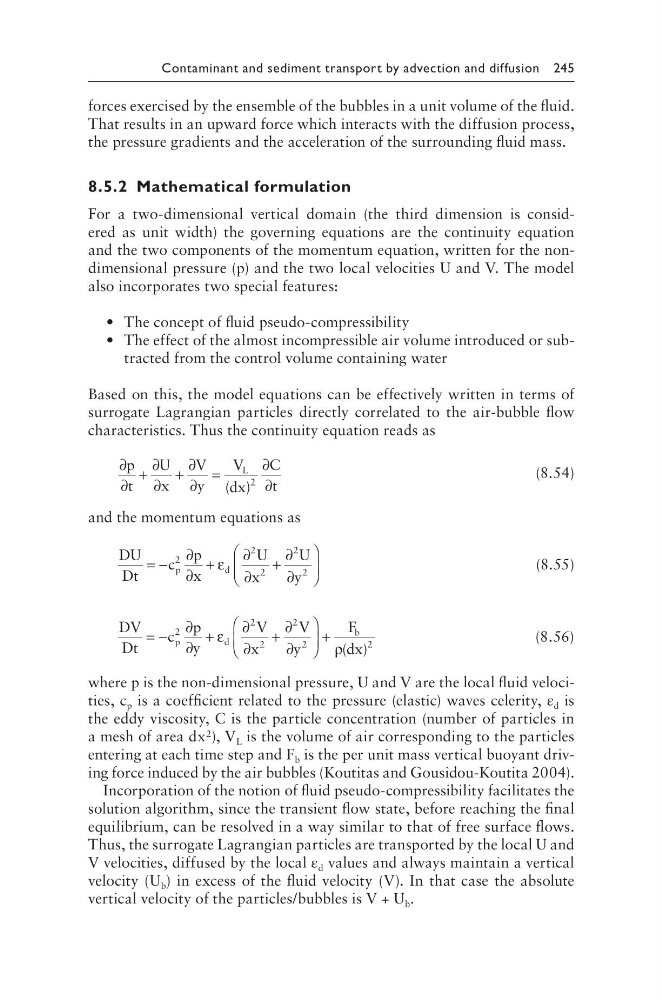
For a two-dimensional vertical domain (the third dimension is considered as unit width) the governing equations are the continuity equation
and the two components of the momentum equation, written for the nondimensional pressure (p) and the two local velocities U and V. The model
also incorporates two special features:
• The concept of fluid pseudo-compressibility
• The effect of the almost incompressible air volume introduced or subtracted from the control volume containing water
Based on this, the model equations can be effectively written in terms of
surrogate Lagrangian particles directly correlated to the air-bubble flow
characteristics. Thus the continuity equation reads as
∂
∂
+
∂
∂
+
∂
∂
=
∂
∂
p
t
U
x
V
y
V
dx
C
t
L
( )
2
(8.54)
and the momentum equations as
DU
Dt
c
p
x
U
x
U
y
p
d
= −
∂
∂
+
∂
∂
+
∂
∂
2
2
2
2
2
ε
(8.55)
DV
Dt
c
p
y
V
x
V
y
F
dx
p
d
b
= −
∂
∂
+
∂
∂
+
∂
∂
+
2
2
2
2
2
2
ε
ρ( )
(8.56)
where p is the non-dimensional pressure, U and V are the local fluid velocities, c p is a coefficient related to the pressure (elastic) waves celerity, ε d is
the eddy viscosity, C is the particle concentration (number of particles in
a mesh of area dx 2 ), V L is the volume of air corresponding to the particles
entering at each time step and F b is the per unit mass vertical buoyant driving force induced by the air bubbles (Koutitas and Gousidou-Koutita 2004).
Incorporation of the notion of fluid pseudo-compressibility facilitates the
solution algorithm, since the transient flow state, before reaching the final
equilibrium, can be resolved in a way similar to that of free surface flows.
Thus, the surrogate Lagrangian particles are transported by the local U and
V velocities, diffused by the local ε d values and always maintain a vertical
velocity (U b ) in excess of the fluid velocity (V). In that case the absolute
vertical velocity of the particles/bubbles is V + U b .
forces exercised by the ensemble of the bubbles in a unit volume of the fluid.
That results in an upward force which interacts with the diffusion process,
the pressure gradients and the acceleration of the surrounding fluid mass.
8.5.2 Mathematical formulation
For a two-dimensional vertical domain (the third dimension is considered as unit width) the governing equations are the continuity equation
and the two components of the momentum equation, written for the nondimensional pressure (p) and the two local velocities U and V. The model
also incorporates two special features:
• The concept of fluid pseudo-compressibility
• The effect of the almost incompressible air volume introduced or subtracted from the control volume containing water
Based on this, the model equations can be effectively written in terms of
surrogate Lagrangian particles directly correlated to the air-bubble flow
characteristics. Thus the continuity equation reads as
∂
∂
+
∂
∂
+
∂
∂
=
∂
∂
p
t
U
x
V
y
V
dx
C
t
L
( )
2
(8.54)
and the momentum equations as
DU
Dt
c
p
x
U
x
U
y
p
d
= −
∂
∂
+
∂
∂
+
∂
∂
2
2
2
2
2
ε
(8.55)
DV
Dt
c
p
y
V
x
V
y
F
dx
p
d
b
= −
∂
∂
+
∂
∂
+
∂
∂
+
2
2
2
2
2
2
ε
ρ( )
(8.56)
where p is the non-dimensional pressure, U and V are the local fluid velocities, c p is a coefficient related to the pressure (elastic) waves celerity, ε d is
the eddy viscosity, C is the particle concentration (number of particles in
a mesh of area dx 2 ), V L is the volume of air corresponding to the particles
entering at each time step and F b is the per unit mass vertical buoyant driving force induced by the air bubbles (Koutitas and Gousidou-Koutita 2004).
Incorporation of the notion of fluid pseudo-compressibility facilitates the
solution algorithm, since the transient flow state, before reaching the final
equilibrium, can be resolved in a way similar to that of free surface flows.
Thus, the surrogate Lagrangian particles are transported by the local U and
V velocities, diffused by the local ε d values and always maintain a vertical
velocity (U b ) in excess of the fluid velocity (V). In that case the absolute
vertical velocity of the particles/bubbles is V + U b .