

222 Computational Modelling in Hydraulic and Coastal Engineering
since in reality there is a continuous sediment particle exchange between
bed load and suspended load.
The rate of transported sediments is expressed in terms of the volume,
mass or weight of sediment material carried per unit width (specific discharge). The ‘total load’ (q t ) can be obtained by adding the bed load and the
suspended load (Yang 2003).
The concentration of suspended sediments is not uniform along the
depth C(z) (concentration increases from the water surface towards the
bed). Thus, in a horizontal two-dimensional domain, under steady-state
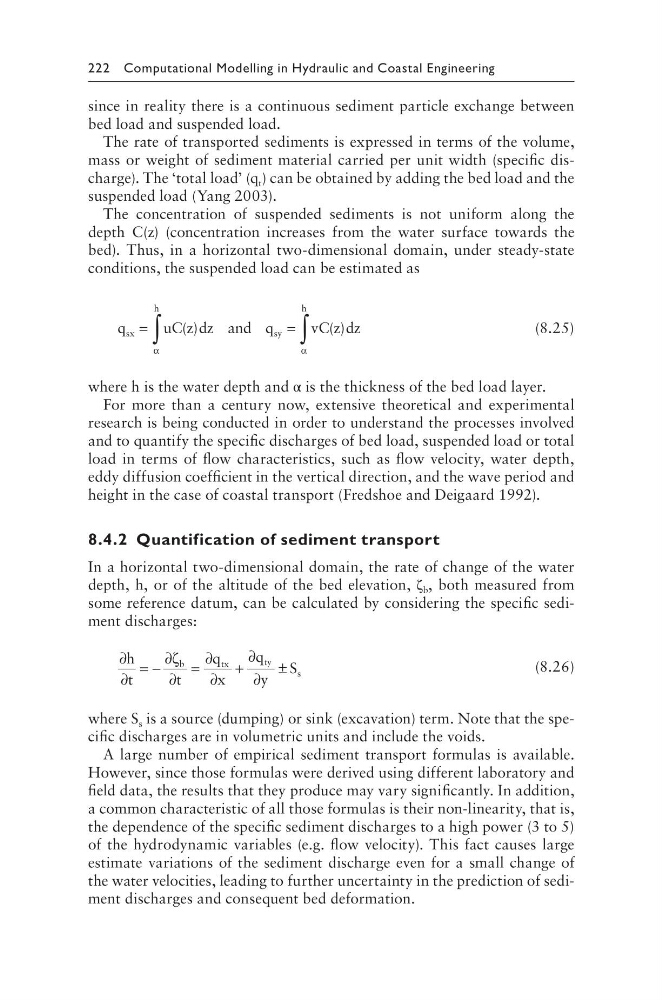
conditions, the suspended load can be estimated as
q
uC z dz and q
vC z dz
sx
h
sy
h
=
=
∫
∫
( )
( )
α
α
(8.25)
where h is the water depth and α is the thickness of the bed load layer.
For more than a century now, extensive theoretical and experimental
research is being conducted in order to understand the processes involved
and to quantify the specific discharges of bed load, suspended load or total
load in terms of flow characteristics, such as flow velocity, water depth,
eddy diffusion coefficient in the vertical direction, and the wave period and
height in the case of coastal transport (Fredshoe and Deigaard 1992).
8.4.2 Quantification of sediment transport
In a horizontal two-dimensional domain, the rate of change of the water
depth, h, or of the altitude of the bed elevation, ζ b , both measured from
some reference datum, can be calculated by considering the specific sediment discharges:
∂
∂
= −
∂
∂
=
∂
∂
+
∂
∂
±
h
t
t
q
x
q
y
S
b
t x
ty
s
ζ
(8.26)
where S s is a source (dumping) or sink (excavation) term. Note that the specific discharges are in volumetric units and include the voids.
A large number of empirical sediment transport formulas is available.
However, since those formulas were derived using different laboratory and
field data, the results that they produce may vary significantly. In addition,
a common characteristic of all those formulas is their non-linearity, that is,
the dependence of the specific sediment discharges to a high power (3 to 5)
of the hydrodynamic variables (e.g. flow velocity). This fact causes large
estimate variations of the sediment discharge even for a small change of
the water velocities, leading to further uncertainty in the prediction of sediment discharges and consequent bed deformation.
since in reality there is a continuous sediment particle exchange between
bed load and suspended load.
The rate of transported sediments is expressed in terms of the volume,
mass or weight of sediment material carried per unit width (specific discharge). The ‘total load’ (q t ) can be obtained by adding the bed load and the
suspended load (Yang 2003).
The concentration of suspended sediments is not uniform along the
depth C(z) (concentration increases from the water surface towards the
bed). Thus, in a horizontal two-dimensional domain, under steady-state
conditions, the suspended load can be estimated as
q
uC z dz and q
vC z dz
sx
h
sy
h
=
=
∫
∫
( )
( )
α
α
(8.25)
where h is the water depth and α is the thickness of the bed load layer.
For more than a century now, extensive theoretical and experimental
research is being conducted in order to understand the processes involved
and to quantify the specific discharges of bed load, suspended load or total
load in terms of flow characteristics, such as flow velocity, water depth,
eddy diffusion coefficient in the vertical direction, and the wave period and
height in the case of coastal transport (Fredshoe and Deigaard 1992).
8.4.2 Quantification of sediment transport
In a horizontal two-dimensional domain, the rate of change of the water
depth, h, or of the altitude of the bed elevation, ζ b , both measured from
some reference datum, can be calculated by considering the specific sediment discharges:
∂
∂
= −
∂
∂
=
∂
∂
+
∂
∂
±
h
t
t
q
x
q
y
S
b
t x
ty
s
ζ
(8.26)
where S s is a source (dumping) or sink (excavation) term. Note that the specific discharges are in volumetric units and include the voids.
A large number of empirical sediment transport formulas is available.
However, since those formulas were derived using different laboratory and
field data, the results that they produce may vary significantly. In addition,
a common characteristic of all those formulas is their non-linearity, that is,
the dependence of the specific sediment discharges to a high power (3 to 5)
of the hydrodynamic variables (e.g. flow velocity). This fact causes large
estimate variations of the sediment discharge even for a small change of
the water velocities, leading to further uncertainty in the prediction of sediment discharges and consequent bed deformation.