

Contaminant and sediment transport by advection and diffusion 221
cause serious water management, environmental and engineering problems. Aquatic sediments are subject to a dynamic cycle of erosion, transport, settling, deposition and re-suspension. For granular (non-cohesive)
sediments, the driving forces are all mechanical, that is, inertial, gravity
and impact from particle collisions. For cohesive sediments, in addition
to the mechanical forces, electrochemical forces play a predominant role
through the processes of aggregation and flocculation.
Sediments are the result of weathering of surface rocks and other surficial
geologic formations. Stream sediments can enter the system from upstream
sources, known as ‘wash load’, or can be entrained from bed erosion caused
by the shear stresses of the moving water.
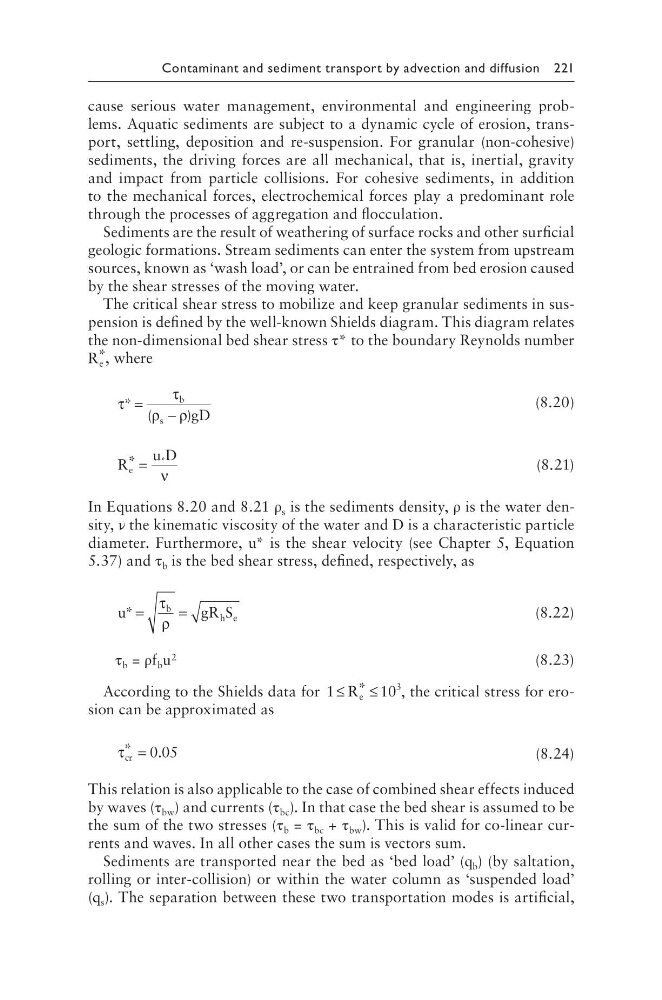
The critical shear stress to mobilize and keep granular sediments in suspension is defined by the well-known Shields diagram. This diagram relates
the non-dimensional bed shear stress τ* to the boundary Reynolds number
R e
* , where
τ
τ
ρ ρ
* (
)
=
−
b
s
gD
(8.20)
R
u D
e
*
*
= ν
(8.21)
In Equations 8.20 and 8.21 ρ s is the sediments density, ρ is the water density, ν the kinematic viscosity of the water and D is a characteristic particle
diameter. Furthermore, u* is the shear velocity (see Chapter 5, Equation
5.37) and τ b is the bed shear stress, defined, respectively, as
u
g R S
b
h e
* =
=
τ
ρ
(8.22)
τ b = ρf b u 2
(8.23)
According to the Shields data for 1
1 0
3
≤
≤
R e
*
, the critical stress for erosion can be approximated as
τ cr
*
.
= 0 05
(8.24)
This relation is also applicable to the case of combined shear effects induced
by waves (τ bw ) and currents (τ bc ). In that case the bed shear is assumed to be
the sum of the two stresses (τ b = τ bc + τ bw ). This is valid for co-linear currents and waves. In all other cases the sum is vectors sum.
Sediments are transported near the bed as ‘bed load’ (q b ) (by saltation,
rolling or inter-collision) or within the water column as ‘suspended load’
(q s ). The separation between these two transportation modes is artificial,
cause serious water management, environmental and engineering problems. Aquatic sediments are subject to a dynamic cycle of erosion, transport, settling, deposition and re-suspension. For granular (non-cohesive)
sediments, the driving forces are all mechanical, that is, inertial, gravity
and impact from particle collisions. For cohesive sediments, in addition
to the mechanical forces, electrochemical forces play a predominant role
through the processes of aggregation and flocculation.
Sediments are the result of weathering of surface rocks and other surficial
geologic formations. Stream sediments can enter the system from upstream
sources, known as ‘wash load’, or can be entrained from bed erosion caused
by the shear stresses of the moving water.
The critical shear stress to mobilize and keep granular sediments in suspension is defined by the well-known Shields diagram. This diagram relates
the non-dimensional bed shear stress τ* to the boundary Reynolds number
R e
* , where
τ
τ
ρ ρ
* (
)
=
−
b
s
gD
(8.20)
R
u D
e
*
*
= ν
(8.21)
In Equations 8.20 and 8.21 ρ s is the sediments density, ρ is the water density, ν the kinematic viscosity of the water and D is a characteristic particle
diameter. Furthermore, u* is the shear velocity (see Chapter 5, Equation
5.37) and τ b is the bed shear stress, defined, respectively, as
u
g R S
b
h e
* =
=
τ
ρ
(8.22)
τ b = ρf b u 2
(8.23)
According to the Shields data for 1
1 0
3
≤
≤
R e
*
, the critical stress for erosion can be approximated as
τ cr
*
.
= 0 05
(8.24)
This relation is also applicable to the case of combined shear effects induced
by waves (τ bw ) and currents (τ bc ). In that case the bed shear is assumed to be
the sum of the two stresses (τ b = τ bc + τ bw ). This is valid for co-linear currents and waves. In all other cases the sum is vectors sum.
Sediments are transported near the bed as ‘bed load’ (q b ) (by saltation,
rolling or inter-collision) or within the water column as ‘suspended load’
(q s ). The separation between these two transportation modes is artificial,