

Contaminant and sediment transport by advection and diffusion 223
8.4.2.1 Meyer-Peter and Muller formula
for bed load transport
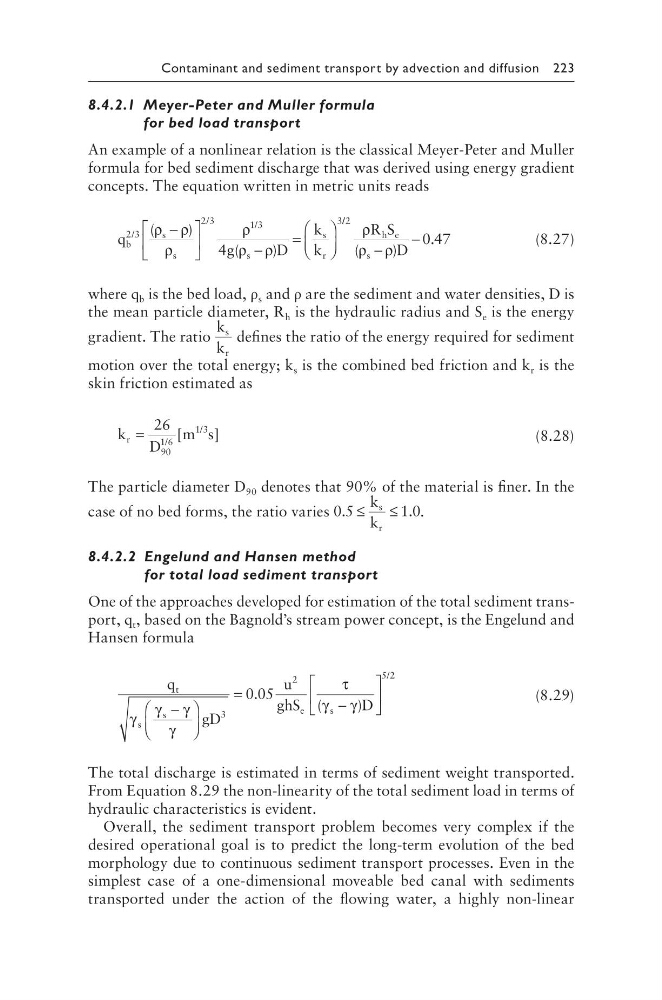
An example of a nonlinear relation is the classical Meyer-Peter and Muller
formula for bed sediment discharge that was derived using energy gradient
concepts. The equation written in metric units reads
q
g
D
k
k
b
s
s
s
s
r
2 3
2 3
1 3
3
4
/
/
/
(
)
(
)
ρ ρ
ρ
ρ
ρ ρ
−
−
=
/ /
(
)
.
2
0 47
ρ
ρ ρ
R S
D
h e
s −
−
(8.27)
where q b is the bed load, ρ s and ρ are the sediment and water densities, D is
the mean particle diameter, R h is the hydraulic radius and S e is the energy
gradient. The ratio
k
k
s
r
defines the ratio of the energy required for sediment
motion over the total energy; k s is the combined bed friction and k r is the
skin friction estimated as
k
D
m s
r =
26
90
1 6
1 3
/
/
[
]
(8.28)
The particle diameter D 90 denotes that 90% of the material is finer. In the
case of no bed forms, the ratio varies 0 5
1 0
.
.
≤
≤
k
k
s
r
.
8.4.2.2 Engelund and Hansen method
for total load sediment transport
One of the approaches developed for estimation of the total sediment transport, q t , based on the Bagnold’s stream power concept, is the Engelund and
Hansen formula
q
gD
u
ghS
D
t
s
s
e
s
γ
γ γ
γ
τ
γ γ
−
=
−
3
2
5 2
0 05
.
(
)
/
(8.29)
The total discharge is estimated in terms of sediment weight transported.
From Equation 8.29 the non-linearity of the total sediment load in terms of
hydraulic characteristics is evident.
Overall, the sediment transport problem becomes very complex if the
desired operational goal is to predict the long-term evolution of the bed
morphology due to continuous sediment transport processes. Even in the
simplest case of a one-dimensional moveable bed canal with sediments
transported under the action of the flowing water, a highly non-linear
8.4.2.1 Meyer-Peter and Muller formula
for bed load transport
An example of a nonlinear relation is the classical Meyer-Peter and Muller
formula for bed sediment discharge that was derived using energy gradient
concepts. The equation written in metric units reads
q
g
D
k
k
b
s
s
s
s
r
2 3
2 3
1 3
3
4
/
/
/
(
)
(
)
ρ ρ
ρ
ρ
ρ ρ
−
−
=
/ /
(
)
.
2
0 47
ρ
ρ ρ
R S
D
h e
s −
−
(8.27)
where q b is the bed load, ρ s and ρ are the sediment and water densities, D is
the mean particle diameter, R h is the hydraulic radius and S e is the energy
gradient. The ratio
k
k
s
r
defines the ratio of the energy required for sediment
motion over the total energy; k s is the combined bed friction and k r is the
skin friction estimated as
k
D
m s
r =
26
90
1 6
1 3
/
/
[
]
(8.28)
The particle diameter D 90 denotes that 90% of the material is finer. In the
case of no bed forms, the ratio varies 0 5
1 0
.
.
≤
≤
k
k
s
r
.
8.4.2.2 Engelund and Hansen method
for total load sediment transport
One of the approaches developed for estimation of the total sediment transport, q t , based on the Bagnold’s stream power concept, is the Engelund and
Hansen formula
q
gD
u
ghS
D
t
s
s
e
s
γ
γ γ
γ
τ
γ γ
−
=
−
3
2
5 2
0 05
.
(
)
/
(8.29)
The total discharge is estimated in terms of sediment weight transported.
From Equation 8.29 the non-linearity of the total sediment load in terms of
hydraulic characteristics is evident.
Overall, the sediment transport problem becomes very complex if the
desired operational goal is to predict the long-term evolution of the bed
morphology due to continuous sediment transport processes. Even in the
simplest case of a one-dimensional moveable bed canal with sediments
transported under the action of the flowing water, a highly non-linear