

Flow in porous media 171
where q is the discharge from withdrawal (+) or injection (–) wells, and < >
denote spatially averaged quantities. In case of incompressible fluids (ρ is
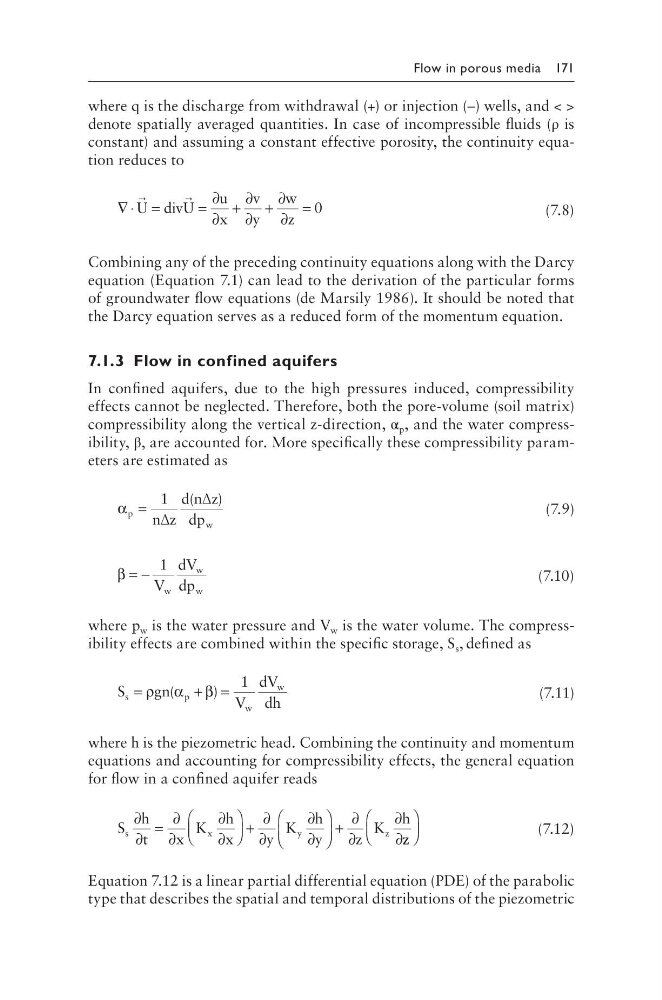
constant) and assuming a constant effective porosity, the continuity equation reduces to
∇ ⋅ =
=
∂
∂
+
∂
∂
+
∂
∂
=
U divU
u
x
v
y
w
z
0
(7.8)
Combining any of the preceding continuity equations along with the Darcy
equation (Equation 7.1) can lead to the derivation of the particular forms
of groundwater flow equations (de Marsily 1986). It should be noted that
the Darcy equation serves as a reduced form of the momentum equation.
7.1.3 Flow in confined aquifers
In confined aquifers, due to the high pressures induced, compressibility
effects cannot be neglected. Therefore, both the pore-volume (soil matrix)
compressibility along the vertical z-direction, α p , and the water compressibility, β, are accounted for. More specifically these compressibility parameters are estimated as
α p
w
n z
d n z
dp
=
1
∆
∆
(
)
(7.9)
β = −
1
V
dV
dp
w
w
w
(7.10)
where p w is the water pressure and V w is the water volume. The compressibility effects are combined within the specific storage, S s , defined as
S
gn
V
dV
dh
s
p
w
w
=
+ =
ρ α β
(
)
1
(7.11)
where h is the piezometric head. Combining the continuity and momentum
equations and accounting for compressibility effects, the general equation
for flow in a confined aquifer reads
S
h
t
x
K
h
x
y
K
h
y
z
K
h
s
x
y
z
∂
∂
=
∂
∂
∂
∂
+
∂
∂
∂
∂
+
∂
∂
∂
∂z z
(7.12)
Equation 7.12 is a linear partial differential equation (PDE) of the parabolic
type that describes the spatial and temporal distributions of the piezometric
where q is the discharge from withdrawal (+) or injection (–) wells, and < >
denote spatially averaged quantities. In case of incompressible fluids (ρ is
constant) and assuming a constant effective porosity, the continuity equation reduces to
∇ ⋅ =
=
∂
∂
+
∂
∂
+
∂
∂
=
U divU
u
x
v
y
w
z
0
(7.8)
Combining any of the preceding continuity equations along with the Darcy
equation (Equation 7.1) can lead to the derivation of the particular forms
of groundwater flow equations (de Marsily 1986). It should be noted that
the Darcy equation serves as a reduced form of the momentum equation.
7.1.3 Flow in confined aquifers
In confined aquifers, due to the high pressures induced, compressibility
effects cannot be neglected. Therefore, both the pore-volume (soil matrix)
compressibility along the vertical z-direction, α p , and the water compressibility, β, are accounted for. More specifically these compressibility parameters are estimated as
α p
w
n z
d n z
dp
=
1
∆
∆
(
)
(7.9)
β = −
1
V
dV
dp
w
w
w
(7.10)
where p w is the water pressure and V w is the water volume. The compressibility effects are combined within the specific storage, S s , defined as
S
gn
V
dV
dh
s
p
w
w
=
+ =
ρ α β
(
)
1
(7.11)
where h is the piezometric head. Combining the continuity and momentum
equations and accounting for compressibility effects, the general equation
for flow in a confined aquifer reads
S
h
t
x
K
h
x
y
K
h
y
z
K
h
s
x
y
z
∂
∂
=
∂
∂
∂
∂
+
∂
∂
∂
∂
+
∂
∂
∂
∂z z
(7.12)
Equation 7.12 is a linear partial differential equation (PDE) of the parabolic
type that describes the spatial and temporal distributions of the piezometric