

170 Computational Modelling in Hydraulic and Coastal Engineering
of anisotropy x′, y′, z′, only the diagonal terms of the tensor remain different than zero. For a homogeneous isotropic aquifer, the tensor is reduced
to a single scalar permeability coefficient, K (= K xx = K yy = K zz ). From the
Darcy equation it is evident that the piezometric gradient is linearly related
to the velocity, which is an experimental confirmation that the flow is laminar. The Darcy velocity estimated by Equation 7.1 differs from the actual
flow velocity through the pores
V. By defining the total porosity (n) as the
percentage of the volume of voids over the total volume of the sample, and
by specifying the effective porosity (n e ) as the percentage of interconnected
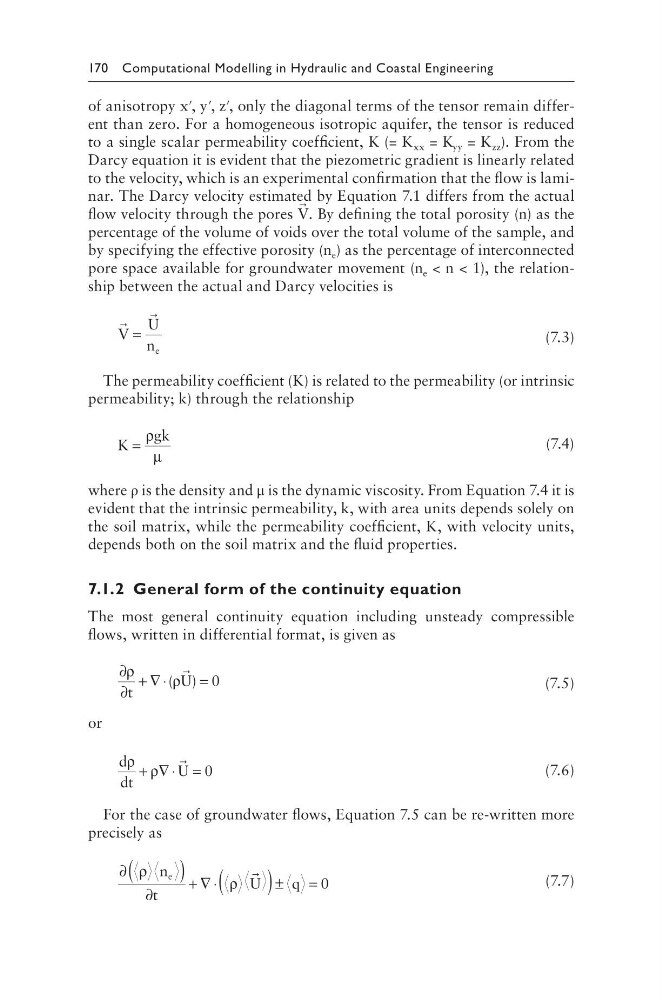
pore space available for groundwater movement (n e < n < 1), the relationship between the actual and Darcy velocities is
V
U
n e
=
(7.3)
The permeability coefficient (K) is related to the permeability (or intrinsic
permeability; k) through the relationship
K
gk
=
ρ
µ
(7.4)
where ρ is the density and μ is the dynamic viscosity. From Equation 7.4 it is
evident that the intrinsic permeability, k, with area units depends solely on
the soil matrix, while the permeability coefficient, K, with velocity units,
depends both on the soil matrix and the fluid properties.
7.1.2 General form of the continuity equation
The most general continuity equation including unsteady compressible
flows, written in differential format, is given as
∂
∂
+ ∇ ⋅
=
ρ
ρ
t
U
( )
0
(7.5)
or
d
dt
U
ρ ρ
+ ∇⋅ =
0
(7.6)
For the case of groundwater flows, Equation 7.5 can be re-written more
precisely as
∂ (
)
∂
+ ∇ ⋅ ( )± =
ρ
ρ
n
t
U
q
e
0
(7.7)
of anisotropy x′, y′, z′, only the diagonal terms of the tensor remain different than zero. For a homogeneous isotropic aquifer, the tensor is reduced
to a single scalar permeability coefficient, K (= K xx = K yy = K zz ). From the
Darcy equation it is evident that the piezometric gradient is linearly related
to the velocity, which is an experimental confirmation that the flow is laminar. The Darcy velocity estimated by Equation 7.1 differs from the actual
flow velocity through the pores
V. By defining the total porosity (n) as the
percentage of the volume of voids over the total volume of the sample, and
by specifying the effective porosity (n e ) as the percentage of interconnected
pore space available for groundwater movement (n e < n < 1), the relationship between the actual and Darcy velocities is
V
U
n e
=
(7.3)
The permeability coefficient (K) is related to the permeability (or intrinsic
permeability; k) through the relationship
K
gk
=
ρ
µ
(7.4)
where ρ is the density and μ is the dynamic viscosity. From Equation 7.4 it is
evident that the intrinsic permeability, k, with area units depends solely on
the soil matrix, while the permeability coefficient, K, with velocity units,
depends both on the soil matrix and the fluid properties.
7.1.2 General form of the continuity equation
The most general continuity equation including unsteady compressible
flows, written in differential format, is given as
∂
∂
+ ∇ ⋅
=
ρ
ρ
t
U
( )
0
(7.5)
or
d
dt
U
ρ ρ
+ ∇⋅ =
0
(7.6)
For the case of groundwater flows, Equation 7.5 can be re-written more
precisely as
∂ (
)
∂
+ ∇ ⋅ ( )± =
ρ
ρ
n
t
U
q
e
0
(7.7)