

169
Chapter 7
Flow in porous media
7.1 GENERAL GROUNDWATER FLOW EQUATIONS
Porous media flows belong to the general class of creeping flows, those with
very small velocities. There is a wide variety of significant engineering, ecological and geological applications that require an understanding of flow
through porous media. Some examples include flow in confined and unconfined aquifers, groundwater contamination, saltwater intrusion, management of well-field withdrawal or recharge rates, and so forth. Most of the
groundwater phenomena can be described by partial differential equations
mainly of the parabolic or elliptic type, along with the appropriate boundary and initial conditions (Bear and Verruijt 1987).
7.1.1 Darcy equation
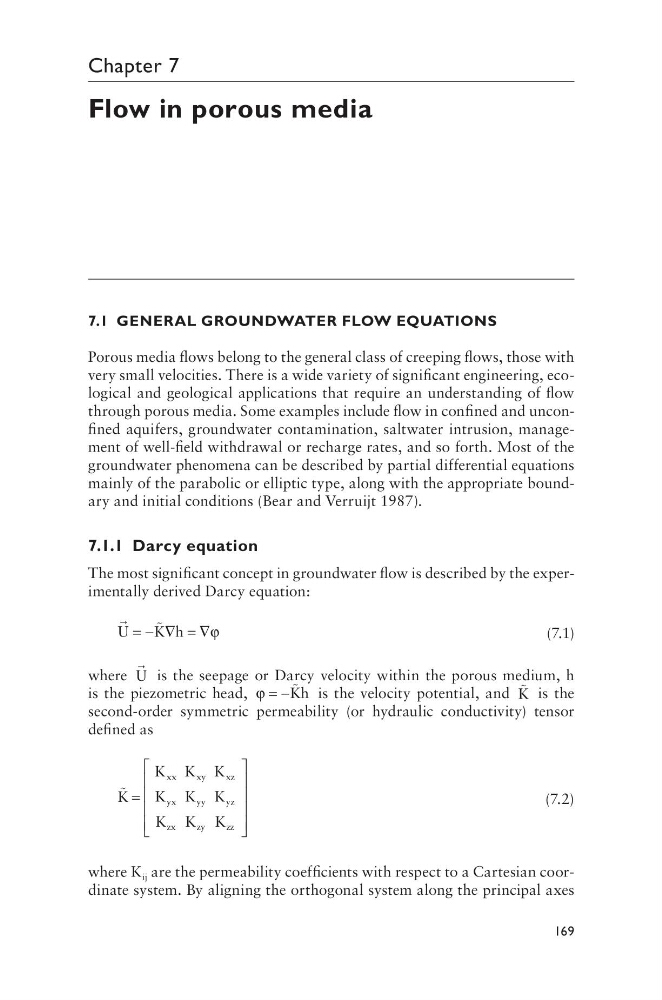
The most significant concept in groundwater flow is described by the experimentally derived Darcy equation:
U
K h
= − ∇ = ∇ϕ
(7.1)
where
U is the seepage or Darcy velocity within the porous medium, h
is the piezometric head, ϕ = −
Kh is the velocity potential, and
K is the
second-order symmetric permeability (or hydraulic conductivity) tensor
defined as
K
K K K
K K K
K K K
xx
xy
xz
yx
yy
yz
zx
zy
zz
=
(7.2)
where K ij are the permeability coefficients with respect to a Cartesian coordinate system. By aligning the orthogonal system along the principal axes
Chapter 7
Flow in porous media
7.1 GENERAL GROUNDWATER FLOW EQUATIONS
Porous media flows belong to the general class of creeping flows, those with
very small velocities. There is a wide variety of significant engineering, ecological and geological applications that require an understanding of flow
through porous media. Some examples include flow in confined and unconfined aquifers, groundwater contamination, saltwater intrusion, management of well-field withdrawal or recharge rates, and so forth. Most of the
groundwater phenomena can be described by partial differential equations
mainly of the parabolic or elliptic type, along with the appropriate boundary and initial conditions (Bear and Verruijt 1987).
7.1.1 Darcy equation
The most significant concept in groundwater flow is described by the experimentally derived Darcy equation:
U
K h
= − ∇ = ∇ϕ
(7.1)
where
U is the seepage or Darcy velocity within the porous medium, h
is the piezometric head, ϕ = −
Kh is the velocity potential, and
K is the
second-order symmetric permeability (or hydraulic conductivity) tensor
defined as
K
K K K
K K K
K K K
xx
xy
xz
yx
yy
yz
zx
zy
zz
=
(7.2)
where K ij are the permeability coefficients with respect to a Cartesian coordinate system. By aligning the orthogonal system along the principal axes