

NONLINEAR WAVES
73
In general, p must satisfy the following form of Bernoulli’s équation:
P
lz 2
2,
-----uc + -(u + w ) 4- gz = constant
p-----------L
(3.29)
If the moving horizontal axis is denoted by £, where £ = x—ct, then the potential
function , the surface water élévation rj, and the vertical water particle velocity
w must vanish for large £. For these conditions, and provided that H/d is less
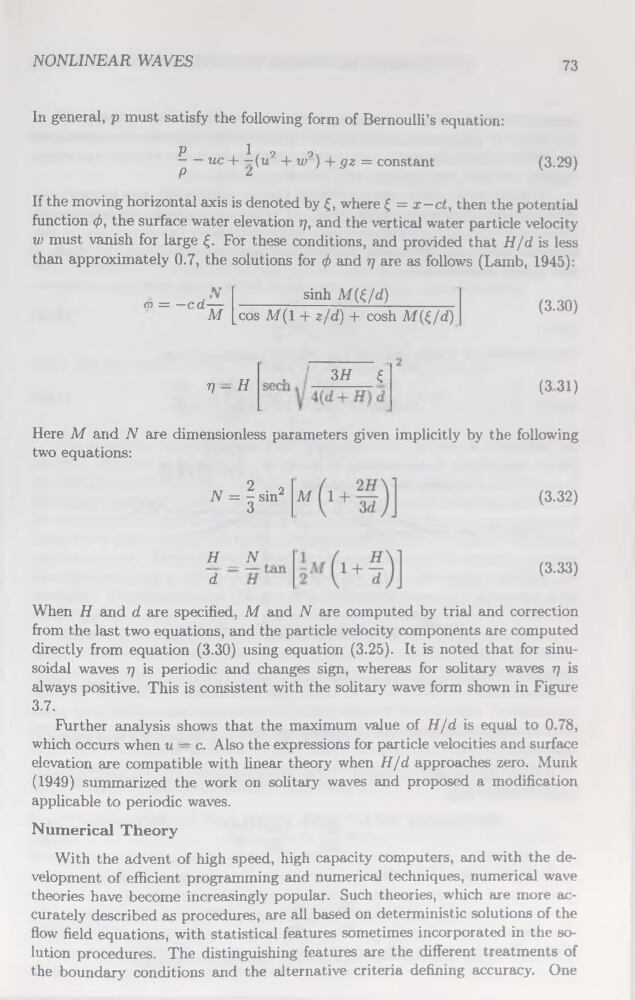
than approximately 0.7, the solutions for and rj are as follows (Lamb, 1945):
(D =
N
—cd—
,--------------------------------M [cos Af(l + z/d) + cosh M(£/d)
sinh M(£/d)
(3.30)
77- H
, ' 3H
Ç
(331)
Here M and N are dimensionless parameters given implicitly by the following
two équations:
M
2
,
N = - sin2
3
H
d
N
(3.32)
(3.33)
When H and d are specified, M and N are computed by trial and correction
from the last two équations, and the particle velocity components are computed
directly from équation (3.30) using équation (3.25). It is noted that for sinusoïdal waves 77 is periodic and changes sign, whereas for solitary waves 77 is
always positive. This is consistent with the solitary wave form shown in Figure
3.7.
Further analysis shows that the maximum value of H/d is equal to 0.78,
which occurs when u — c. Also the expressions for particle velocities and surface
élévation are compatible with linear theory when H/d approaches zéro. Munk
(1949) summarized the work on solitary waves and proposed a modification
applicable to periodic waves.
Numerical Theory
With the advent of high speed, high capacity computers, and with the development of efficient programming and numerical techniques, numerical wave
théories hâve become increasingly popular. Such théories, which are more accurately described as procedures, are ail based on deterministic solutions of the
flow field équations, with statistical features sometimes incorporated in the solution procedures. The distinguishing features are the different treatments of
the boundary conditions and the alternative criteria defining accuracy. One
73
In general, p must satisfy the following form of Bernoulli’s équation:
P
lz 2
2,
-----uc + -(u + w ) 4- gz = constant
p-----------L
(3.29)
If the moving horizontal axis is denoted by £, where £ = x—ct, then the potential
function , the surface water élévation rj, and the vertical water particle velocity
w must vanish for large £. For these conditions, and provided that H/d is less
than approximately 0.7, the solutions for and rj are as follows (Lamb, 1945):
(D =
N
—cd—
,--------------------------------M [cos Af(l + z/d) + cosh M(£/d)
sinh M(£/d)
(3.30)
77- H
, ' 3H
Ç
(331)
Here M and N are dimensionless parameters given implicitly by the following
two équations:
M
2
,
N = - sin2
3
H
d
N
(3.32)
(3.33)
When H and d are specified, M and N are computed by trial and correction
from the last two équations, and the particle velocity components are computed
directly from équation (3.30) using équation (3.25). It is noted that for sinusoïdal waves 77 is periodic and changes sign, whereas for solitary waves 77 is
always positive. This is consistent with the solitary wave form shown in Figure
3.7.
Further analysis shows that the maximum value of H/d is equal to 0.78,
which occurs when u — c. Also the expressions for particle velocities and surface
élévation are compatible with linear theory when H/d approaches zéro. Munk
(1949) summarized the work on solitary waves and proposed a modification
applicable to periodic waves.
Numerical Theory
With the advent of high speed, high capacity computers, and with the development of efficient programming and numerical techniques, numerical wave
théories hâve become increasingly popular. Such théories, which are more accurately described as procedures, are ail based on deterministic solutions of the
flow field équations, with statistical features sometimes incorporated in the solution procedures. The distinguishing features are the different treatments of
the boundary conditions and the alternative criteria defining accuracy. One