

74
DEFERAI! NJ STIC DESCRIPTIONS OF OFFSHORE WAVES
popular numerical theory is based on idéal (non-viscous) fluid in plane flow as
described by Laplace’s équation (3.26). A historical computer code that solves
the Navier-Stokes équations for an incompressible fluid, and includes the effects
of fluid viscosity, was developed by Hirt et al. (1975).
To illustrate a widely used numerical theory, consider the free stream fonction approach developed by Dean (1965). The fluid is assumed to be non-viscous,
incompressible, and irrotational, with motion limited to the x, z-plane. In this
case, the governing differential équation of Laplace can be written in terms of
the stream fonction V», or
dx2
dz2
The velocities in terms of ijj and the velocity potential 0 are
dtp
dÿ
dV>
dz
dx '
dx
dz
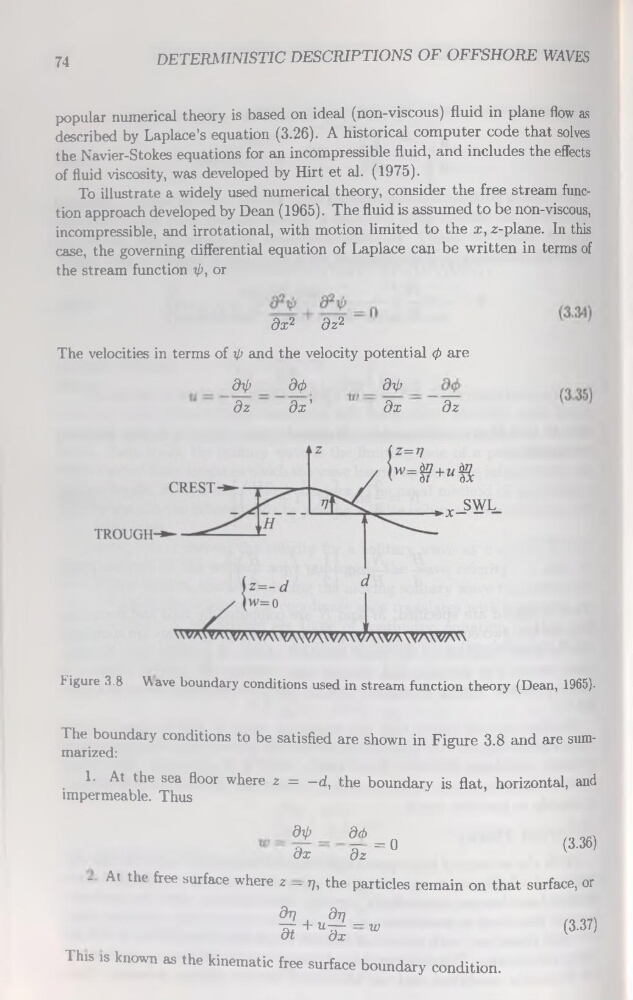
Figure 3.8 Wave boundary conditions used in stream fonction theory (Dean, 1965)The boundary conditions to be satisfied are shown in Figure 3.8 and are summarized:
1- At the sea floor where z = —d, the boundary is flat, horizontal, and
imperméable. Thus
dÿ
dcb
= °
dx
dz
(3.36)
- At the free surface where z — ri, the particles remain on that surface, or
07?
ÔT)
-HT + u~ — W
ut
dx
This is known as the kinematic free surface boundary condition.
(3.37)
DEFERAI! NJ STIC DESCRIPTIONS OF OFFSHORE WAVES
popular numerical theory is based on idéal (non-viscous) fluid in plane flow as
described by Laplace’s équation (3.26). A historical computer code that solves
the Navier-Stokes équations for an incompressible fluid, and includes the effects
of fluid viscosity, was developed by Hirt et al. (1975).
To illustrate a widely used numerical theory, consider the free stream fonction approach developed by Dean (1965). The fluid is assumed to be non-viscous,
incompressible, and irrotational, with motion limited to the x, z-plane. In this
case, the governing differential équation of Laplace can be written in terms of
the stream fonction V», or
dx2
dz2
The velocities in terms of ijj and the velocity potential 0 are
dtp
dÿ
dV>
dz
dx '
dx
dz
Figure 3.8 Wave boundary conditions used in stream fonction theory (Dean, 1965)The boundary conditions to be satisfied are shown in Figure 3.8 and are summarized:
1- At the sea floor where z = —d, the boundary is flat, horizontal, and
imperméable. Thus
dÿ
dcb
= °
dx
dz
(3.36)
- At the free surface where z — ri, the particles remain on that surface, or
07?
ÔT)
-HT + u~ — W
ut
dx
This is known as the kinematic free surface boundary condition.
(3.37)