

72
DETERMINISTIC DESCRIPTIONS OF OFFSHORE WAVES
VAWAWAWAWAWAWAWAWAW
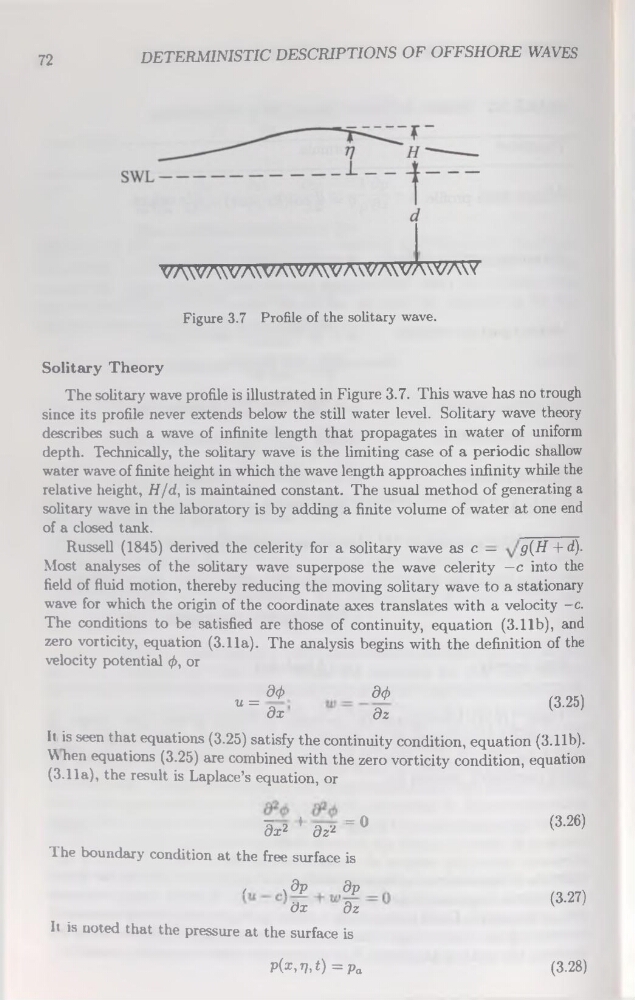
Figure 3.7 Profile of the solitary wave.
Solitary Theory
The solitary wave profile is illustrated in Figure 3.7. This wave has no trough
since its profile never extends below the still water level. Solitary wave theory
describes such a wave of infinité length that propagates in water of uniform
depth. Technically, the solitary wave is the limiting case of a periodic shallow
water wave of finite height in which the wave length approaches infinity while the
relative height, H/d, is maintained constant. The usual method of generating a
solitary wave in the laboratory is by adding a finite volume of water at one end
of a closed tank.
_______
Russell (1845) derived the celerity for a solitary wave as c —
g(H + d).
Most analyses of the solitary wave superpose the wave celerity — c into the
field of fluid motion, thereby reducing the moving solitary wave to a stationary
wave for which the origin of the coordinate axes translates with a velocity — c.
The conditions to be satisfied are those of continuity, équation (3.11b), and
zéro vorticity, équation (3.11a). The analysis begins with the définition of the
velocity potential, or
u =
d
dx
d
dz
(3.25)
It is seen that équations (3.25) satisfy the continuity condition, équation (3.11b).
W hen équations (3.25) are combined with the zéro vorticity condition, équation
(3.11a), the resuit is Laplace’s équation, or
â 2 ♦
=0
ax*
dz2
The boundary condition at the free surface is
/
xdp
dp
dx
dz
h is noted that the pressure at the surface is
(3.26)
(3.27)
P(x,7/,t)=pa
(3.28)
DETERMINISTIC DESCRIPTIONS OF OFFSHORE WAVES
VAWAWAWAWAWAWAWAWAW
Figure 3.7 Profile of the solitary wave.
Solitary Theory
The solitary wave profile is illustrated in Figure 3.7. This wave has no trough
since its profile never extends below the still water level. Solitary wave theory
describes such a wave of infinité length that propagates in water of uniform
depth. Technically, the solitary wave is the limiting case of a periodic shallow
water wave of finite height in which the wave length approaches infinity while the
relative height, H/d, is maintained constant. The usual method of generating a
solitary wave in the laboratory is by adding a finite volume of water at one end
of a closed tank.
_______
Russell (1845) derived the celerity for a solitary wave as c —
g(H + d).
Most analyses of the solitary wave superpose the wave celerity — c into the
field of fluid motion, thereby reducing the moving solitary wave to a stationary
wave for which the origin of the coordinate axes translates with a velocity — c.
The conditions to be satisfied are those of continuity, équation (3.11b), and
zéro vorticity, équation (3.11a). The analysis begins with the définition of the
velocity potential
u =
d
dx
d
dz
(3.25)
It is seen that équations (3.25) satisfy the continuity condition, équation (3.11b).
W hen équations (3.25) are combined with the zéro vorticity condition, équation
(3.11a), the resuit is Laplace’s équation, or
â 2 ♦
=0
ax*
dz2
The boundary condition at the free surface is
/
xdp
dp
dx
dz
h is noted that the pressure at the surface is
(3.26)
(3.27)
P(x,7/,t)=pa
(3.28)