

an EXAMPLE: LATERAL PILE LOADING
307
bottom of the pile and two at the top can be added to the n + 1 standard
équations. Solutions of these n + 5 simultaneous équations yield the deflections
along the length of the pile, from which slope, bending moment, shear, and soil
reaction may be readily computed. Equation (11.23) is written for a’constant
EI\ however, the équation can be rewritten to account for a change in pile
stiffness. This expanded équation présents little additional difficulty in writing
the computer program.
A number of methods can be used to solve the simultaneous, finite différence
équations. A method of Gaussian élimination discussed by Reese and Van Impe
(2001) was found to be efficient. The mesh size h and the number of significant
figures in the computation procedure must be controlled in order to achieve
acceptable accuracy. Reese and Van Impe (2001) présent several case studies.
The definite advantages of a computer-aided solution are summarized:
1. Changes in flexural stiffness of the pile can be introduced at any depth.
2. The pile length can be changed as desired.
3. The p-y data can be introduced in several ways.
4. The Epy value can be changed from point to point as dictated by the soil
response.
5. An axial load can be specified and accounted for in obtaining the shape
of the deflected pile.
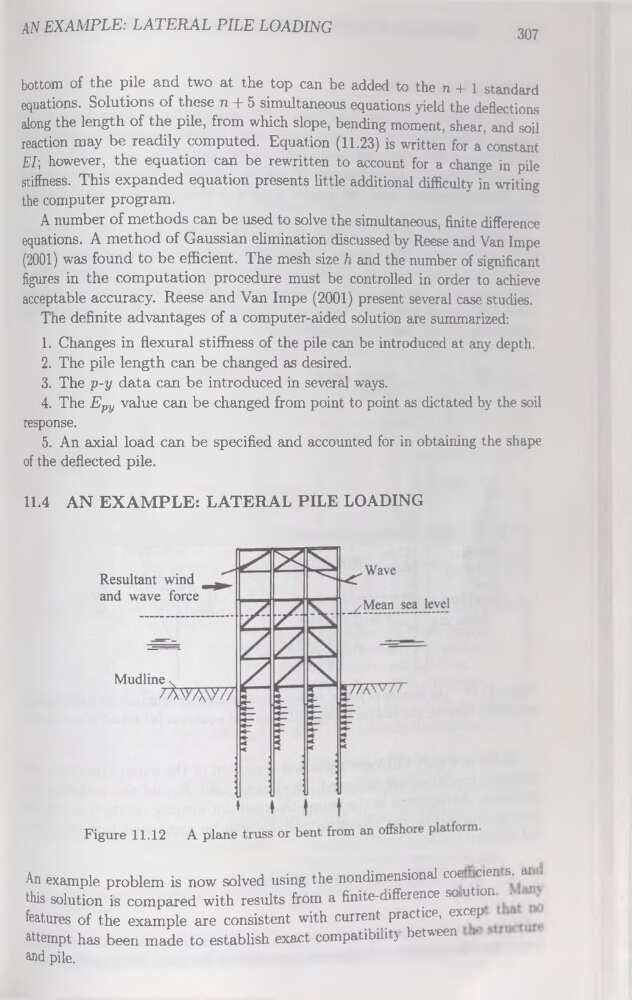
11.4 AN EXAMPLE: LATERAL PILE LOADING
An example problem is now solved using the nondimensional coe cien s. ai
this solution is compared with results from a finite-difference so ution .
features of the example are consistent with current practice, excep
attempt has been made to establish exact compatibilité between i
and pile.
307
bottom of the pile and two at the top can be added to the n + 1 standard
équations. Solutions of these n + 5 simultaneous équations yield the deflections
along the length of the pile, from which slope, bending moment, shear, and soil
reaction may be readily computed. Equation (11.23) is written for a’constant
EI\ however, the équation can be rewritten to account for a change in pile
stiffness. This expanded équation présents little additional difficulty in writing
the computer program.
A number of methods can be used to solve the simultaneous, finite différence
équations. A method of Gaussian élimination discussed by Reese and Van Impe
(2001) was found to be efficient. The mesh size h and the number of significant
figures in the computation procedure must be controlled in order to achieve
acceptable accuracy. Reese and Van Impe (2001) présent several case studies.
The definite advantages of a computer-aided solution are summarized:
1. Changes in flexural stiffness of the pile can be introduced at any depth.
2. The pile length can be changed as desired.
3. The p-y data can be introduced in several ways.
4. The Epy value can be changed from point to point as dictated by the soil
response.
5. An axial load can be specified and accounted for in obtaining the shape
of the deflected pile.
11.4 AN EXAMPLE: LATERAL PILE LOADING
An example problem is now solved using the nondimensional coe cien s. ai
this solution is compared with results from a finite-difference so ution .
features of the example are consistent with current practice, excep
attempt has been made to establish exact compatibilité between i
and pile.