

306
BEHAVIOR OF PILES SUPPORTING OFFSHORE STRUCTURES
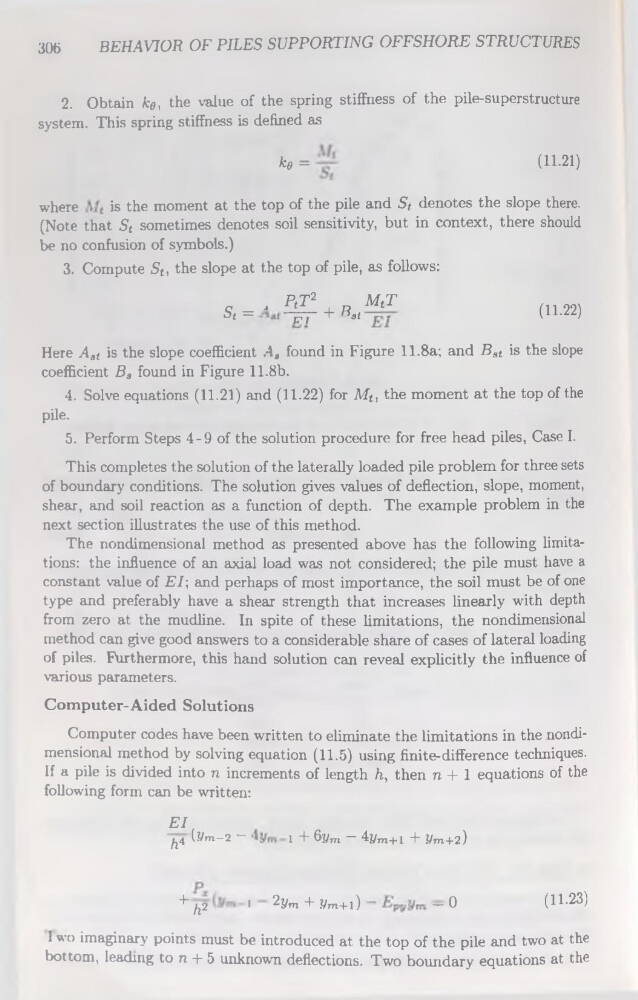
2. Obtain kg, the value of the spring stiffness of the pile-superstructure
System. This spring stiffness is defined as
kB =
(H-21)
where
is the moment at the top of the pile and St. dénotés the slope there.
(Note that St sometimes dénotés soil sensitivity, but in context, there should
be no confusion of symbols.)
3. Compute St, the slope at the top of pile, as follows:
„
„ PtTI 2
n MtT
I wo imaginary points must be introduced at the top of the pile and two at the
bottom, leading to n + 5 unknown deflections. Two boundary équations at the
St =
-77- + Rst
(11.22)
Here Aat is the slope coefficient .4, found in Figure 11.8a; and Bst is the slope
coefficient B3 found in Figure 11.8b.
4. Solve équations (11.21) and (11.22) for Mt, the moment at the top of the
pile.
5. Perform Steps 4-9 of the solution procedure for free head piles, Case I.
This complétés the solution of the laterally loaded pile problem for three sets
of boundary conditions. The solution gives values of deflection, slope, moment,
shear, and soil reaction as a function of depth. The example problem in the
next section illustrâtes the use of this method.
The nondimensional method as presented above has the following limitations: the influence of an axial load was not considered; the pile must hâve a
constant value of El; and perhaps of most importance, the soil must be of one
type and preferably hâve a shear strength that increases linearly with depth
from zéro at the mudline. In spite of these limitations, the nondimensional
method can give good answers to a considérable share of cases of latéral loading
of piles. Furthermore, this hand solution can reveal explicitly the influence of
varions parameters.
Computer-Aided Solutions
Computer codes hâve been written to eliminate the limitations in the nondimensional method by solving équation (11.5) using finite-différence techniques.
If a pile is divided into n incréments of length h, then n + 1 équations of the
following form can be written:
EZ
^4 (Z/m—2 “
1 + 6vm - 4ÿm+i + ym+2)
+ ^2
1
2j/m + ?/m+l)
— 0
(11.23)
BEHAVIOR OF PILES SUPPORTING OFFSHORE STRUCTURES
2. Obtain kg, the value of the spring stiffness of the pile-superstructure
System. This spring stiffness is defined as
kB =
(H-21)
where
is the moment at the top of the pile and St. dénotés the slope there.
(Note that St sometimes dénotés soil sensitivity, but in context, there should
be no confusion of symbols.)
3. Compute St, the slope at the top of pile, as follows:
„
„ PtTI 2
n MtT
I wo imaginary points must be introduced at the top of the pile and two at the
bottom, leading to n + 5 unknown deflections. Two boundary équations at the
St =
-77- + Rst
(11.22)
Here Aat is the slope coefficient .4, found in Figure 11.8a; and Bst is the slope
coefficient B3 found in Figure 11.8b.
4. Solve équations (11.21) and (11.22) for Mt, the moment at the top of the
pile.
5. Perform Steps 4-9 of the solution procedure for free head piles, Case I.
This complétés the solution of the laterally loaded pile problem for three sets
of boundary conditions. The solution gives values of deflection, slope, moment,
shear, and soil reaction as a function of depth. The example problem in the
next section illustrâtes the use of this method.
The nondimensional method as presented above has the following limitations: the influence of an axial load was not considered; the pile must hâve a
constant value of El; and perhaps of most importance, the soil must be of one
type and preferably hâve a shear strength that increases linearly with depth
from zéro at the mudline. In spite of these limitations, the nondimensional
method can give good answers to a considérable share of cases of latéral loading
of piles. Furthermore, this hand solution can reveal explicitly the influence of
varions parameters.
Computer-Aided Solutions
Computer codes hâve been written to eliminate the limitations in the nondimensional method by solving équation (11.5) using finite-différence techniques.
If a pile is divided into n incréments of length h, then n + 1 équations of the
following form can be written:
EZ
^4 (Z/m—2 “
1 + 6vm - 4ÿm+i + ym+2)
+ ^2
1
2j/m + ?/m+l)
— 0
(11.23)